

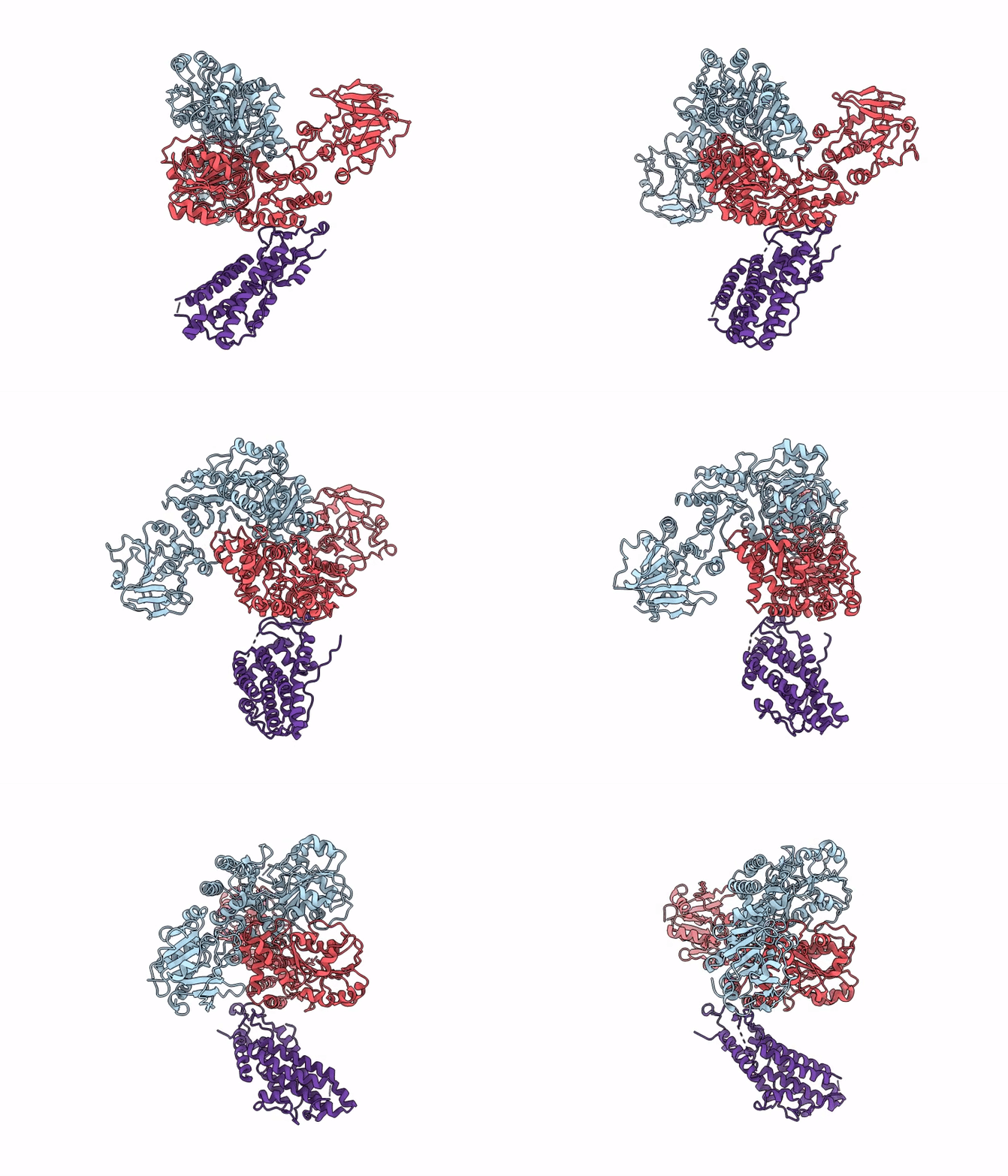
9OS7 image
Deposition Date 2025-05-23
Release Date 2026-02-25
Last Version Date 2026-06-24
Entry Detail
PDB ID:
9OS7
Keywords:
Title:
Mycoplasma penetrans Methionyl tRNA Synthetase is an Asymmetric Dimer fused to N-terminal Ancillary Domains
Biological Source:
Source Organism(s):
Expression System(s):
Method Details:
Experimental Method:
Resolution:
3.66 Å
Aggregation State:
TISSUE
Reconstruction Method:
SINGLE PARTICLE
Macromolecular Entities
Polymer Type:polypeptide(L)
Molecule:Methionine--tRNA ligase
Gene (Uniprot):metG
Chain IDs:A, B
Chain Length:555
Number of Molecules:2
Biological Source:Malacoplasma penetrans
Polymer Type:polypeptide(L)
Molecule:Methionine--tRNA ligase
Gene (Uniprot):metG
Chain IDs:C
Chain Length:506
Number of Molecules:1
Biological Source:Malacoplasma penetrans
Ligand Molecules
Primary Citation
Mycoplasma penetrans methionyl-tRNA synthetase dimerizes via tandem N-terminal ancillary domains.
Plos One 21 e0347747 e0347747 (2026)
PMID: 42201864 DOI: 10.1371/journal.pone.0347747

Abstact

Diverse aminoacyl-tRNA synthetase gene fusions are now recognized as a common mechanism for enhancing genetic diversity across all domains of life. The metS gene from Mycoplasma penetrans is a striking example of such an evolutionary mechanism because although M. penetrans has a condensed genome, the metS gene is nearly twice the size of a typical bacterial gene encoding methionyl-tRNA synthetase (MetRS). We used cryo-EM to analyze the structure of the metS gene product (MpMetRS) to show that it is the fusion of three distinct enzyme domains: an N-terminal domain of unknown function, a dimeric alanine-glyoxylate aminotransferase (AGAT), and a MetRS. Only the first two N-terminal domains show two-fold symmetry and were resolved to 3.27 A resolution; the MetRS domain is only partially resolved to 3.66 A resolution. Modelling the full structure shows that a rotation of the MetRS domain relative to the AGAT domain must occur to accommodate a tRNA-bound MetRS. Further rearrangement of the catalytic domains would also be necessary to bring the active sites adjacent to one another if this unique assembly of catalytic domains functions to channel substrates to MetRS.

Legend

Protein

Chemical

Disease

Primary Citation of related structures
Feedback Form
Name
Email
Institute
Feedback