

9OME image
Deposition Date 2025-05-13
Release Date 2026-03-18
Last Version Date 2026-04-08
Entry Detail
PDB ID:
9OME
Title:
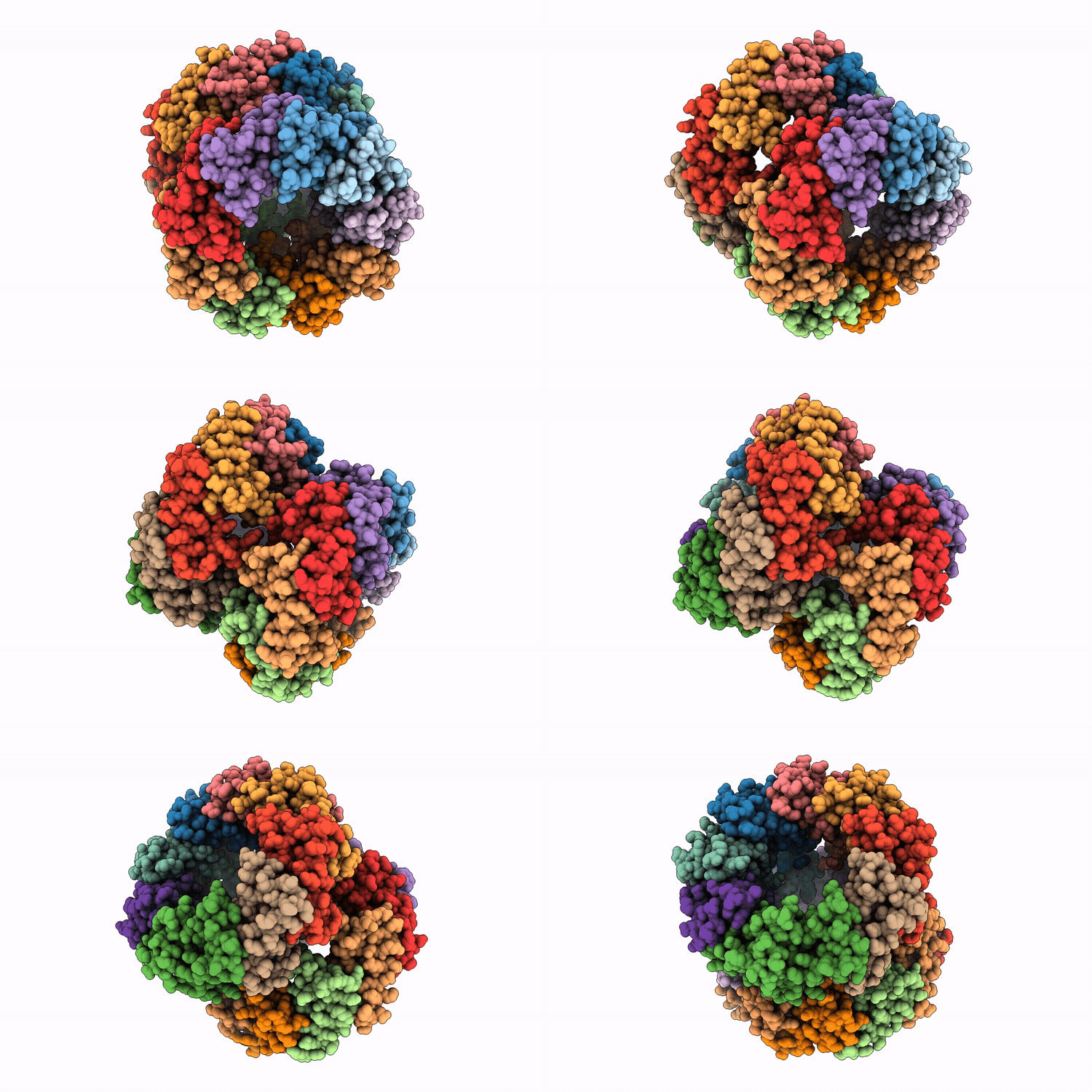
CryoEM structure of FPM13
Biological Source:
Source Organism(s):
Francisella (Taxon ID: 262)
Method Details:
Experimental Method:
Resolution:
3.60 Å
Aggregation State:
PARTICLE
Reconstruction Method:
SINGLE PARTICLE
Macromolecular Entities
Structures with similar UniProt ID
Protein Blast
Polymer Type:polypeptide(L)
Molecule:Lipoprotein
Gene (Uniprot):FTN_1118
Chain IDs:A, B, C, D, E, F, G, H, I, J, K, L, M, N, O, P, Q, R
Chain Length:111
Number of Molecules:18
Biological Source:Francisella
Ligand Molecules
Primary Citation
Discovery and cryoEM structure of FPM13, a periplasmic metalloprotein unique to Francisella.
PLoS Pathog. 22 e1014024 e1014024 (2026)
PMID: 41894480 DOI: 10.1371/journal.ppat.1014024

Abstact

We report the identification and cryoEM structure of the Francisella protein FTN_1118, a previously uncharacterized 13 kDa periplasmic protein unique to the Francisella genus. The protein was serendipitously discovered during purification of Francisella type VI secretion system (T6SS) effector proteins and is hereby designated as FPM13 (Francisella Periplasmic Metalloprotein, 13 kDa) based on its cellular and biochemical properties. Identified by the cryoID approach based on our cryoEM density map, FPM13 exists naturally as a cylindrical 18-mer complex with 9-fold dihedral symmetry, formed by stacking two donut-shaped nonamers head-to-head. Measuring ~8 nm in height and outer diameter with a 3.5 nm central channel, the complex features a double-layered wall comprising an inner beta-sheet core and an outer alpha-helical shell. Each FPM13 monomer adopts a compact fold comprising an N-terminus beta-strand, an alpha-helix and two additional beta strands at the C-terminus. Inter-ring loop interactions, hydrophobic contacts, and electrostatic interactions between adjacent subunits stabilize the assembly. Biochemical analyses, including APEX-biotinylation and Triton X-114 phase partitioning, confirmed FPM13 as a soluble periplasmic protein. Inductively coupled plasma mass spectrometry (ICP-MS) revealed FPM13 binds iron, copper, and zinc, with alanine substitution of predicted metal-binding cysteine and histidine residues abolishing this capability. Biochemical assays further revealed that wild-type FPM13 catalyzes disulfide bond formation and rescues alkaline phosphatase from reductive inactivation, indicating a role in maintaining periplasmic disulfide bonds. The metal-binding disruption mutant loses this oxidation activity. Deletion of FPM13 in Francisella novicida caused no growth defects in vitro, in macrophages, or in mice under tested conditions, suggesting functional redundancy may compensate for its absence. This study unveils a novel metalloprotein and demonstrates the power of cryoID in identifying uncharacterized proteins directly from structural data, offering new insights into Francisella biology.

Legend

Protein

Chemical

Disease

Primary Citation of related structures
Feedback Form
Name
Email
Institute
Feedback