

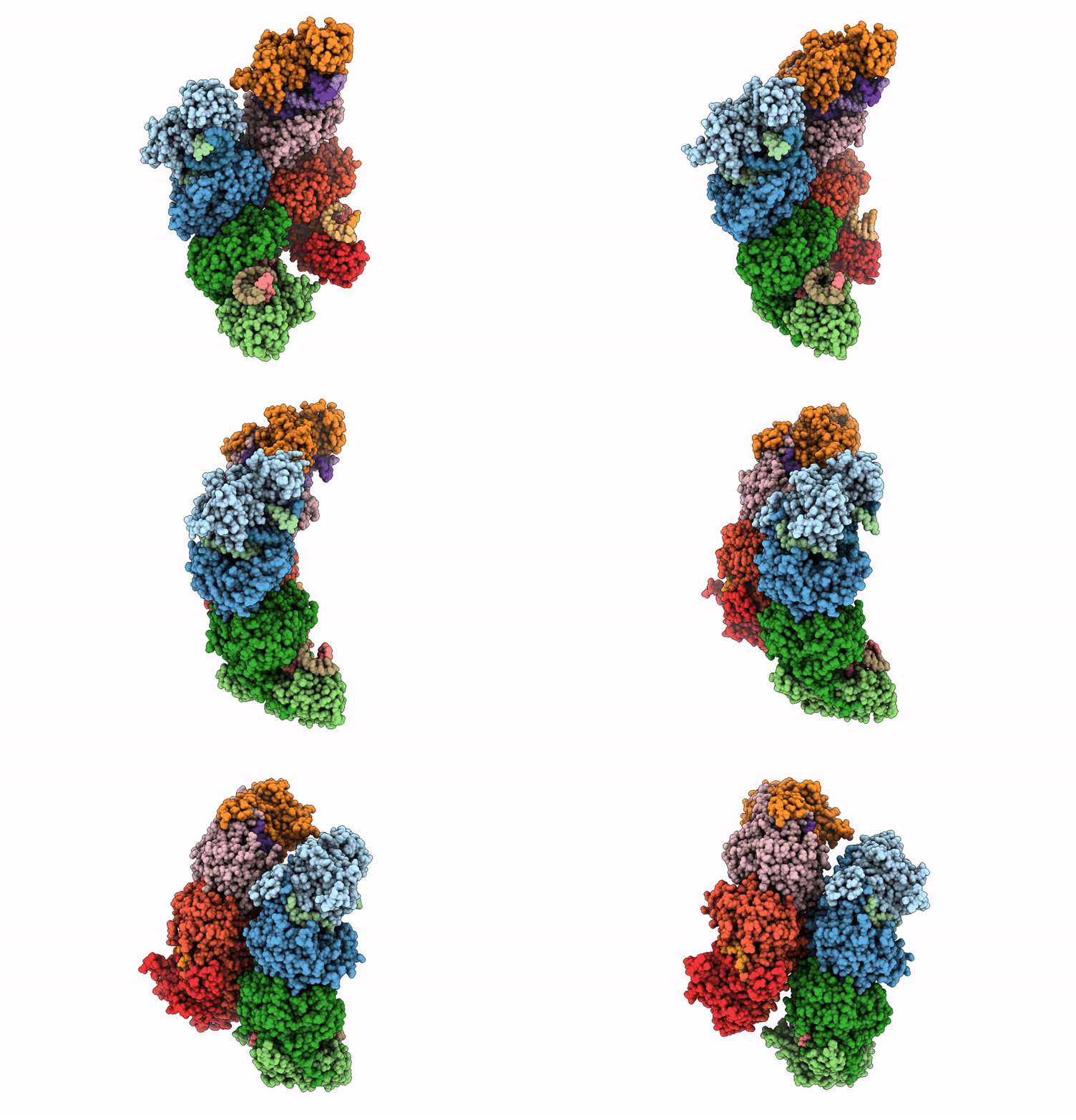
9OM4 image
Deposition Date 2025-05-13
Release Date 2025-10-22
Last Version Date 2026-05-13
Entry Detail
PDB ID:
9OM4
Title:
Cryo-EM structure of filament form Acidithiobacillus caldus (Aca) short prokaryotic argonautes, HNH-associated (SPARHA) with gRNA and tDNA
Biological Source:
Source Organism(s):
Expression System(s):
Method Details:
Experimental Method:
Resolution:
3.38 Å
Aggregation State:
FILAMENT
Reconstruction Method:
SINGLE PARTICLE
Macromolecular Entities
Protein Blast
Polymer Type:polypeptide(L)
Molecule:HNH endonuclease
Chain IDs:A, E, I, M
Chain Length:435
Number of Molecules:4
Biological Source:Acidithiobacillus caldus
Structures with similar UniProt ID
Protein Blast
Polymer Type:polypeptide(L)
Molecule:Prokaryotic argonaute MID-PIW
Chain IDs:B, F, J, N
Chain Length:471
Number of Molecules:4
Biological Source:Acidithiobacillus caldus
Polymer Type:polyribonucleotide
Molecule:RNA (5'-R(P*AP*UP*UP*UP*GP*GP
Chain IDs:C, G, K, O
Chain Length:18
Number of Molecules:4
Biological Source:Acidithiobacillus caldus
Polymer Type:polydeoxyribonucleotide
Molecule:DNA (5'-D(*AP*GP*AP*GP*CP*AP*
Chain IDs:D, H, L, P
Chain Length:18
Number of Molecules:4
Biological Source:Acidithiobacillus caldus
Ligand Molecules
Primary Citation
Argonaute-HNH filaments triggered by invader DNA confer bacterial immunity.
Nat Commun 16 11389 11389 (2025)
PMID: 41315870 DOI: 10.1038/s41467-025-66189-7

Abstact

Argonaute proteins provide innate immunity in all domains of life through guide-dependent recognition and cleavage of invader nucleic acids. Many short prokaryotic Argonautes (pAgos) lack nuclease activity and are instead co-encoded with tentative nuclease effectors, but their activation mechanisms remain unknown. Here, we characterize SPARHA systems (short prokaryotic argonautes, HNH-associated), containing HNH nuclease effectors. RNA-guided target DNA recognition by pAgo induces formation of SPARHA filaments with a chain of double nuclease sites formed by HNH tetramers, leading to indiscriminate collateral degradation of DNA and protecting bacterial population from invaders. We show that the assembly of filaments proceeds via a universal activation pathway involving a cascade of target-induced conformational changes in SPARHA, conserved in other short pAgo systems containing various types of effectors. pAgos and associated effectors act as modular defense systems that translate recognition of specific DNA into immune response through assembly of supramolecular complexes, deleterious for invaders and potentially useful for biotechnology.

Legend

Protein

Chemical

Disease

Primary Citation of related structures
Feedback Form
Name
Email
Institute
Feedback