

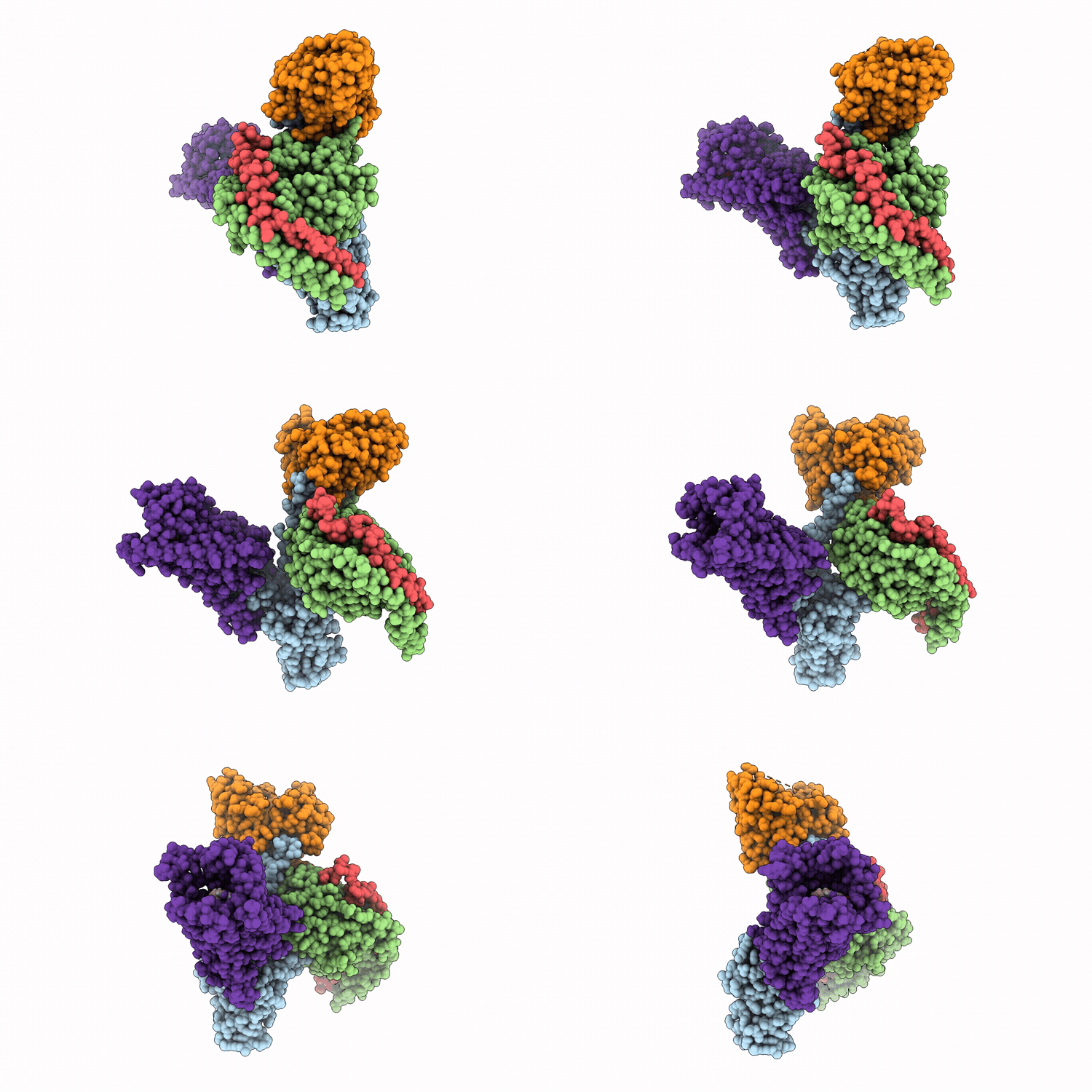
9O36 image
Deposition Date 2025-04-05
Release Date 2026-04-01
Last Version Date 2026-05-13
Entry Detail
PDB ID:
9O36
Title:
CryoEM structure of mu-opioid receptor - Gi protein complex bound to fluornitrazene (FNZ)
Biological Source:
Source Organism(s):
Homo sapiens (Taxon ID: 9606)
Mus musculus (Taxon ID: 10090)
Expression System(s):
Method Details:
Experimental Method:
Resolution:
2.30 Å
Aggregation State:
PARTICLE
Reconstruction Method:
SINGLE PARTICLE

Macromolecular Entities
Structures with similar UniProt ID
Protein Blast
Polymer Type:polypeptide(L)
Molecule:Guanine nucleotide-binding pr
Gene (Uniprot):GNAI1
Chain IDs:A
Chain Length:354
Number of Molecules:1
Biological Source:Homo sapiens
Structures with similar UniProt ID
Protein Blast
Polymer Type:polypeptide(L)
Molecule:Guanine nucleotide-binding pr
Gene (Uniprot):GNB1
Chain IDs:B
Chain Length:344
Number of Molecules:1
Biological Source:Homo sapiens
Structures with similar UniProt ID
Protein Blast
Polymer Type:polypeptide(L)
Molecule:Guanine nucleotide-binding pr
Gene (Uniprot):GNG2
Chain IDs:C
Chain Length:71
Number of Molecules:1
Biological Source:Homo sapiens
Protein Blast
Polymer Type:polypeptide(L)
Molecule:scFv16
Chain IDs:D (auth: E)
Chain Length:259
Number of Molecules:1
Biological Source:Mus musculus
Structures with similar UniProt ID
Protein Blast
Polymer Type:polypeptide(L)
Molecule:Mu-type opioid receptor
Gene (Uniprot):Oprm1
Chain IDs:E (auth: R)
Chain Length:426
Number of Molecules:1
Biological Source:Mus musculus
Ligand Molecules
Primary Citation

Abstact

Developing safe and effective pain medications is an ongoing challenge for human health. Agonists for the micro-opioid receptor (MOR) are essential pain medications, but their high intrinsic efficacy also induces adverse side effects, including respiratory depression, constipation, tolerance, dependence, withdrawal and addiction(1-7). Strategies to limit adverse effects traditionally include developing MOR agonists that have low intrinsic efficacy or that preferentially activate G-protein signalling over beta-arrestin signalling(8). Here we identify a novel MOR agonist with supramaximal intrinsic efficacy and a unique pharmacological profile that produced effective analgesia in rodents with minimal adverse effects. N-desethyl-fluornitrazene (DFNZ) was derived from a class of synthetic benzimidazole opioids called nitazenes. DFNZ has impaired brain penetrance, a unique spatiotemporal MOR cellular signalling profile, and diminished efficacy at the MOR-galanin 1 receptor (GAL1) heteromer. DFNZ does not induce respiratory depression, tolerance or MOR downregulation after repeated exposure. Compared with other MOR agonists, DFNZ has limited effects on dopamine neurotransmission in nucleus accumbens and weaker reinforcing effects in the drug self-administration procedure. These results provide novel insights about MOR and nitazene pharmacology, have important implications for pain and addiction treatment, and challenge the prevailing dogma that high-efficacy MOR agonists cannot constitute safe and effective therapeutic agents.

Legend

Protein

Chemical

Disease

Primary Citation of related structures
Feedback Form
Name
Email
Institute
Feedback