

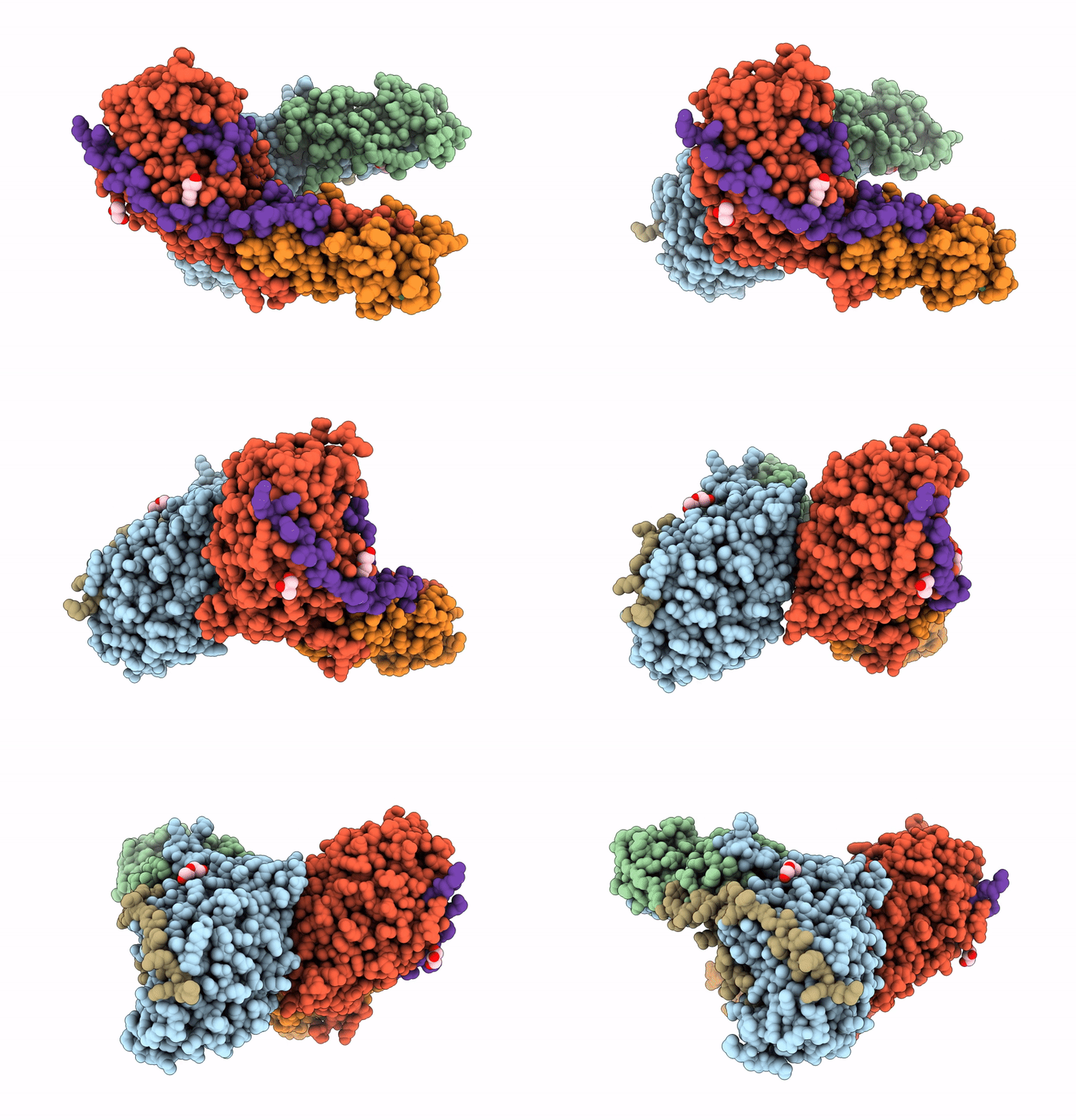
9NXF image
Deposition Date 2025-03-25
Release Date 2025-12-17
Last Version Date 2026-07-01
Entry Detail
PDB ID:
9NXF
Keywords:
Title:
Crystal structure of CN:Tak1 complex
Biological Source:
Source Organism(s):
Homo sapiens (Taxon ID: 9606)
Expression System(s):
Method Details:
Experimental Method:
Resolution:
3.13 Å
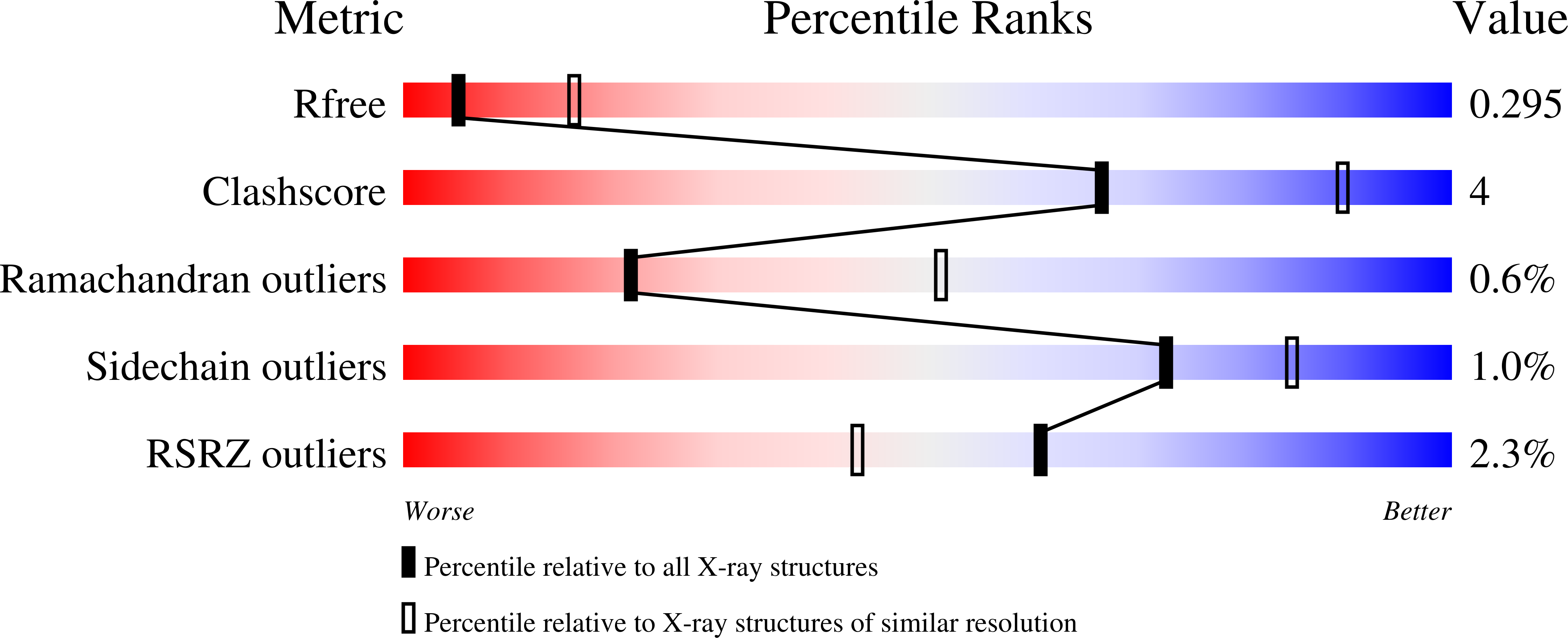
R-Value Free:
0.29
R-Value Work:
0.24
R-Value Observed:
0.25
Space Group:
C 1 2 1
Macromolecular Entities
Structures with similar UniProt ID
Protein Blast
Polymer Type:polypeptide(L)
Molecule:Protein phosphatase 3 catalyt
Gene (Uniprot):PPP3CA
Mutagens:D90A
Chain IDs:A, D
Chain Length:370
Number of Molecules:2
Biological Source:Homo sapiens
Structures with similar UniProt ID
Protein Blast
Polymer Type:polypeptide(L)
Molecule:Calcineurin subunit B type 1
Gene (Uniprot):PPP3R1
Chain IDs:B, E
Chain Length:156
Number of Molecules:2
Biological Source:Homo sapiens
Protein Blast
Polymer Type:polypeptide(L)
Molecule:IkB-like protein,Mitogen-acti
Gene (Uniprot):A238L, MAP3K7
Mutagens:Q441R,D442P
Chain IDs:C, F
Chain Length:53
Number of Molecules:2
Biological Source:Homo sapiens
Modified Residue
Compound ID Chain ID Parent Comp ID Details 2D Image
2RX C SER modified residue
Primary Citation
The clinical missense variant E282K in PPP3CA/calcineurin shifts substrate dephosphorylation by altering active site recruitment.
Nat Commun 17 ? ? (2026)
PMID: 41698888 DOI: 10.1038/s41467-026-69535-5

Abstact

Recently, de novo heterozygous variants of Calcineurin (CN) were reported as the cause of a neurodevelopmental disorder that presents with epileptic encephalopathy and dysmorphism (DEE91), with the largest group of patients harboring the CN missense mutation E282K (glutamate --> lysine). Here, we use molecular and cellular techniques to define how this mutation alters CN activity. We discover that basophilic substrates use an arginine residue to bind to CN via an acidic substrate recruitment pocket adjacent to the CN active site, the E282 pocket. Furthermore, we show that basic residues in the i-1 position of the substrate relative to the substrate phosphosite enhance CN-mediated dephosphorylation. While the CN(E282K) structure shows that the overall conformation is unchanged, the E282 pocket transforms from acidic to basic, with pocket access blocked by the formation of a E282K-E237 salt bridge. Finally, in vitro assays and in cell phosphoproteomics show that CN(E282K) shifts CN substrate dephosphorylation profiles from basic to acidic, thereby altering CN-mediated dephosphorylation signaling. Together, these data define the molecular impact of the CN(E282K) variant in cells and development, providing a key step for developing strategies to treat this disorder and its accompanying complications.

Legend

Protein

Chemical

Disease

Primary Citation of related structures
Feedback Form
Name
Email
Institute
Feedback