

9NJ2 image
Deposition Date 2025-02-26
Release Date 2026-03-11
Last Version Date 2026-04-22
Entry Detail
PDB ID:
9NJ2
Title:
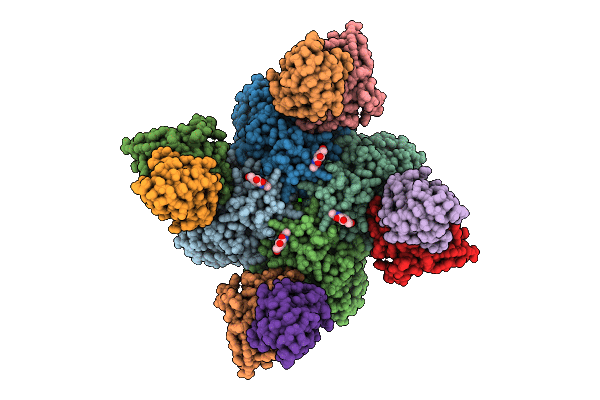
N1 neuraminidase of influenza A/Vietnam/1203/2004 H5N1 in complex with four FNI9 Fab molecules
Biological Source:
Source Organism(s):
Expression System(s):
Method Details:
Experimental Method:
Resolution:
2.40 Å
Aggregation State:
PARTICLE
Reconstruction Method:
SINGLE PARTICLE
Macromolecular Entities
Structures with similar UniProt ID
Protein Blast
Polymer Type:polypeptide(L)
Molecule:Neuraminidase
Gene (Uniprot):NA
Chain IDs:A, B, C, D
Chain Length:470
Number of Molecules:4
Biological Source:Influenza A virus (A/Viet Nam/1203/2004(H5N1))
Protein Blast
Polymer Type:polypeptide(L)
Molecule:FNI9 Fab heavy chain
Chain IDs:E (auth: H), F (auth: I), G (auth: J), H (auth: K)
Chain Length:128
Number of Molecules:4
Biological Source:Homo sapiens
Protein Blast
Polymer Type:polypeptide(L)
Molecule:FNI9 Fab light chain
Chain IDs:I (auth: L), J (auth: M), K (auth: N), L (auth: O)
Chain Length:108
Number of Molecules:4
Biological Source:Homo sapiens
Primary Citation

Abstact

For nearly 30 years, Goose/Guangdong-derived highly pathogenic avian influenza H5N1 viruses have posed significant risks to economic stability, food security, and public health. Virus evolution has resulted in various clades, including the panzootic subclade 2.3.4.4b, recognized for its pandemic potential. Here we present the potent in vitro activity of FNI9, a pan-influenza NA-inhibiting monoclonal antibody, against a range of pseudoparticles with NA spanning decades of H5N1 virus evolution. FNI9 also shows strong prophylactic protection in female mice against lethal challenges with H5N1 from clade 1 and 2.3.4.4b. Cryo-EM and molecular dynamics analysis reveal that FNI9 binds to 7 highly conserved H5N1 NA residues (R118, E119, D151, E228, E278, R293, and R368). In silico evolutionary escape profiling and machine learning predict low escapability, high fitness costs, and minimal spread likelihood for viral mutations that evade FNI9 binding. These findings support FNI9 broad protection and underscore the NA role in future influenza vaccine design.

Legend

Protein

Chemical

Disease

Primary Citation of related structures
Feedback Form
Name
Email
Institute
Feedback