

9MYV image
Deposition Date 2025-01-22
Release Date 2025-12-03
Last Version Date 2026-04-01
Entry Detail
PDB ID:
9MYV
Keywords:
Title:
Structure of human neuronal nitric oxide synthase R354A/G357D mutant heme domain bound with 2-(2-amino-6-fluoro-4-methylquinolin-7-yl)-5-(aminomethyl)phenol
Biological Source:
Source Organism(s):
Homo sapiens (Taxon ID: 9606)
Expression System(s):
Method Details:
Experimental Method:
Resolution:
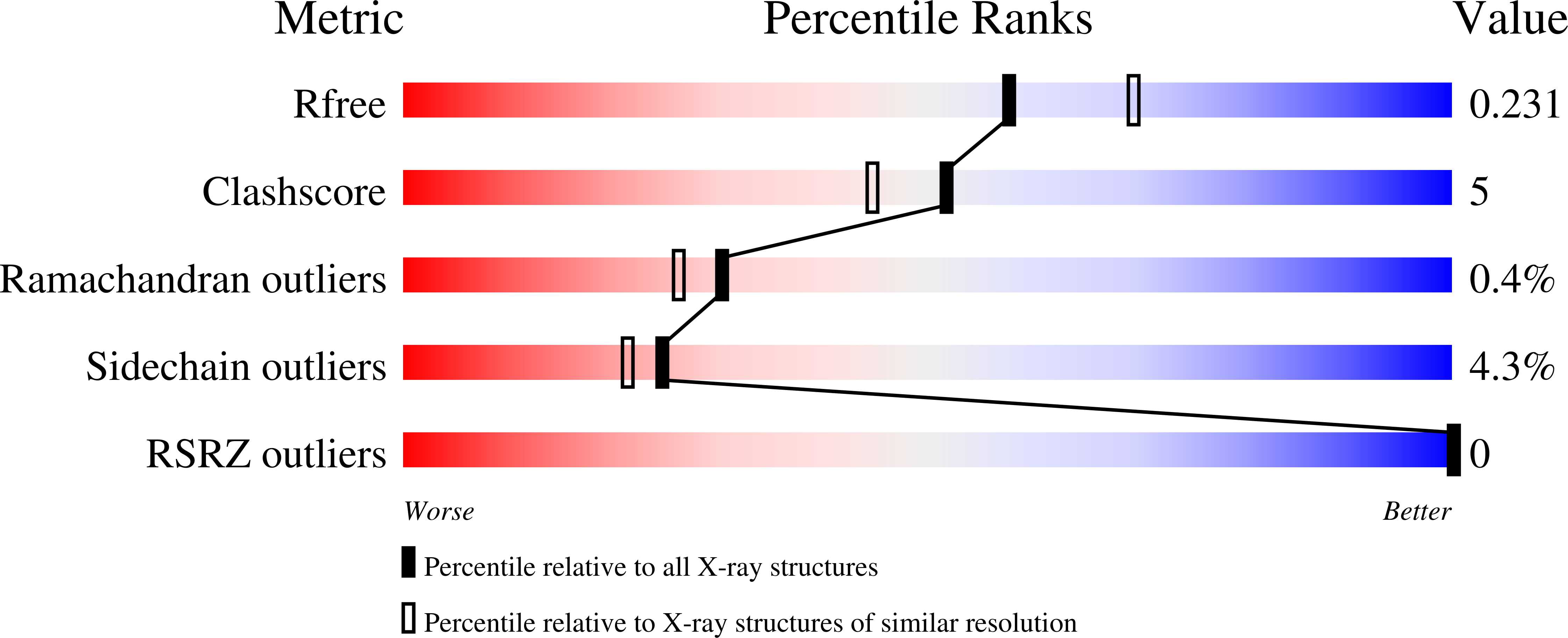
2.15 Å
R-Value Free:
0.23
R-Value Work:
0.17
R-Value Observed:
0.18
Space Group:
P 1 21 1
Macromolecular Entities
Structures with similar UniProt ID
Protein Blast
Polymer Type:polypeptide(L)
Molecule:Nitric oxide synthase, brain
Gene (Uniprot):NOS1
Mutagens:R354A, G357DCPRFLKVKNWETEVVLTDTLHLKSTLETGCTEYICMGSIMHPSQHARRPEDVATKDQLFPLAKEFIDQYYSSIKRFGSKA HMERLEEVNKEIDTTSTYQLKDTELIYGAKHAWRNASRCVGRIQWSKLQVFDARDCTTAHGMFNYICNHVKYATNKGNLR SAITIFPQRTDGKHDFRVWNSQLIRYAGYKQPDGSTLGDPANVQFTEICIQQGWKPPRGRFDVLPLLLQANGNDPELFQI PPELVLEVPIRHPKFEWFKDLGLKWYGLPAVSNMLLEIGGLEFSACPFSGWYMGTEIGVRDYCDNSRYNILEEVAKKMNL DMRKTSSLWKDQALVEINIAVLYSFQSDKVTIVDHHSATESFIKHMENEYRCRGGCPADWVWIVPPMSGSITPVFHQEML NYRLTPSFEYQPDPWNTHVWKLV
Chain IDs:A, B, C, D
Chain Length:423
Number of Molecules:4
Biological Source:Homo sapiens
Primary Citation
Enhancement of Potency and Selectivity of 2-Aminoquinoline-Based Human Neuronal Nitric Oxide Synthase Inhibitors.
J. Med. Chem. 69 3779 3795 (2026)
PMID: 41635994 DOI: 10.1021/acs.jmedchem.5c01679

Abstact

Neuronal nitric oxide synthase (nNOS) is a key enzyme in neurodegenerative diseases and melanoma, making it an important therapeutic target. We previously reported 2-aminoquinoline-based nNOS inhibitors with promising activity but limited by suboptimal potency, isoform selectivity, and off-target effects. To address these issues, we designed and synthesized a new series of 7-aryl-6-fluoro-4-methyl-2-aminoquinoline derivatives. Compound 16 showed excellent potency against human nNOS (K(i) 16 nM), with approximately 1800-fold selectivity over human endothelial NOS (eNOS) and approximately 2900-fold over human inducible NOS (iNOS). PAMPA-BBB experiments indicated high effective permeability (P(e) = 13.04 x 10(-6) cm/s), suggesting strong CNS drug potential. In vivo pharmacokinetic studies in mice further demonstrated sustained systemic exposure, low clearance, and robust brain penetration. In contrast, compound 24, the N-Me analogue of 16, was inactive. Molecular dynamics simulations indicated that N-methylation disrupted the favorable solvation of the tail amino group, likely contributing to its loss of activity and nNOS affinity.

Legend

Protein

Chemical

Disease

Primary Citation of related structures
Feedback Form
Name
Email
Institute
Feedback