

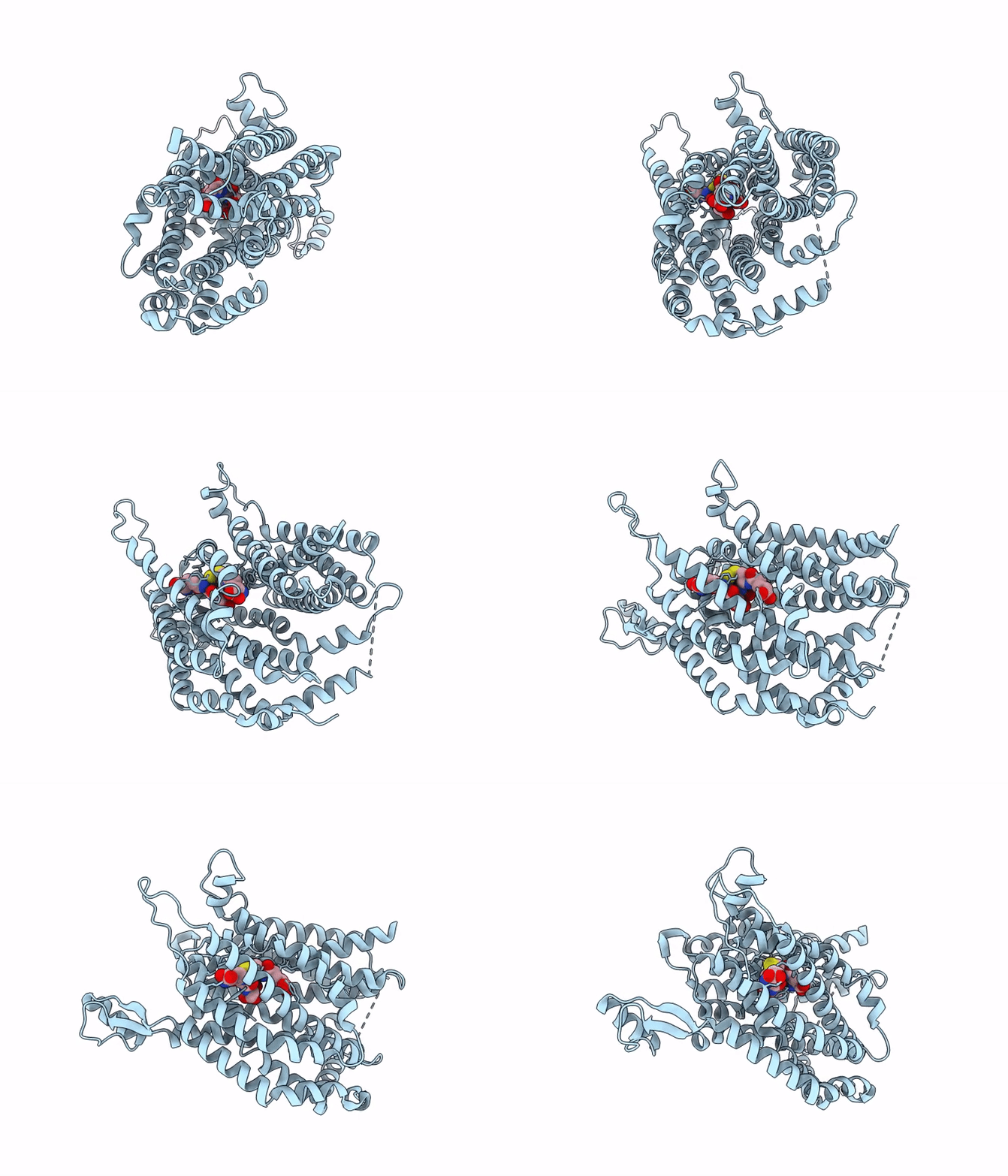
9MUN image
Deposition Date 2025-01-14
Release Date 2026-02-25
Last Version Date 2026-05-27
Entry Detail
PDB ID:
9MUN
Title:
Structure of Human SLC33A1 in complex with oxidized glutathione
Biological Source:
Source Organism(s):
Homo sapiens (Taxon ID: 9606)
Expression System(s):
Method Details:
Experimental Method:
Resolution:
3.26 Å
Aggregation State:
PARTICLE
Reconstruction Method:
SINGLE PARTICLE
Macromolecular Entities
Structures with similar UniProt ID
Protein Blast
Polymer Type:polypeptide(L)
Molecule:Acetyl-coenzyme A transporter
Gene (Uniprot):SLC33A1
Chain IDs:A
Chain Length:561
Number of Molecules:1
Biological Source:Homo sapiens
Ligand Molecules
Primary Citation
SLC33A1 exports oxidized glutathione to maintain endoplasmic reticulum redox homeostasis.
Nat.Cell Biol. 28 903 914 (2026)
PMID: 41998286 DOI: 10.1038/s41556-026-01922-y

Abstact

The endoplasmic reticulum (ER) requires an oxidative environment to support the efficient maturation of secretory and membrane proteins. This is in part established by glutathione, a redox-active metabolite present in reduced (GSH) and oxidized (GSSG) forms. The ER maintains a higher GSSG:GSH ratio than the cytosol; however, the mechanisms controlling ER redox balance remain poorly understood. To address this, we developed a method for the rapid immunopurification of the ER, enabling comprehensive profiling of its proteome and metabolome. Combining this approach with CRISPR screening, we identified SLC33A1 as the major ER GSSG exporter in mammalian cells. Loss of SLC33A1 led to GSSG accumulation in the ER and a liposome-based assay demonstrated that SLC33A1 directly transports GSSG. Cryogenic electron microscopy structures and molecular dynamics simulations revealed how SLC33A1 binds GSSG and identified residues critical for its transport. Finally, an imbalance in GSSG:GSH ratio induced ER stress and dependency on the ER-associated degradation pathway, driven by a shift in protein disulfide isomerases towards their oxidized forms. Together, our work establishes SLC33A1-mediated GSSG export as a key mechanism for ER redox homeostasis and protein maturation.

Legend

Protein

Chemical

Disease

Primary Citation of related structures
Feedback Form
Name
Email
Institute
Feedback