

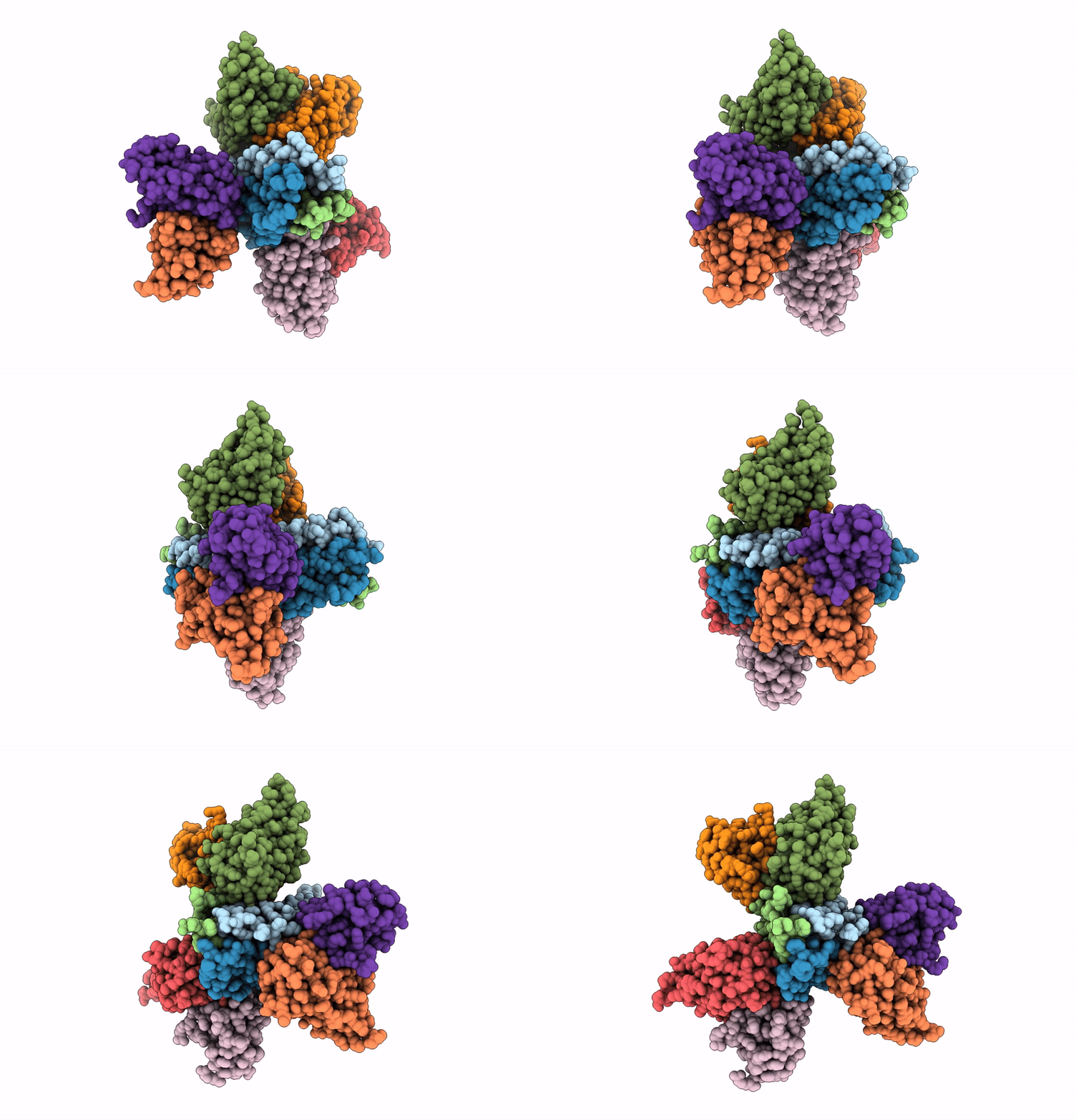
9MLK image
Deposition Date 2024-12-19
Release Date 2025-07-30
Last Version Date 2025-07-30
Entry Detail
PDB ID:
9MLK
Keywords:
Title:
Post-fusion HERV-K Envelope Protein in complex with Kenv-4 Fab
Biological Source:
Source Organism(s):
Mus musculus (Taxon ID: 10090)
Homo sapiens (Taxon ID: 9606)
Expression System(s):
Method Details:
Experimental Method:
Resolution:
2.84 Å
Aggregation State:
PARTICLE
Reconstruction Method:
SINGLE PARTICLE

Macromolecular Entities
Structures with similar UniProt ID
Protein Blast
Polymer Type:polypeptide(L)
Molecule:Transmembrane protein
Gene (Uniprot):ERVK-6
Chain IDs:G (auth: A), H (auth: C), I (auth: B)
Chain Length:135
Number of Molecules:3
Biological Source:Homo sapiens
Protein Blast
Polymer Type:polypeptide(L)
Molecule:Kenv-4 Fab Heavy Chain
Chain IDs:A (auth: H), C (auth: I), E (auth: J)
Chain Length:449
Number of Molecules:3
Biological Source:Mus musculus
Protein Blast
Polymer Type:polypeptide(L)
Molecule:Kenv-4 Fab Light Chain
Chain IDs:B (auth: L), D (auth: M), F (auth: N)
Chain Length:213
Number of Molecules:3
Biological Source:Mus musculus
Ligand Molecules
Primary Citation
Human endogenous retrovirus K (HERV-K) envelope structures in pre- and postfusion by cryo-EM.
Sci Adv 11 eady8168 eady8168 (2025)
PMID: 40864726 DOI: 10.1126/sciadv.ady8168

Abstact

Human endogenous retroviruses (HERVs) are remnants of ancient infections that comprise ~8% of the human genome. The HERV-K envelope glycoprotein (Env) is aberrantly expressed in cancers, autoimmune disorders, and neurodegenerative diseases, and is targeted by patients' own antibodies. However, a lack of structural information has limited molecular and immunological studies of the roles of HERVs in disease. Here, we present cryo-electron microscopy structures of stabilized HERV-K Env in the prefusion conformation, revealing a distinct fold and architecture compared to HIV and simian immunodeficiency virus. We also generated and characterized a panel of monoclonal antibodies with subunit and conformational specificity, serving as valuable research tools. These antibodies enabled structure determination of the postfusion conformation of HERV-K Env, including its unique "tether" helix, and antibody-bound prefusion Env. Together, these results provide a structural framework that opens the door to mechanistic studies of HERV-K Env and tools for its evaluation as a potential therapeutic target.

Legend

Protein

Chemical

Disease

Primary Citation of related structures
Feedback Form
Name
Email
Institute
Feedback