

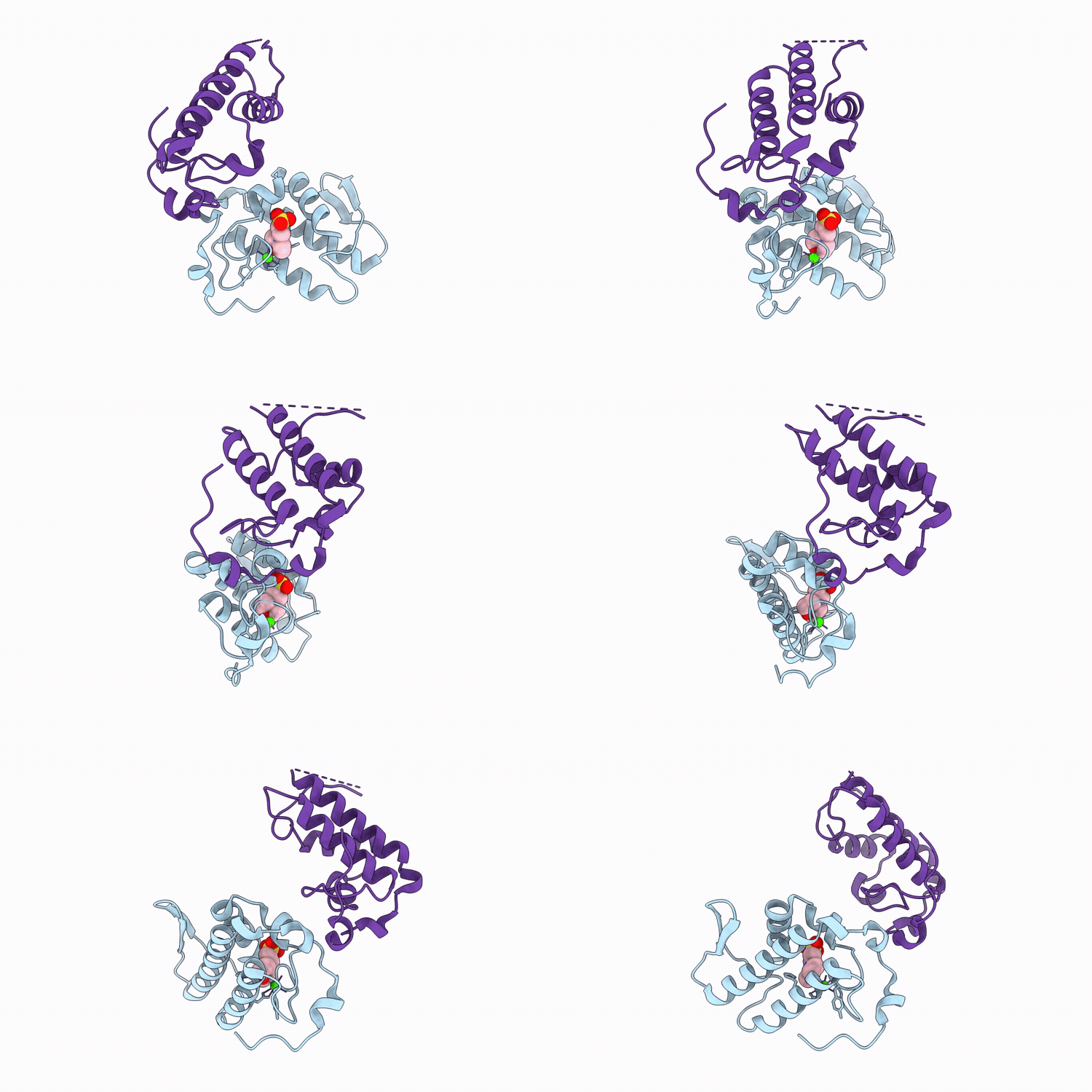
9MLE image
Deposition Date 2024-12-19
Release Date 2026-05-13
Last Version Date 2026-05-13
Entry Detail
PDB ID:
9MLE
Keywords:
Title:
Crystal structure of Asp49 Phospholipase A2 isolated from Lachesis muta
Biological Source:
Source Organism(s):
Lachesis muta (Taxon ID: 8752)
Method Details:
Experimental Method:
Resolution:
2.36 Å
R-Value Free:
0.26
R-Value Work:
0.24
R-Value Observed:
0.24
Space Group:
P 62 2 2

Macromolecular Entities
Protein Blast
Polymer Type:polypeptide(L)
Molecule:Phospholipase A2
Chain IDs:A, B
Chain Length:122
Number of Molecules:2
Biological Source:Lachesis muta
Primary Citation
Crystal structure and functional characterization of an Asp49 phospholipase A 2 from the bushmaster (Lachesis muta).
Acta Crystallogr.,Sect.F 82 150 159 (2026)
PMID: 41944125 DOI: 10.1107/S2053230X26002736

Abstact

Snake-venom phospholipases A(2) (PLA(2)s) are small, structurally conserved enzymes that contribute significantly to the pathophysiology of envenomation. Here, we report the purification and crystal structure of an Asp49-PLA(2) isolated from the venom of Lachesis muta, a pit viper from the Peruvian Amazon. The enzyme was purified using ion-exchange and size-exclusion chromatography and exhibited phospholipase activity in a dose- and time-dependent egg-yolk degradation assay. Pure protein crystals were obtained in space group P6(2)22 and diffracted to 2.36 A resolution, with two molecules in the asymmetric unit. The structure reveals the canonical fold of catalytically active group II PLA(2)s, with a bound Ca(2+) ion and a MES molecule in the active site of one monomer. Seven disulfide bonds stabilize the structure, although one bridge typically associated with the beta-hairpin is absent and is replaced by a salt bridge as in other viperid PLA(2)s. PISA analysis suggests a potential tetrameric assembly composed of two AB dimers generating an interface between two A subunits (A-A'). Electrostatic surface mapping reveals a notable positively charged channel at the A-A' interface, like that seen for a basic PLA(2) homodimer from Crotalus durissus terrificus in which the two active sites lie accessible to the membrane. This study presents the first structural and enzymatic analysis of an Asp49-PLA(2) from L. muta and provides insights into its oligomeric assembly, electrostatic landscape and potential adaptations relevant to its role in venom toxicity.

Legend

Protein

Chemical

Disease

Primary Citation of related structures
Feedback Form
Name
Email
Institute
Feedback