

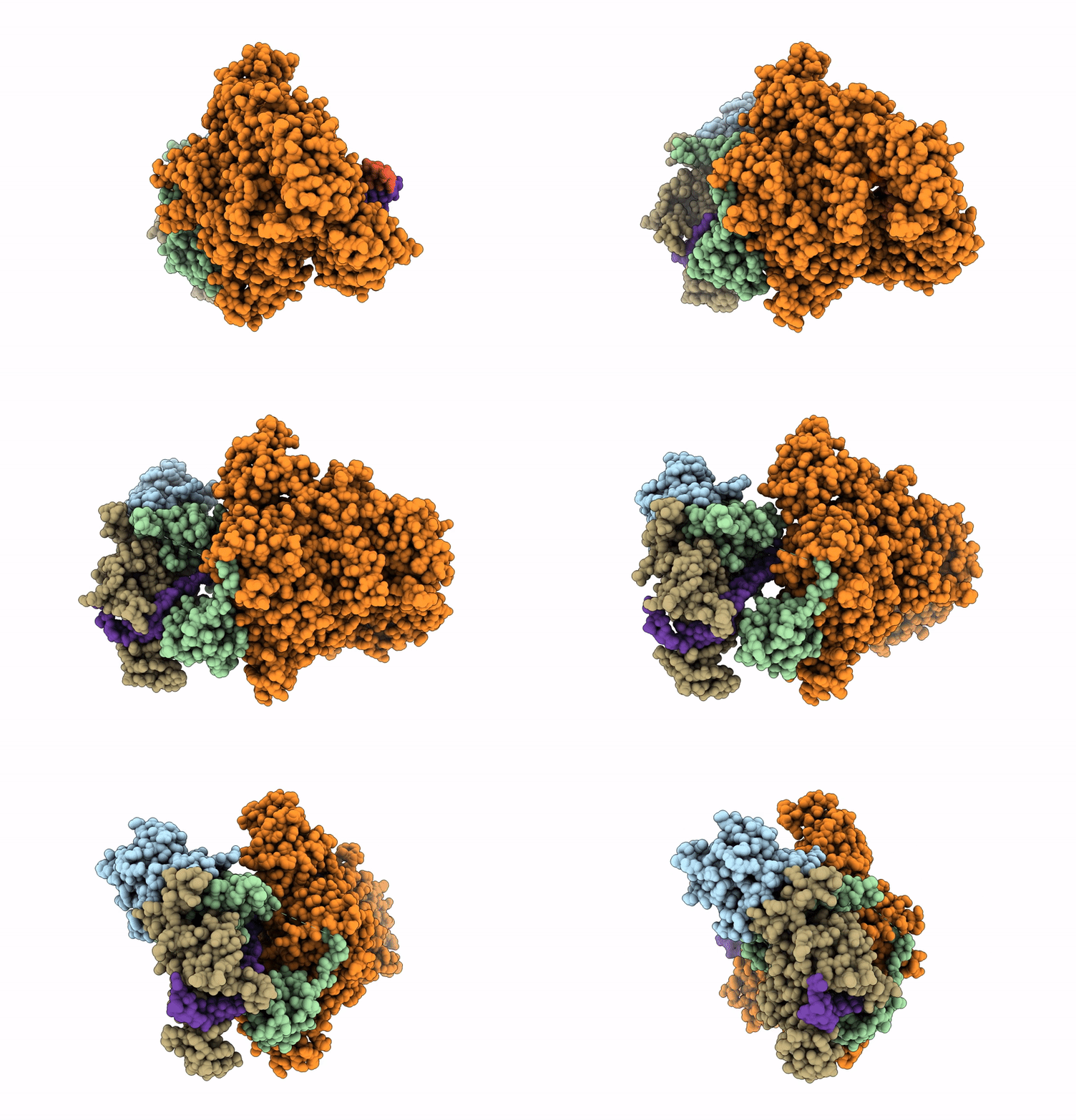
9MJ5 image
Deposition Date 2024-12-13
Release Date 2025-02-19
Last Version Date 2025-03-12
Entry Detail
PDB ID:
9MJ5
Title:
Catalytic domain of human DNA polymerase alpha in complex with DNA and RPA
Biological Source:
Source Organism(s):
Homo sapiens (Taxon ID: 9606)
Method Details:
Experimental Method:
Resolution:
3.50 Å
Aggregation State:
PARTICLE
Reconstruction Method:
SINGLE PARTICLE
Macromolecular Entities
Structures with similar UniProt ID
Protein Blast
Polymer Type:polypeptide(L)
Molecule:Replication protein A 14 kDa
Gene (Uniprot):RPA3
Chain IDs:A
Chain Length:121
Number of Molecules:1
Biological Source:Homo sapiens
Structures with similar UniProt ID
Protein Blast
Polymer Type:polypeptide(L)
Molecule:Replication protein A 32 kDa
Gene (Uniprot):RPA2
Chain IDs:B
Chain Length:236
Number of Molecules:1
Biological Source:Homo sapiens
Structures with similar UniProt ID
Protein Blast
Polymer Type:polypeptide(L)
Molecule:Replication protein A 70 kDa
Gene (Uniprot):RPA1
Chain IDs:C
Chain Length:179
Number of Molecules:1
Biological Source:Homo sapiens
Polymer Type:polydeoxyribonucleotide/polyribonucleotide hybrid
Molecule:RNA-DNA primer (11-mer)
Chain IDs:D (auth: P)
Chain Length:11
Number of Molecules:1
Biological Source:Homo sapiens
Structures with similar UniProt ID
Protein Blast
Polymer Type:polypeptide(L)
Molecule:DNA polymerase alpha catalyti
Gene (Uniprot):POLA1
Chain IDs:E (auth: S)
Chain Length:910
Number of Molecules:1
Biological Source:Homo sapiens
Polymer Type:polydeoxyribonucleotide
Molecule:DNA template (35-mer)
Chain IDs:F (auth: T)
Chain Length:35
Number of Molecules:1
Biological Source:Homo sapiens
Primary Citation
The human primosome requires replication protein A when copying DNA with inverted repeats.
Nucleic Acids Res. 53 ? ? (2025)
PMID: 40829805 DOI: 10.1093/nar/gkaf799

Abstact

The human primosome, a four-subunit complex of primase and DNA polymerase alpha (Polα), initiates DNA synthesis on both chromosome strands by generating chimeric RNA-DNA primers for loading DNA polymerases delta and epsilon (Polϵ). Replication protein A (RPA) tightly binds to single-stranded DNA strands, protecting them from nucleolytic digestion and unauthorized transactions. We report here that RPA plays a critical role for the human primosome during DNA synthesis across inverted repeats prone to hairpin formation. On other alternatively structured DNA, forming a G-quadruplex, RPA does not assist primosome. A stimulatory effect of RPA on DNA synthesis across hairpins was also observed for the catalytic domain of Polα but not of Polϵ. The winged helix-turn-helix domain of RPA is essential for an efficient hairpin bypass and increases RPA-Polα cooperativity on the primed DNA template. Cryo-EM studies revealed that this domain is mainly responsible for the interaction between RPA and Polα. The flexible mode of RPA-Polα interaction during DNA synthesis implies the mechanism of template handover between them when the hairpin formation should be avoided. This work provides insight into a cooperative action of RPA and primosome on DNA, which is critical for DNA synthesis across inverted repeats.

Legend

Protein

Chemical

Disease

Primary Citation of related structures
Feedback Form
Name
Email
Institute
Feedback