

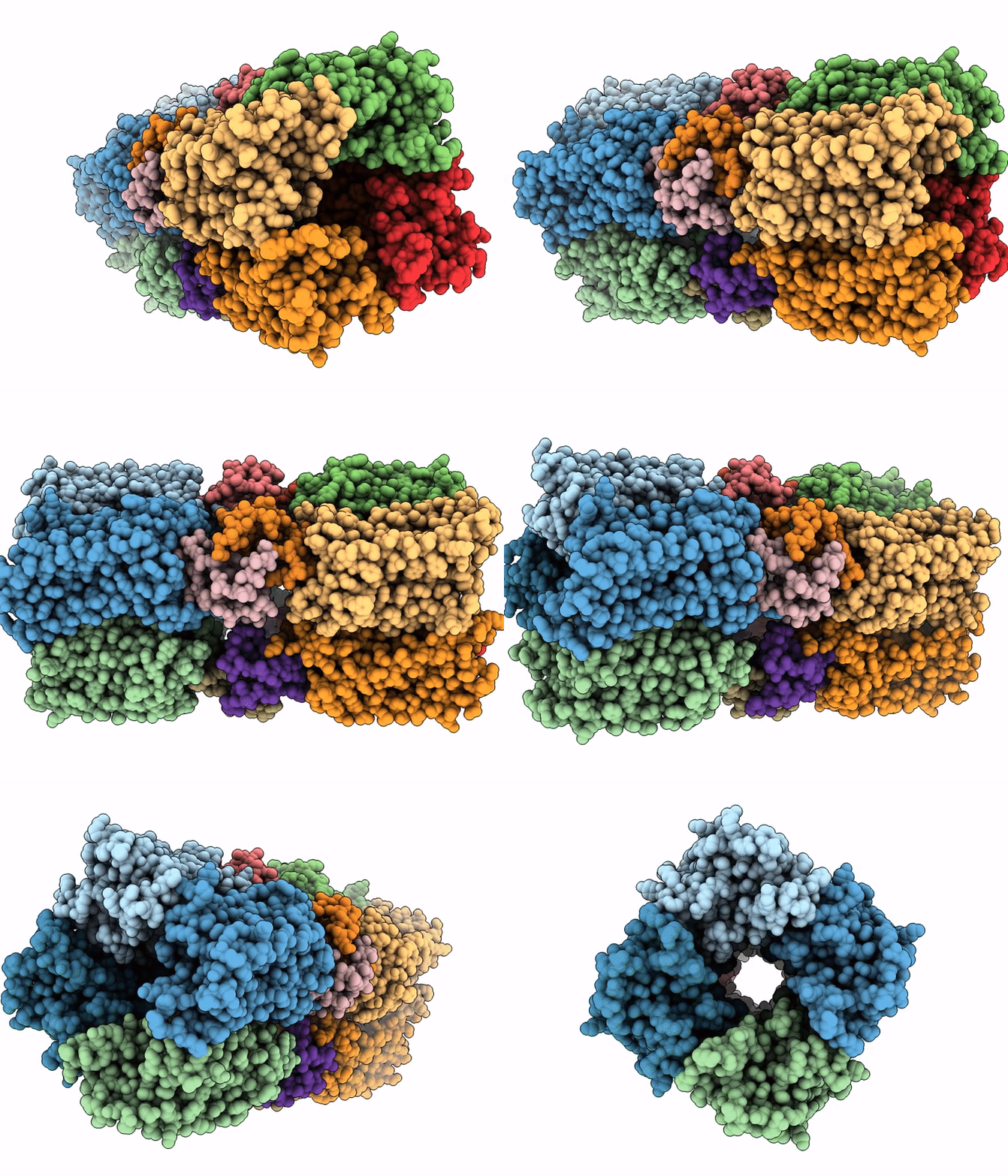
9ME1 image
Deposition Date 2024-12-05
Release Date 2025-09-10
Last Version Date 2026-03-25
Entry Detail
PDB ID:
9ME1
Title:
hCXCR4-CXCL12 complex with 1:1 stoichiometry
Biological Source:
Source Organism(s):
Homo sapiens (Taxon ID: 9606)
Expression System(s):
Method Details:
Experimental Method:
Resolution:
3.37 Å
Aggregation State:
PARTICLE
Reconstruction Method:
SINGLE PARTICLE

Macromolecular Entities
Structures with similar UniProt ID
Protein Blast
Polymer Type:polypeptide(L)
Molecule:C-X-C chemokine receptor type
Gene (Uniprot):CXCR4
Chain IDs:A (auth: B), B (auth: A), E (auth: C), F (auth: D), G (auth: I), H (auth: E), I (auth: K), J (auth: L)
Chain Length:360
Number of Molecules:8
Biological Source:Homo sapiens
Structures with similar UniProt ID
Protein Blast
Polymer Type:polypeptide(L)
Molecule:Stromal cell-derived factor 1
Gene (Uniprot):CXCL12
Chain IDs:C (auth: N), D (auth: O), K (auth: P), L (auth: M), M (auth: J), N (auth: F), O (auth: G), P (auth: H)
Chain Length:80
Number of Molecules:8
Biological Source:Homo sapiens
Ligand Molecules
Primary Citation
CXCR4 mediated recognition of HIV envelope spike and inhibition by CXCL12.
Nat Commun 16 8653 8653 (2025)
PMID: 41027939 DOI: 10.1038/s41467-025-63815-2

Abstact

CCR5 and CXCR4 both act as HIV co-receptors, though CXCR4 is less explored. CXCR4 binds the chemokine CXCL12 to regulate cellular processes and mediate HIV entry, a process that CXCL12 inhibits. Using cryo-EM, we investigate HIV-2 envelope (Env) spike recognition by CXCR4 and how CXCL12 inhibit this interaction. We discover that CXCR4 unexpected forms a tetramer, both alone and in complex. It binds CXCL12 with 4:8 and 8:8 stoichiometries, with the CXCL12 N-terminus inserting into the CXCR4 pocket. Structures of CXCR4-gp120(HIV-2) complex show one or two gp120 molecules per CXCR4 tetramer, with the V3 loop occupying the major sub-pocket of CXCR4 through deep embedment of its GFKF motif. The CXCL12 N-terminus chashes with gp120(HIV-2) V3 loops, explain its inhibitory effect. Docking analyses of other HIV antagonists further clarify their mechanisms. The CXCR4-gp120(HIV-1) model illustrate how V3 loop residues define co-receptor specificity, offering insights into co-receptor switching and therapeutic design.

Legend

Protein

Chemical

Disease

Primary Citation of related structures
Feedback Form
Name
Email
Institute
Feedback