

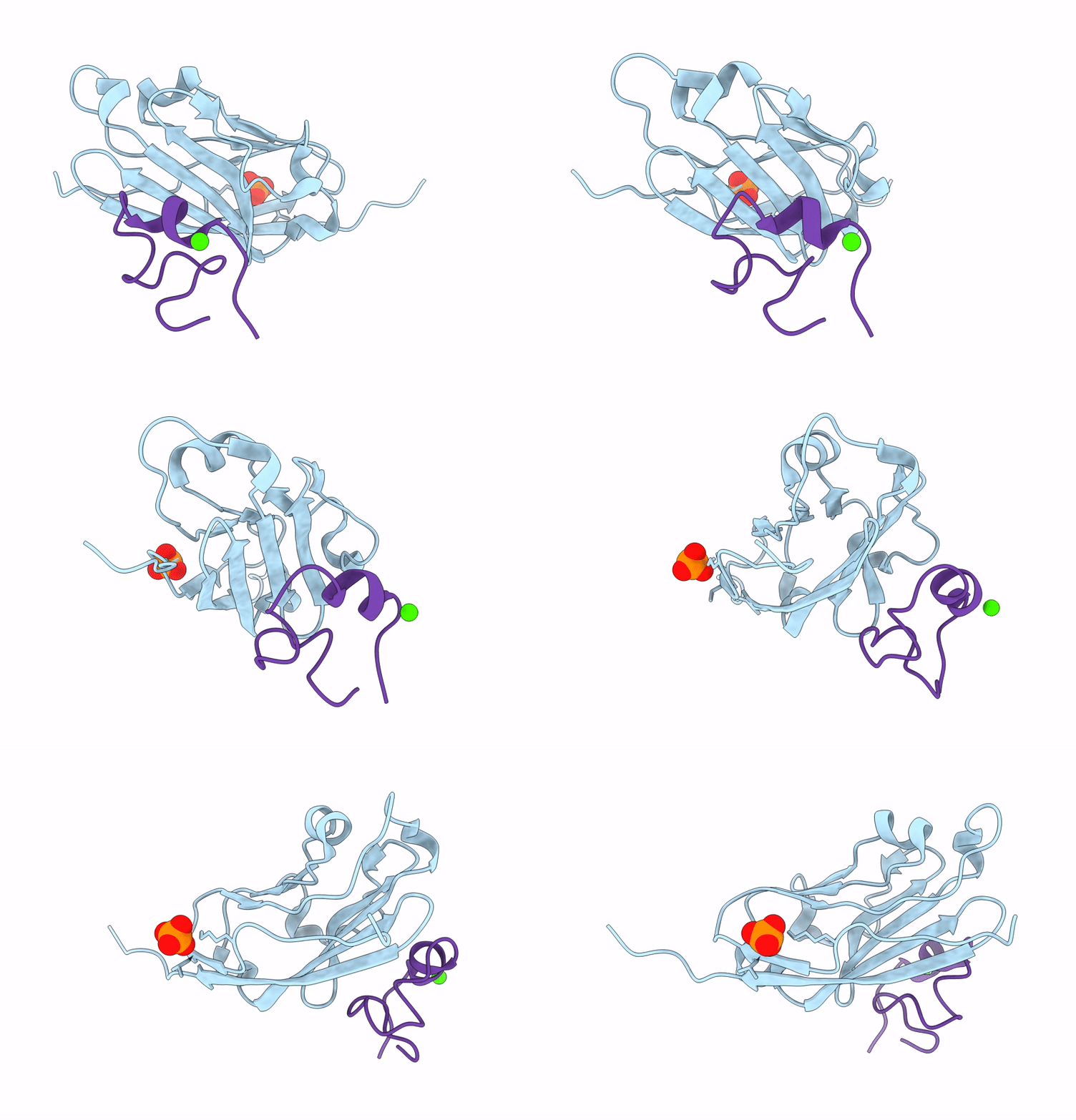
9MAP image
Deposition Date 2025-03-14
Release Date 2025-12-03
Last Version Date 2026-04-08
Entry Detail
PDB ID:
9MAP
Keywords:
Title:
Crystal structure of GAGWLP and PD-L1
Biological Source:
Source Organism(s):
Homo sapiens (Taxon ID: 9606)
Expression System(s):
Method Details:
Experimental Method:
Resolution:
3.00 Å
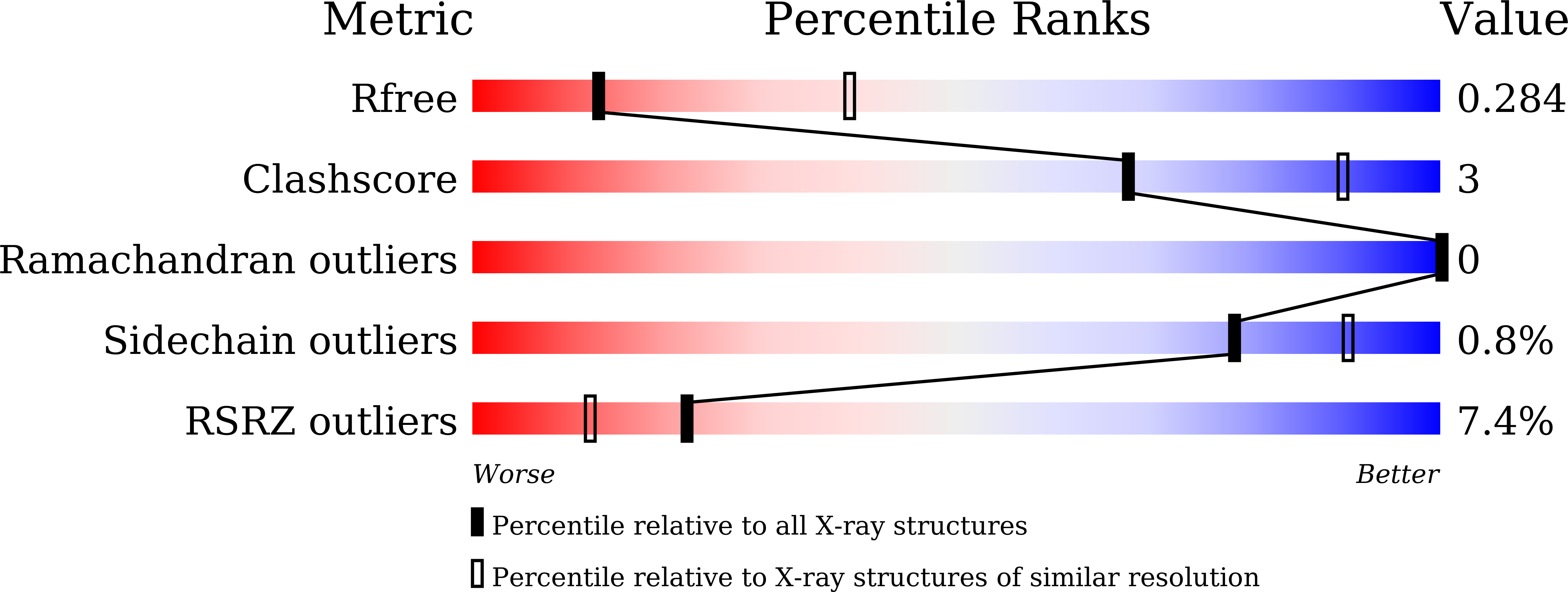
R-Value Free:
0.28
R-Value Work:
0.27
R-Value Observed:
0.27
Space Group:
I 41 3 2
Macromolecular Entities
Structures with similar UniProt ID
Protein Blast
Polymer Type:polypeptide(L)
Molecule:Programmed cell death 1 ligan
Gene (Uniprot):CD274
Chain IDs:A
Chain Length:122
Number of Molecules:1
Biological Source:Homo sapiens
Protein Blast
Polymer Type:polypeptide(L)
Molecule:G-AGWLP
Chain IDs:B
Chain Length:28
Number of Molecules:1
Biological Source:Homo sapiens
Primary Citation
Multicyclic Peptides Targeting PD-L1 for Radiotheranostics: From Discovery to Clinical Proof-of-Concept.
J. Am. Chem. Soc. 147 35638 35654 (2025)
PMID: 40974147 DOI: 10.1021/jacs.5c11292

Abstact

Radiotheranostics holds transformative potential for precision oncology by integrating diagnostic imaging with targeted radionuclide therapy. However, advancements in this field are significantly hindered by the limited availability of high-affinity ligands that are capable of engaging challenging cell-surface antigens, particularly flat, low-druggability targets such as programmed death-ligand 1 (PD-L1). Here, we overcome this barrier through de novo discovery and rational engineering of a disulfide-directed multicyclic peptide (DDMP), dmp10, which achieves a picomolar affinity for PD-L1 by leveraging conformationally constrained structural scaffolds. By combining disulfide-directed library design with iterative directed evolution, we successfully generated dmp10, a approximately 3 kDa multicyclic peptide that establishes unprecedented shape complementarity to the expansive binding interface of PD-L1. Preclinical evaluations demonstrated that (68)Ga-labeled dmp10 enables high-contrast PET imaging of PD-L1(+) tumors in murine models, achieving a tumor uptake of 13.27 %ID/g at 4 h post-injection. The therapeutic counterpart, (177)Lu-labeled dmp10, effectively eradicated 92.47% of established tumors in tumor models while sparing healthy tissues, thereby validating its dual radiotheranostic utility. The translational relevance of our findings was further confirmed in a first-in-human pilot study, where (68)Ga-labeled dmp10 was well tolerated and allowed visualization of PD-L1(+) lesions in patients with solid tumors. This work not only establishes DDMPs as a versatile platform for targeting geometrically complex antigens but also delivers a promising radiotheranostic agent that bridges molecular imaging and precision radionuclide therapy for PD-L1-driven malignancies. Our findings advance current strategies for designing ultrahigh-affinity peptide binders and underscore the untapped potential of multicyclic architectures in overcoming longstanding challenges in cancer theranostics.

Legend

Protein

Chemical

Disease

Primary Citation of related structures
Feedback Form
Name
Email
Institute
Feedback