

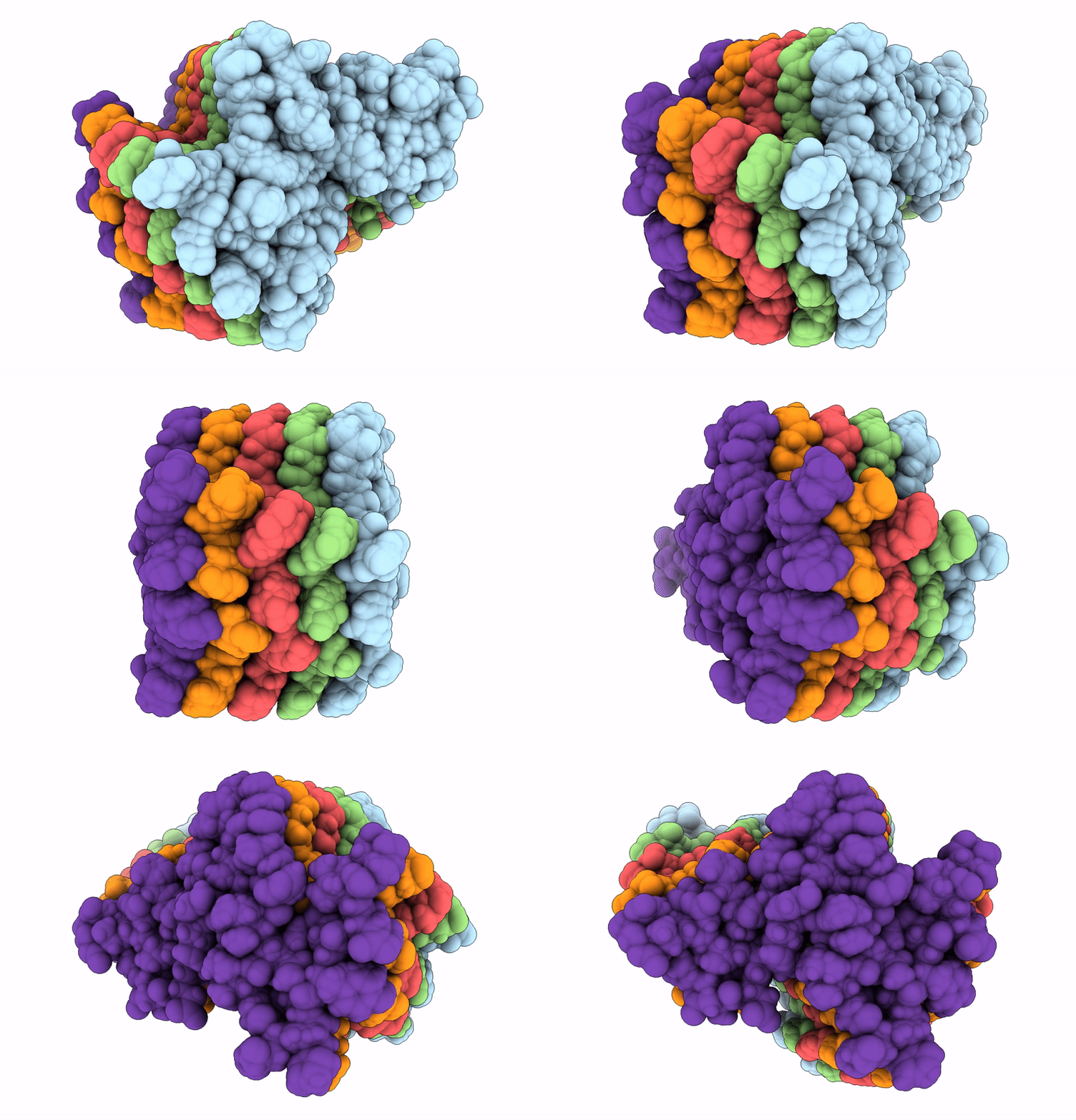
9M6M image
Deposition Date 2025-03-07
Release Date 2025-10-22
Last Version Date 2026-04-01
Entry Detail
PDB ID:
9M6M
Keywords:
Title:
Atomic-Level Architecture and Assembly Mechanism of High-order Structures of RIPK1 Fibril Network Revealed by Integrated Structural Biology
Biological Source:
Source Organism(s):
Mus musculus (Taxon ID: 10090)
Expression System(s):
Method Details:
Experimental Method:
Conformers Calculated:
192
Conformers Submitted:
10
Selection Criteria:
structures with the lowest energy
Macromolecular Entities
Structures with similar UniProt ID
Protein Blast
Polymer Type:polypeptide(L)
Molecule:Receptor-interacting serine/t
Gene (Uniprot):Ripk1
Chain IDs:A, B, C, D, E
Chain Length:25
Number of Molecules:5
Biological Source:Mus musculus
Ligand Molecules
Primary Citation
Atomic-level architecture and assembly mechanism of high-order structures of RIPK1 fibril revealed by integrated structural biology.
Proc. Natl. Acad. Sci. U.S.A. 123 e2529157123 e2529157123 (2026)
PMID: 41855259 DOI: 10.1073/pnas.2529157123

Abstact

Receptor-interacting serine/threonine-protein kinase 1 (RIPK1) regulates cell death pathways through RHIM domain-mediated amyloid fibril formation. While amyloid fibrils typically exist as single filaments, we identified a higher-order architecture-the mouse RIPK1 (mRIPK1) fibril network-formed by the self-assembly of mRIPK1 fibrils into quadrilateral/hexagonal lattices under slightly acidic conditions. Using an integrative approach combining solid-state NMR, transmission electron microscopy, atomic force microscopy, X-ray diffraction, Cryo-electron tomography, and molecular dynamics simulations, we elucidated the atomic structure and assembly mechanism of this network. In this study, solid-state NMR analysis demonstrates that the mRIPK1 fibril core adopts an N-shaped parallel beta-sheet conformation, with dynamic regions flanking the fibril core that likely participate in network formation. We propose that the electrostatic interactions between fibril core edge residues D516-K519 or D537-K519 are essential for the network formation, with proper positioning and exposure for interaction determined by the fibril structure and the length of the dynamic flexible domain, particularly the periodic twist of the fibril. Site-directed mutagenesis confirms the critical role of these edge residues in maintaining network integrity. This study presents an atomic model of a higher-order assembly formed by naturally occurring amyloid fibrils, offers fundamental insights into hierarchical fibril assembly, and establishes a framework for designing engineered amyloid-based materials.

Legend

Protein

Chemical

Disease

Primary Citation of related structures
Feedback Form
Name
Email
Institute
Feedback