

9LZ1 image
Deposition Date 2025-02-21
Release Date 2026-03-11
Last Version Date 2026-09-23
Entry Detail
PDB ID:
9LZ1
Title:
Cryo-EM structure of PTH1R-beta-arrestin1 complex in state 2
Biological Source:
Source Organism(s):
Mus musculus (Taxon ID: 10090)
Homo sapiens (Taxon ID: 9606)
Bos taurus (Taxon ID: 9913)
synthetic construct (Taxon ID: 32630)
Method Details:
Experimental Method:
Resolution:
3.20 Å
Aggregation State:
PARTICLE
Reconstruction Method:
SINGLE PARTICLE
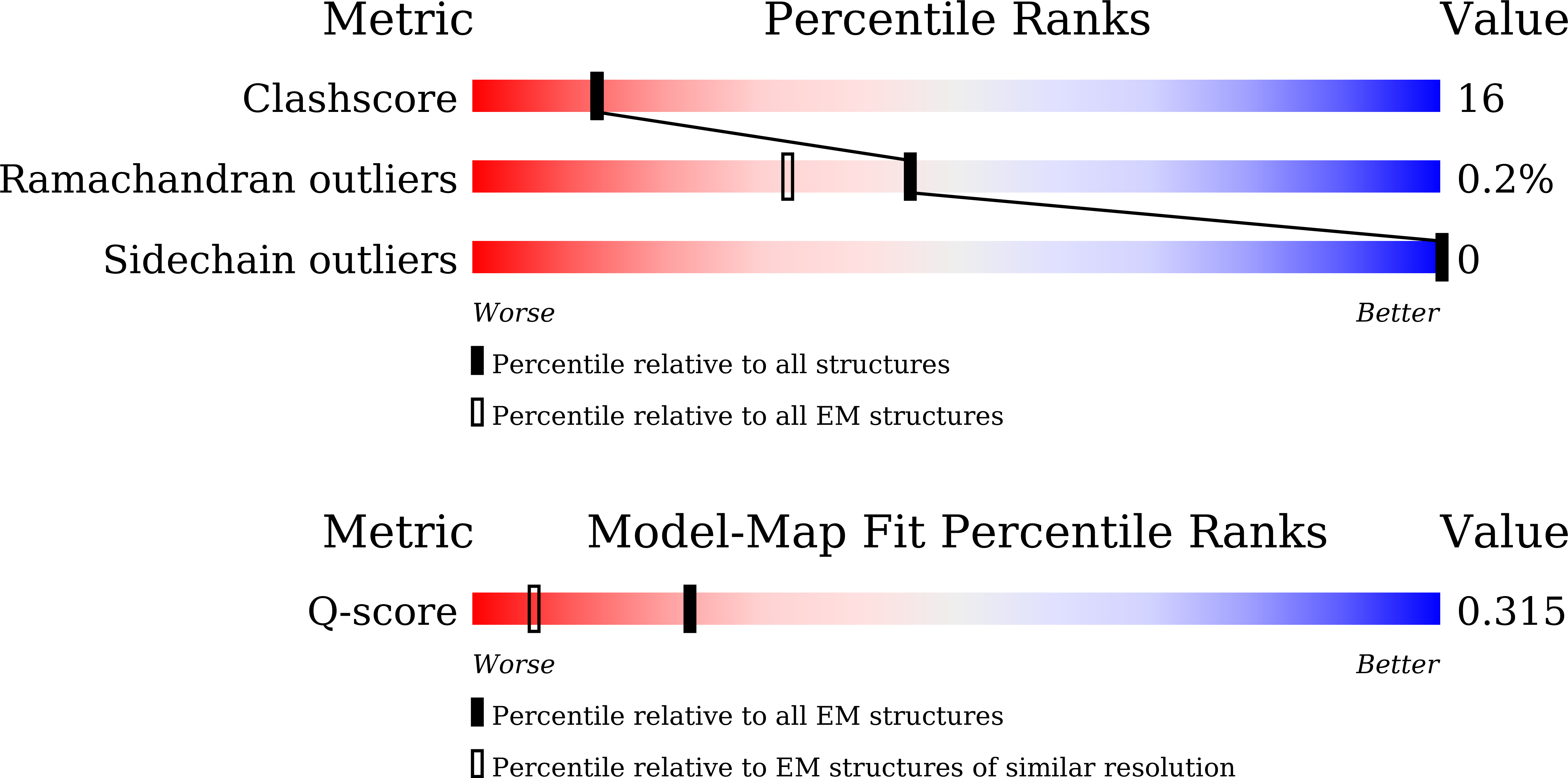
Macromolecular Entities
Polymer Type:polypeptide(L)
Molecule:Beta-arrestin-1
Gene (Uniprot):ARRB1
Chain IDs:E (auth: A)
Chain Length:0
Number of Molecules:1
Biological Source:Bos taurus
Polymer Type:polypeptide(L)
Molecule:Fab30 heavy chain
Chain IDs:A (auth: H)
Chain Length:0
Number of Molecules:1
Biological Source:Mus musculus
Polymer Type:polypeptide(L)
Molecule:Fab30 light chain
Chain IDs:B (auth: L)
Chain Length:0
Number of Molecules:1
Biological Source:Mus musculus
Polymer Type:polypeptide(L)
Molecule:Long-acting PTH
Chain IDs:C (auth: P)
Chain Length:0
Number of Molecules:1
Biological Source:synthetic construct
Polymer Type:polypeptide(L)
Molecule:Parathyroid hormone/parathyro
Gene (Uniprot):PTH1R
Chain IDs:D (auth: R)
Chain Length:0
Number of Molecules:1
Biological Source:Homo sapiens
Modified Residue
Compound ID Chain ID Parent Comp ID Details 2D Image
SEP D SER modified residue
TPO D THR modified residue
Ligand Molecules
Primary Citation
Core conformation of arrestin coupling to parathyroid hormone type 1 receptor.
Nat Commun 17 ? ? (2026)
PMID: 42034616 DOI: 10.1038/s41467-026-72448-y

Abstact

The recruitment of beta-arrestin (betaarr) by G-protein-coupled receptor (GPCR) holds imperative importance in physiological processes, while the mechanisms underlying arrestin engagement with receptors remain obscure. The parathyroid hormone type 1 receptor (PTH1R), as a prototypical class B1 receptor, incorporates arrestin for signaling and regulates G-protein signaling by distinct mechanisms. Here, we report three cryo-electron microscopy structures of beta-arrestin1 (betaarr1) engaged with the activated wild-type and chimeric PTH1R in core conformation, revealing a distinctive binding mode of betaarr1 coupling to PTH1R compared to other GPCRs. In addition to the pronounced kinking of transmembrane (TM) 6, betaarr1 establishes extensive interactions with the core cavity of PTH1R by promoting the outward movement of TM5 and intracellular loop (ICL) 2, stabilizing the core conformation of the complex. Further, our work shows that the core coupling mode of betaarr with PTH1R mediates receptor internalization and trafficking. Collectively, our work offers a paradigm for the arrestin coupling to class B1 GPCR and regulating the signaling transduction.

Legend

Protein

Chemical

Disease

Primary Citation of related structures
Feedback Form
Name
Email
Institute
Feedback