

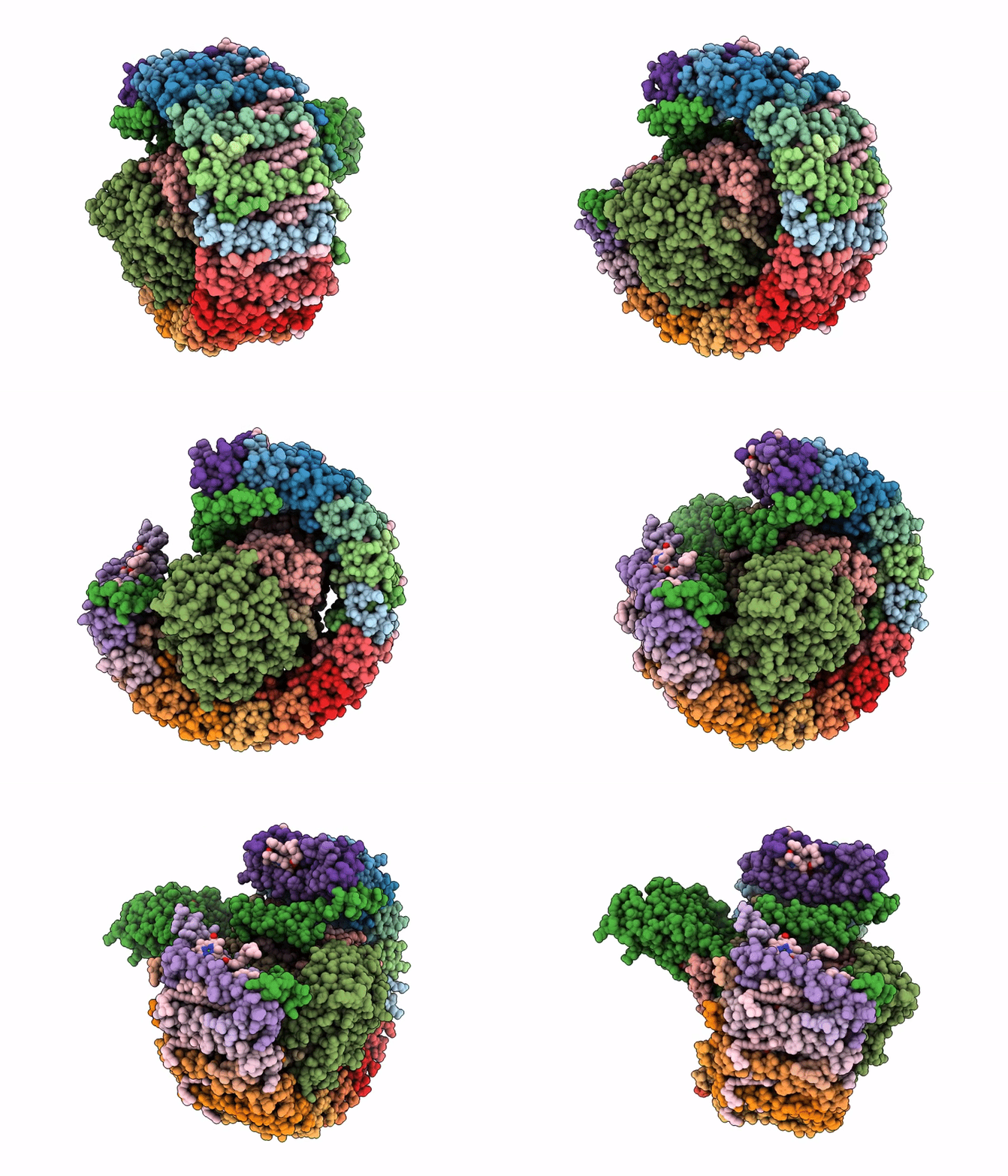
9LTV image
Deposition Date 2025-02-06
Release Date 2025-10-01
Last Version Date 2026-04-15
Entry Detail
PDB ID:
9LTV
Keywords:
Title:
Cryo-EM structure of the Dinoroseobacter shibae RC-LH1 supercomplex with incomplete LH1 ring(State 2)
Biological Source:
Source Organism(s):
Method Details:
Experimental Method:
Resolution:
2.00 Å
Aggregation State:
PARTICLE
Reconstruction Method:
SINGLE PARTICLE
Macromolecular Entities
Structures with similar UniProt ID
Protein Blast
Polymer Type:polypeptide(L)
Molecule:Antenna pigment protein beta
Gene (Uniprot):pufB
Chain IDs:A (auth: 0), C (auth: 2), E (auth: 4), G (auth: 6), I (auth: 8), Q (auth: b), S (auth: d), U (auth: f), W (auth: h), Y (auth: j), AA (auth: l), CA (auth: n), EA (auth: p), GA (auth: x)
Chain Length:44
Number of Molecules:14
Biological Source:Dinoroseobacter shibae DFL 12 = DSM 16493
Structures with similar UniProt ID
Protein Blast
Polymer Type:polypeptide(L)
Molecule:Antenna pigment protein alpha
Gene (Uniprot):pufA
Chain IDs:B (auth: 1), D (auth: 3), F (auth: 5), H (auth: 7), J (auth: 9), P (auth: a), R (auth: c), T (auth: e), V (auth: g), X (auth: i), Z (auth: k), BA (auth: m), DA (auth: o), FA (auth: w)
Chain Length:51
Number of Molecules:14
Biological Source:Dinoroseobacter shibae DFL 12 = DSM 16493
Structures with similar UniProt ID
Protein Blast
Polymer Type:polypeptide(L)
Molecule:Protein LRC
Gene (Uniprot):Dshi_1314
Chain IDs:K (auth: A)
Chain Length:51
Number of Molecules:1
Biological Source:Dinoroseobacter shibae DFL 12 = DSM 16493
Structures with similar UniProt ID
Protein Blast
Polymer Type:polypeptide(L)
Molecule:Photosynthetic reaction cente
Gene (Uniprot):pufC
Chain IDs:L (auth: C)
Chain Length:357
Number of Molecules:1
Biological Source:Dinoroseobacter shibae DFL 12 = DSM 16493
Structures with similar UniProt ID
Protein Blast
Polymer Type:polypeptide(L)
Molecule:Reaction center protein H cha
Gene (Uniprot):puhA
Chain IDs:M (auth: H)
Chain Length:255
Number of Molecules:1
Biological Source:Dinoroseobacter shibae DFL 12 = DSM 16493
Structures with similar UniProt ID
Protein Blast
Polymer Type:polypeptide(L)
Molecule:Reaction center protein L cha
Gene (Uniprot):pufL
Chain IDs:N (auth: L)
Chain Length:44
Number of Molecules:1
Biological Source:Dinoroseobacter shibae DFL 12 = DSM 16493
Structures with similar UniProt ID
Protein Blast
Polymer Type:polypeptide(L)
Molecule:Reaction center protein M cha
Gene (Uniprot):pufM
Chain IDs:O (auth: M)
Chain Length:51
Number of Molecules:1
Biological Source:Dinoroseobacter shibae DFL 12 = DSM 16493
Primary Citation
Structural basis for aerobic anoxygenic photosynthesis in the reaction center-light-harvesting 1 (RC-LH1) supercomplex of Dinoroseobacter shibae.
Commun Biol 8 1565 1565 (2025)
PMID: 41238682 DOI: 10.1038/s42003-025-08935-7

Abstact

Aerobic anoxygenic phototrophic (AAP) bacteria are essential for oceanic carbon cycling. However, their architecture and structural adaptations of their photosynthetic systems to ensure adequate light harvesting, electron transport, and oxidative resilience in oxygen-rich environments remain poorly understood. In this study, we present a 2.4-A cryo-EM structure of the reaction center-light-harvesting 1 (RC-LH1) supercomplex from Dinoroseobacter shibae DFL-12, a marine AAP bacterial symbiont of benthic dinoflagellates. This RC-LH1 supercomplex features a closed LH1 ring comprising 17 alphabeta-subunits, each containing two spheroidenones per alphabeta-heterodimer-a previously unreported configuration in phototrophic bacteria. The cytochrome subunit of the RC is truncated to three hemes, in contrast to the four-heme configuration found in anaerobic relatives. The structure also reveals elongated bacteriochlorophyll (BChl) spacing, which may account for its blue-shifted absorption maximum that is optimized for low-light benthic environments. Furthermore, we identify a previously unknown subunit, protein-LRC, which is hypothesized to functionally couple photochemical and respiratory electron transport. Collectively, these specific structural features allow AAP bacteria to balance anoxygenic photosynthesis and protection against oxidative damage, providing a mechanistic framework for them to thrive in oxygenated marine environments. Our study provides insights into the structural and functional variability of bacterial photosynthesis in response to oxygenated marine environments.

Legend

Protein

Chemical

Disease

Primary Citation of related structures
Feedback Form
Name
Email
Institute
Feedback