

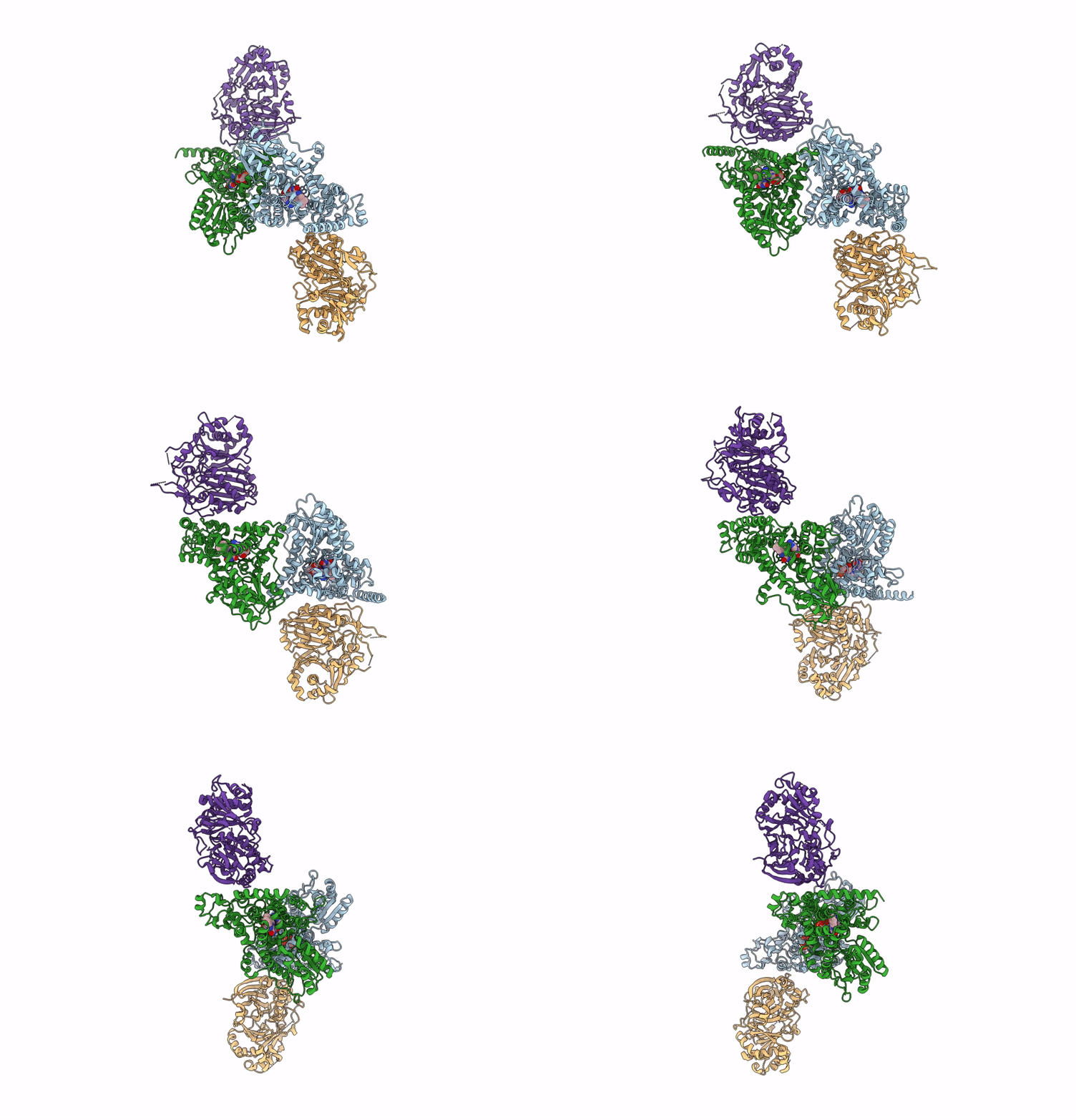
9LPG image
Deposition Date 2025-01-24
Release Date 2025-11-05
Last Version Date 2026-05-27
Entry Detail
PDB ID:
9LPG
Keywords:
Title:
Crystal structure of maize CRY-GL2 photosignaling complex
Biological Source:
Source Organism(s):
Zea mays (Taxon ID: 4577)
Expression System(s):
Method Details:
Experimental Method:
Resolution:
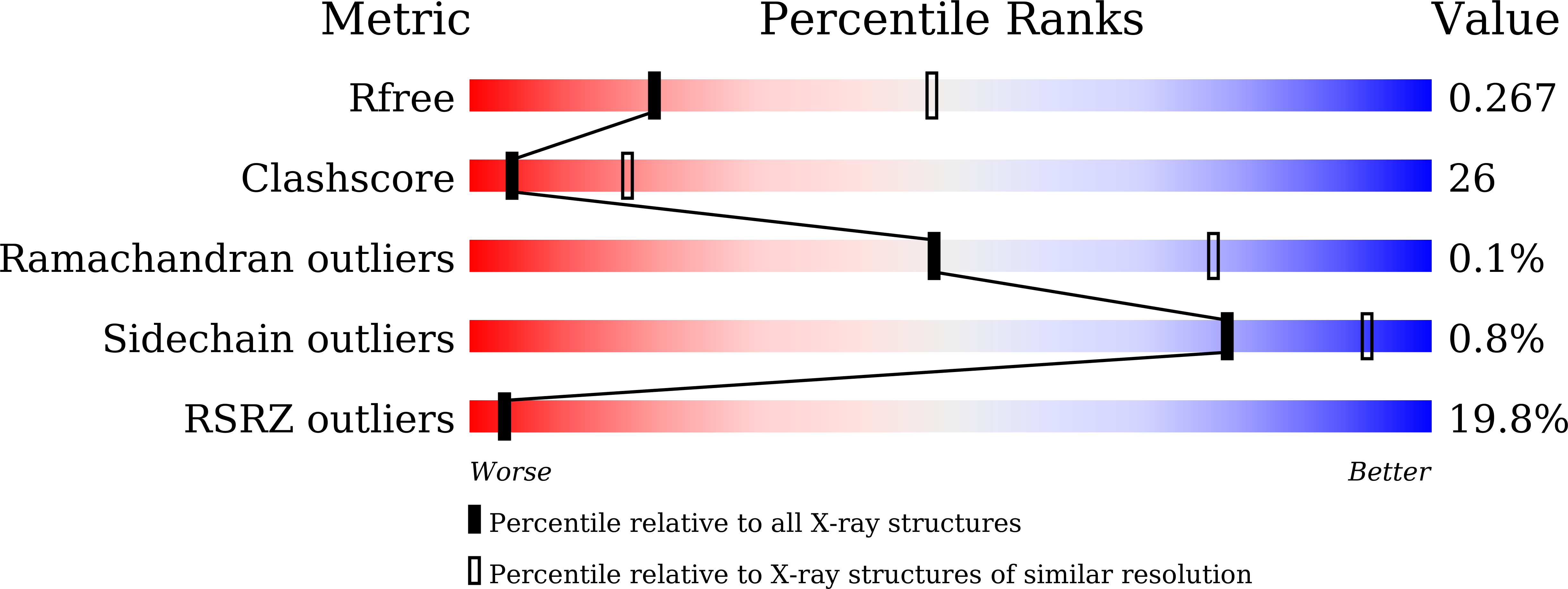
2.80 Å
R-Value Free:
0.26
R-Value Work:
0.23
R-Value Observed:
0.23
Space Group:
C 2 2 21
Macromolecular Entities
Structures with similar UniProt ID
Protein Blast
Polymer Type:polypeptide(L)
Molecule:Cryptochrome2
Gene (Uniprot):LOC100194126
Mutagens:W368A
Chain IDs:A, C (auth: B)
Chain Length:688
Number of Molecules:2
Biological Source:Zea mays
Structures with similar UniProt ID
Protein Blast
Polymer Type:polypeptide(L)
Molecule:Protein ECERIFERUM 26-like
Gene (Uniprot):LOC103645956
Chain IDs:B (auth: E), D (auth: F)
Chain Length:426
Number of Molecules:2
Biological Source:Zea mays
Ligand Molecules
Primary Citation
Structural assembly of maize CRY-GL2 photosignaling complex provides insights into its regulatory role in cuticular wax biosynthesis.
Sci Adv 11 eadz0136 eadz0136 (2025)
PMID: 41337597 DOI: 10.1126/sciadv.adz0136

Abstact

Plant cryptochromes (CRYs) are blue-light photoreceptors regulating physiological processes via oligomerization-dependent interaction with effectors. However, the structural basis for photoactivated CRY-effector assembly remains elusive. Here, we report the crystal structure of an active maize CRY1c photolyase homology region in complex with GLOSSY2 (ZmGL2), a BAHD acyltransferase family protein that could form an enzyme complex with ECERIFERUM6 (ZmCER6) and direct very-long-chain fatty acid elongation in cuticular wax biosynthesis. Light-activated CRY1c forms a homotetrameric scaffold. Each protomer binds one ZmGL2 molecule via conformational changes, forming a 4:4 hetero-octameric photosignaling complex. Structural alignment shows 78% overlap between the GL2-binding interfaces in the ZmCRY1c-ZmGL2 and ZmCER6-ZmGL2 complexes. Biochemically, CRY1c dose-dependently inhibits ZmCER6-ZmGL2 enzyme activity, unveiling a light-dependent regulatory switch modulating very-long-chain fatty acid elongation efficiency. Our work establishes the atomic model for light-activated CRY-effector assembly and uncovers spatial competition between photoreceptor and metabolic enzyme complexes as a photoregulatory paradigm in wax biosynthesis.

Legend

Protein

Chemical

Disease

Primary Citation of related structures
Feedback Form
Name
Email
Institute
Feedback