

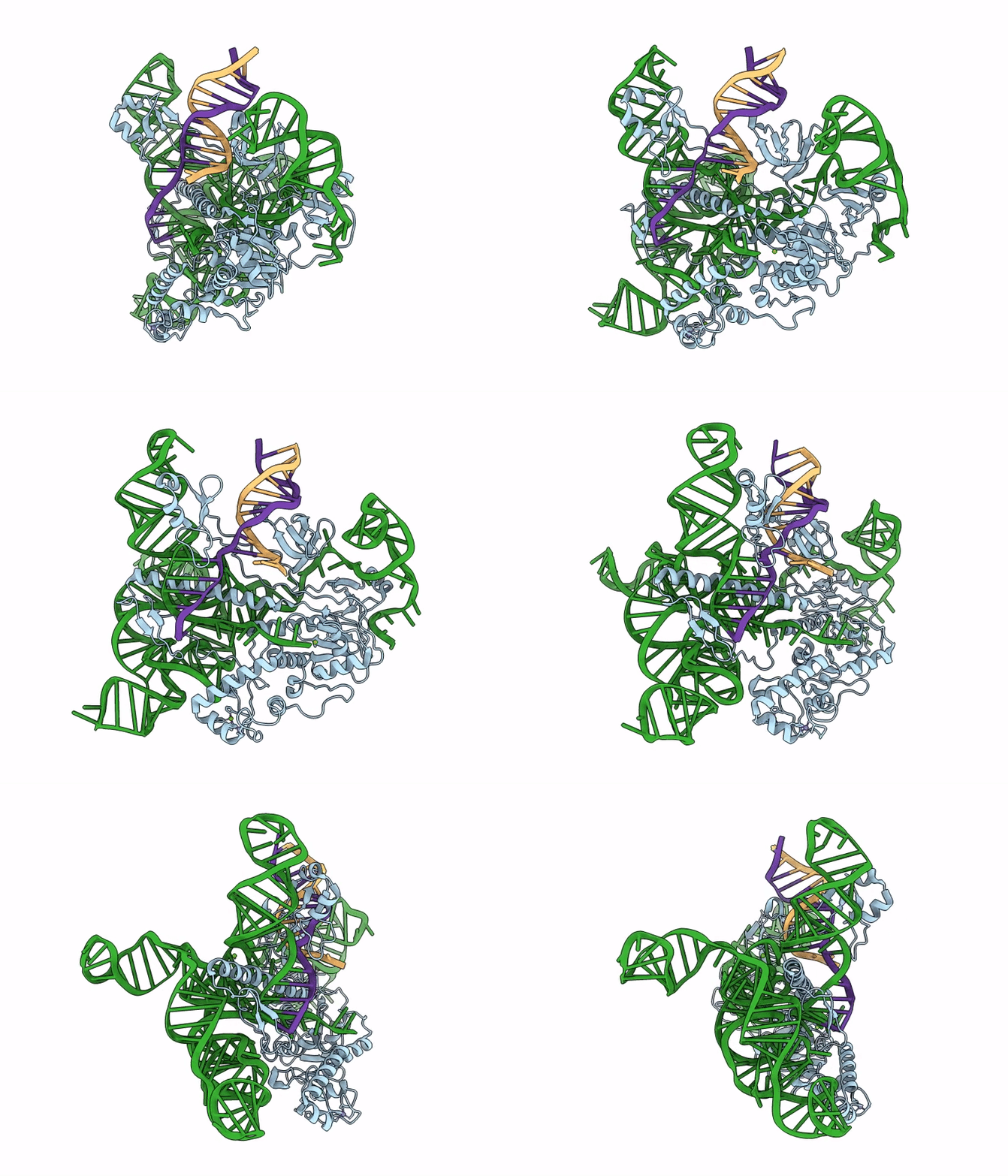
9LIS image
Deposition Date 2025-01-14
Release Date 2026-01-21
Last Version Date 2026-04-29
Entry Detail
PDB ID:
9LIS
Title:
CryoEM Structures Uncover the Unexpected Hinges of IscB for Enhanced Gene Editing
Biological Source:
Source Organism(s):
Expression System(s):
Method Details:
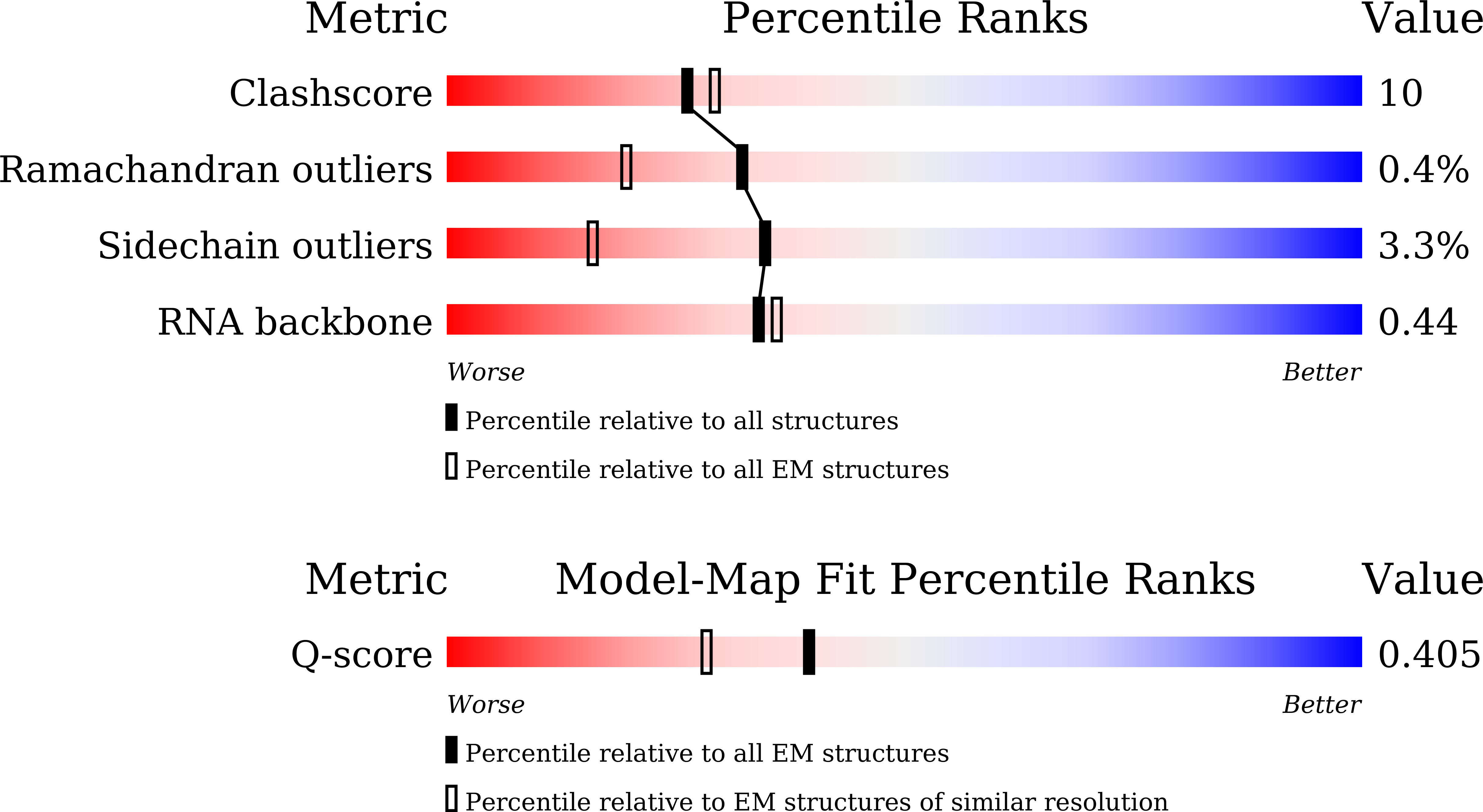
Experimental Method:
Resolution:
3.39 Å
Aggregation State:
PARTICLE
Reconstruction Method:
SINGLE PARTICLE
Macromolecular Entities
Protein Blast
Polymer Type:polypeptide(L)
Molecule:Iscb
Chain IDs:A
Chain Length:547
Number of Molecules:1
Biological Source:synthetic construct
Polymer Type:polyribonucleotide
Molecule:RNA (190-MER)
Chain IDs:B
Chain Length:190
Number of Molecules:1
Biological Source:synthetic construct
Polymer Type:polydeoxyribonucleotide
Molecule:DNA (5'-D(P*CP*TP*CP*AP*AP*CP
Chain IDs:C
Chain Length:13
Number of Molecules:1
Biological Source:synthetic construct
Polymer Type:polydeoxyribonucleotide
Molecule:DNA (5'-D(P*CP*TP*AP*GP*GP*TP
Chain IDs:D
Chain Length:17
Number of Molecules:1
Biological Source:synthetic construct
Primary Citation
Structural insight into IscB's RNA-lid-based inactivation mechanism.
Nat.Struct.Mol.Biol. 33 603 614 (2026)
PMID: 41882346 DOI: 10.1038/s41594-026-01761-3

Abstact

IscB, a compact Cas9 ancestor from the obligate mobile element guided activity system, has attracted growing interest as a programmable genome editor because of its small size and therapeutic delivery potential. Despite its promise, structural insights into IscB's regulation remain limited, with only a target-bound R-loop structure previously reported. Here, we present the structural trajectory of an engineered IscB, capturing its transition from a resting state to activation. Using cryo-electron microscopy, we resolve four high-resolution structures: the apo resting state, two intermediate complexes with 6-nt and 10-nt guide-target pairing and a fully paired 16-nt primed cleavage state. These structures uncover a dual inactivation mechanism mediated by RNA lids; the omegaRNA lid blocks HNH domain access, while the guide RNA lid occludes the RuvC active site. As guide-target pairing progresses, the guide RNA undergoes a stepwise displacement, mimicking a 'car pedal' motion that triggers activation at 11-nt pairing. The HNH domain also contributes to R-loop stabilization through a positively charged R-wedge motif and undergoes a ~90 degrees activation-driven rotation mediated by two hinge regions. In variants IscBHig1 and IscBHig2, engineering these hinge motifs to enhance conformational flexibility notably improved genome-editing efficiency in cells. In summary, our study reveals the molecular basis underlying IscB autoinhibition and activation, identifies previously uncharacterized regulatory features and establishes hinge elements as a target region for engineering compact, efficient genome editors.

Legend

Protein

Chemical

Disease

Primary Citation of related structures
Feedback Form
Name
Email
Institute
Feedback