

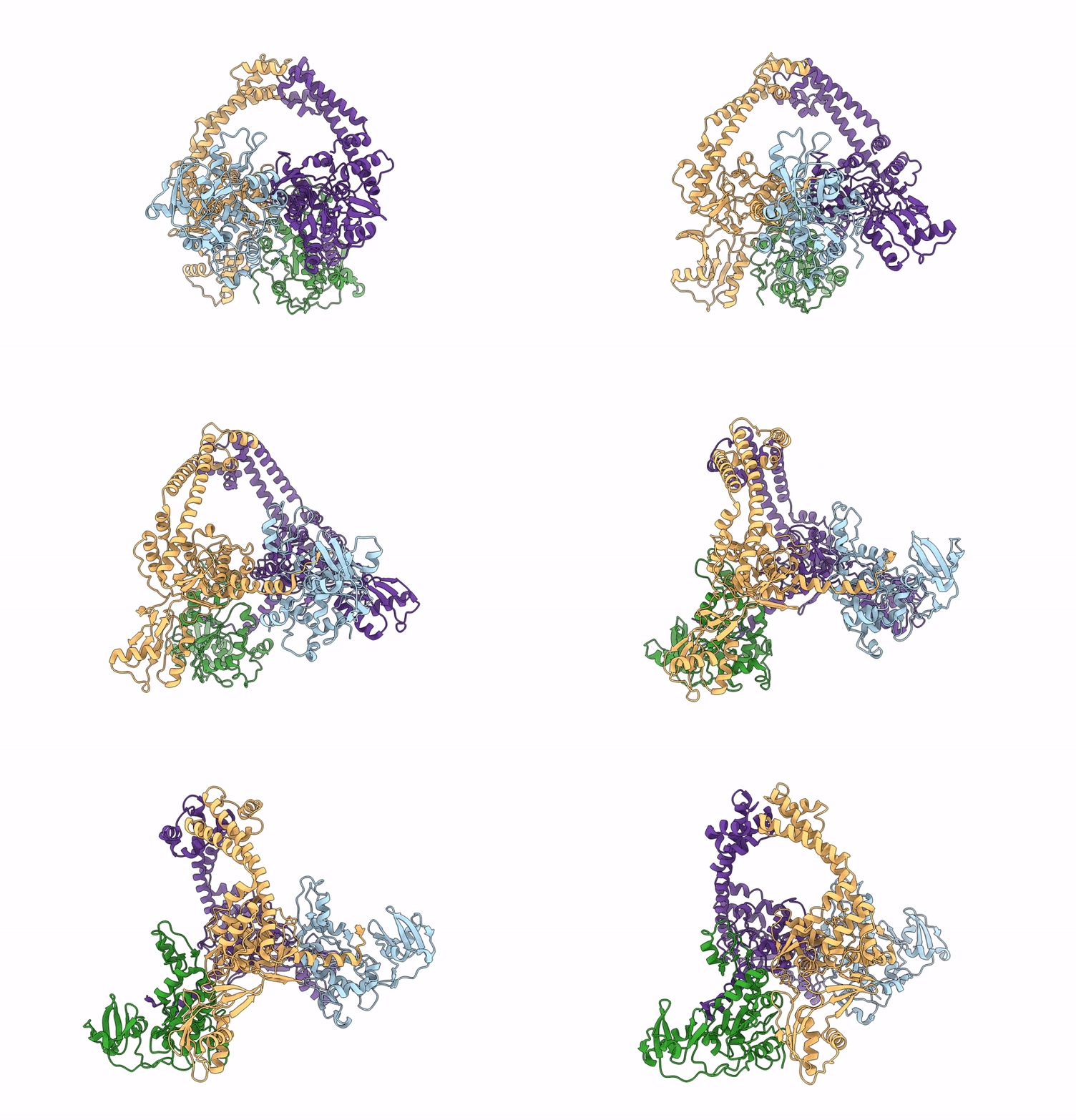
9LII image
Deposition Date 2025-01-14
Release Date 2025-11-26
Last Version Date 2026-04-15
Entry Detail
PDB ID:
9LII
Keywords:
Title:
structure of phage T4 topoisomerase II central domain
Biological Source:
Source Organism(s):
Expression System(s):
Method Details:
Experimental Method:
Resolution:
3.06 Å
Aggregation State:
PARTICLE
Reconstruction Method:
SINGLE PARTICLE
Macromolecular Entities
Protein Blast
Polymer Type:polypeptide(L)
Molecule:DNA topoisomerase large subun
Gene (Uniprot):39, 60
Chain IDs:B (auth: A), D (auth: B)
Chain Length:682
Number of Molecules:2
Biological Source:Enterobacteria phage T4
Structures with similar UniProt ID
Protein Blast
Polymer Type:polypeptide(L)
Molecule:DNA topoisomerase medium subu
Gene (Uniprot):52
Chain IDs:A (auth: C), C (auth: D)
Chain Length:452
Number of Molecules:2
Biological Source:Enterobacteria phage T4
Ligand Molecules
Primary Citation
Direct trapping of the transport-segment DNA by the central domain of type IIA topoisomerases.
Sci Adv 11 eadw2839 eadw2839 (2025)
PMID: 41406217 DOI: 10.1126/sciadv.adw2839

Abstact

Type IIA topoisomerases modulate DNA topology by coordinating the cleavage of gate-segment DNA and the passage of transport-segment DNA-a mechanism conserved across species and essential for diverse cellular processes. While gate-segment interactions have been extensively studied, direct structural evidence of transport-segment capture has remained elusive, limiting our understanding of the full catalytic cycle. Here, we present a cryo-electron microscopy structure of the T4 bacteriophage topoisomerase II with a transport-segment DNA bound directly to its central domain. The structure reveals conformational rearrangements in the central domain that accommodate the transport-segment DNA, suggesting an alternative sequence of events in which the enzyme sliding along the loosely bound religated gate segment may precede transport-segment passage through the coiled-coil gate. Supported by mutational and biochemical assays, our findings provide previously unidentified mechanistic insights and open potential avenues for the development of next-generation type IIA topoisomerase inhibitors.

Legend

Protein

Chemical

Disease

Primary Citation of related structures
Feedback Form
Name
Email
Institute
Feedback