

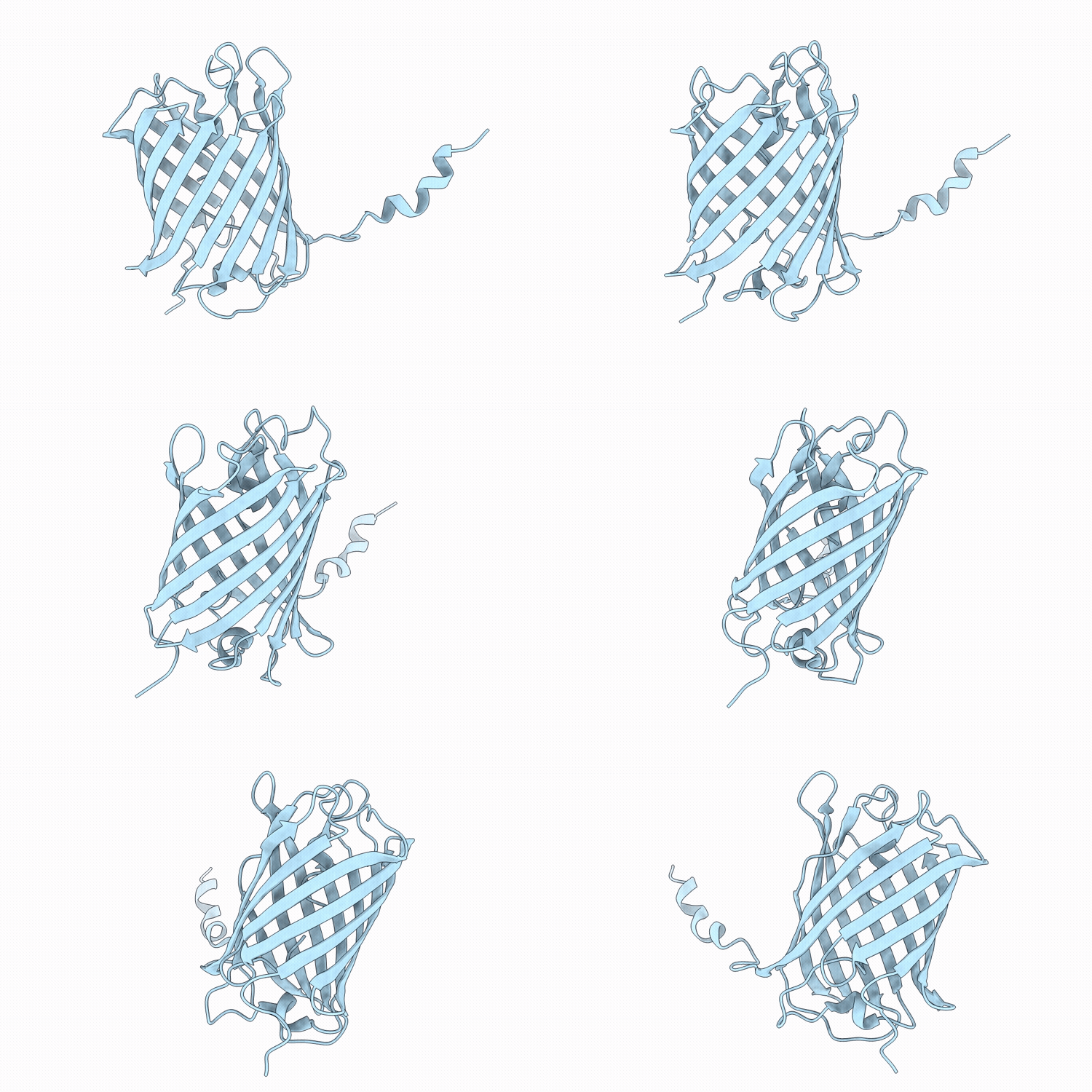
9LD8 image
Deposition Date 2025-01-05
Release Date 2026-04-22
Last Version Date 2026-06-17
Entry Detail
PDB ID:
9LD8
Title:
Crystal structure of LSSmOrange under room temperature at pH 8.0
Biological Source:
Source Organism(s):
Discosoma sp. (Taxon ID: 86600)
Expression System(s):
Method Details:
Experimental Method:
Resolution:
1.70 Å
R-Value Free:
0.20
R-Value Work:
0.16
R-Value Observed:
0.16
Space Group:
P 1 21 1

Macromolecular Entities
Structures with similar UniProt ID
Protein Blast
Polymer Type:polypeptide(L)
Molecule:mOrange
Chain IDs:A
Chain Length:241
Number of Molecules:1
Biological Source:Discosoma sp.
Modified Residue
Compound ID Chain ID Parent Comp ID Details 2D Image
OFM A PHE chromophore
Primary Citation

Abstact

LSSmOrange is a fluorescent protein that exhibits slow photoconversion and is used as an imaging tool to highlight specific subpopulations of molecules. While photoconversion in LSSmOrange is known to involve Kolbe decarboxylation of the E215 side chain, its structural dynamics remain unexplored. We addressed the excited state dynamics of LSSmOrange by using serial femtosecond crystallography (SFX) with an X-ray free electron laser. SFX enabled us to determine the crystal structure of unconverted LSSmOrange without detectable X-ray damage, facilitating a femtosecond optical pumpX-ray probe experiment to track time-resolved structural changes. A decrease in electron density at E215 was observed 250 ps after strong pump laser illumination (mean fluence of 0.31 J/cm(2)), consistent with photoconversion by decarboxylation. Extrapolated structures suggested the appearance of an alternative E215 conformation in addition to illumination-induced decarboxylation. Since the photoinduced decarboxylation occurred despite the extremely low single-photon photoconversion quantum yield of LSSmOrange (8.5 x 10(-6)), we hypothesized that the photoconversion proceeds via a multiphoton process. Power titration using transient absorption spectroscopy revealed that photoconversion was linked to optical nonlinearity under a high pump laser energy. We propose that LSSmOrange photoconversion involves a higher-lying electronic excited state triggered by multiphoton absorption, as supported by quantum-chemical calculations. Photoconversion via a multiphoton process enables spatially confined highlighting on a microscope.

Legend

Protein

Chemical

Disease

Primary Citation of related structures
Feedback Form
Name
Email
Institute
Feedback