

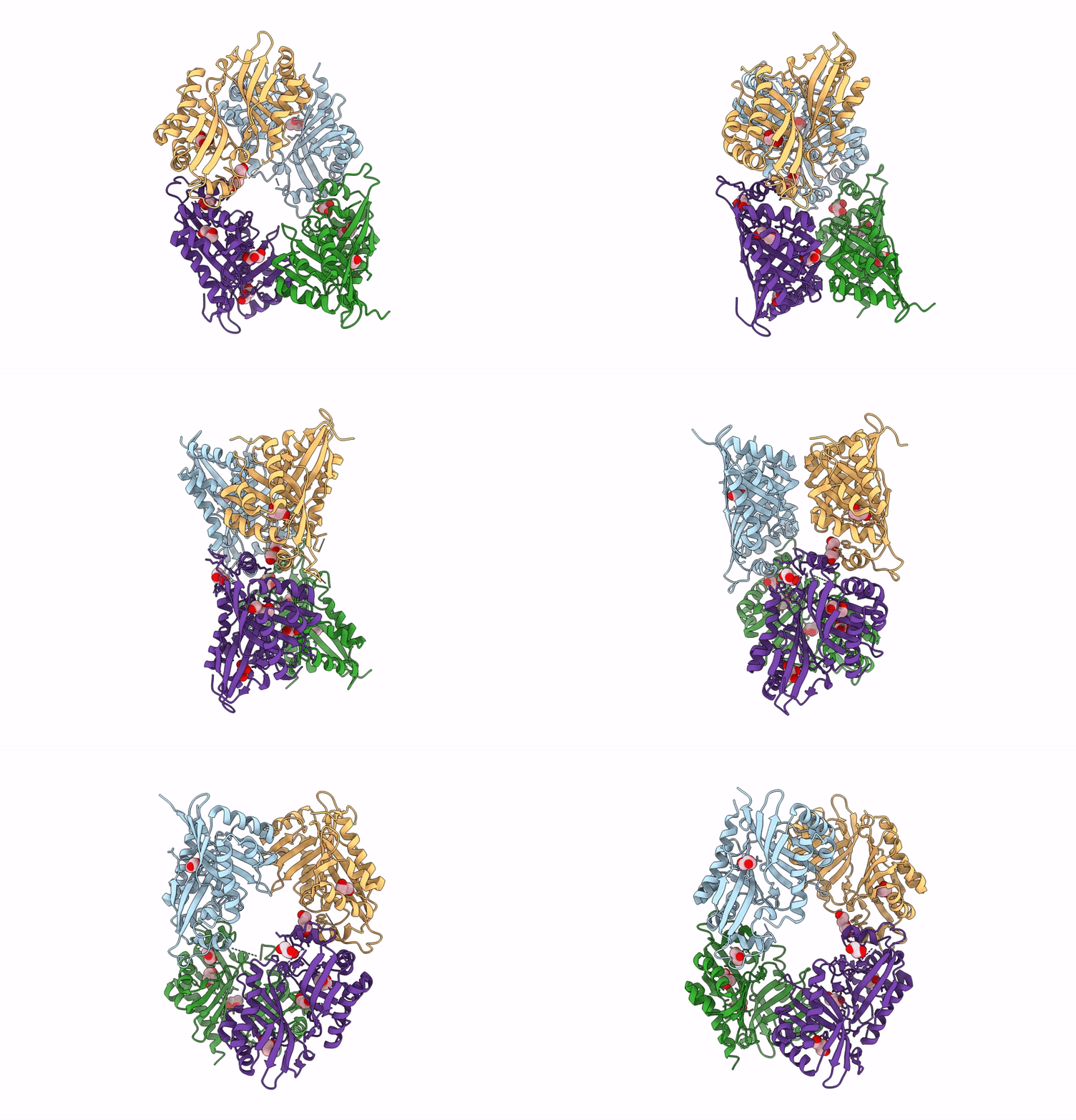
9KW6 image
Deposition Date 2024-12-05
Release Date 2025-12-10
Last Version Date 2026-04-29
Entry Detail
PDB ID:
9KW6
Keywords:
Title:
Polyether epoxide hydrolase MonBI-MonBII complex
Biological Source:
Source Organism(s):
Expression System(s):
Method Details:
Experimental Method:
Resolution:
3.01 Å
R-Value Free:
0.23
R-Value Work:
0.17
R-Value Observed:
0.17
Space Group:
P 21 21 2
Macromolecular Entities
Protein Blast
Polymer Type:polypeptide(L)
Molecule:MonBI,MonBII
Gene (Uniprot):monBI, monBII
Chain IDs:A, B, D
Chain Length:302
Number of Molecules:3
Biological Source:Streptomyces virginiae
Protein Blast
Polymer Type:polypeptide(L)
Molecule:MonBI,MonBII
Gene (Uniprot):monBI, monBII
Chain IDs:C
Chain Length:302
Number of Molecules:1
Biological Source:Streptomyces virginiae
Primary Citation
A system of paired polyether epoxide hydrolases enables a mouldable enzyme for consecutive ring cyclization cascades.
Nat.Chem. ? ? ? (2026)
PMID: 41992003 DOI: 10.1038/s41557-026-02122-9

Abstact

Ionophore polyethers, a major class of polyketide-derived natural products, are characterized by molecular skeletons featuring arrays of tetrahydrofuran and tetrahydropyran rings. However, the precise mechanism underlying their biosynthesis, suggested to occur by a sequential epoxide-opening and ether cyclization cascade to generate more than two ether rings, remains elusive. Here we explore the biosynthesis of monensin and reveal the indispensability of a heterodimeric assembly of polyether epoxide hydrolases (MonBI.MonBII), with MonBII providing the sole active site. Structural analysis demonstrated that MonBII harbours an unusually large cavity, enabling the consecutive cyclization of substrates containing gamma-hydroxy triepoxide moieties. This cavity is formed by the remarkable flexibility of MonBII, which undergoes a dramatic structural transition from a predominantly disordered state to its active folded conformation exclusively in the presence of MonBI. Given the widespread conservation of MonBI- and MonBII-type enzymes, this study emphasizes a unified pairing mechanism, wherein one protomer functions as a molecular mould, facilitating the folding process and stabilizing the structure of its partner for catalysis.

Legend

Protein

Chemical

Disease

Primary Citation of related structures
Feedback Form
Name
Email
Institute
Feedback