

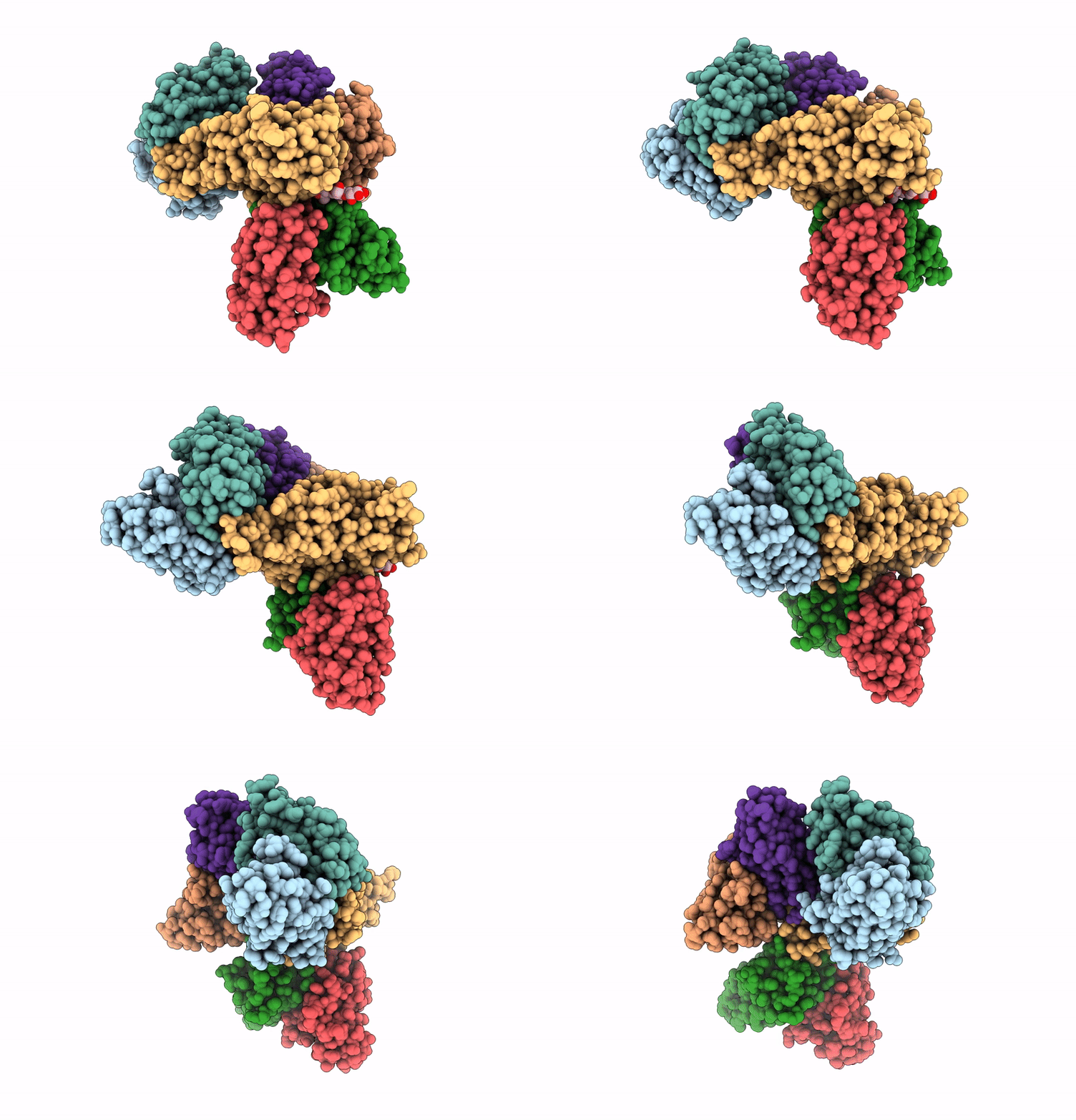
9KVK image
Deposition Date 2024-12-05
Release Date 2025-12-10
Last Version Date 2026-03-18
Entry Detail
PDB ID:
9KVK
Title:
Cryo-EM structure of SARS-CoV-2 spike protein in complex with three-nAb 8H12, 3E2 and 1C4
Biological Source:
Expression System(s):
Method Details:
Experimental Method:
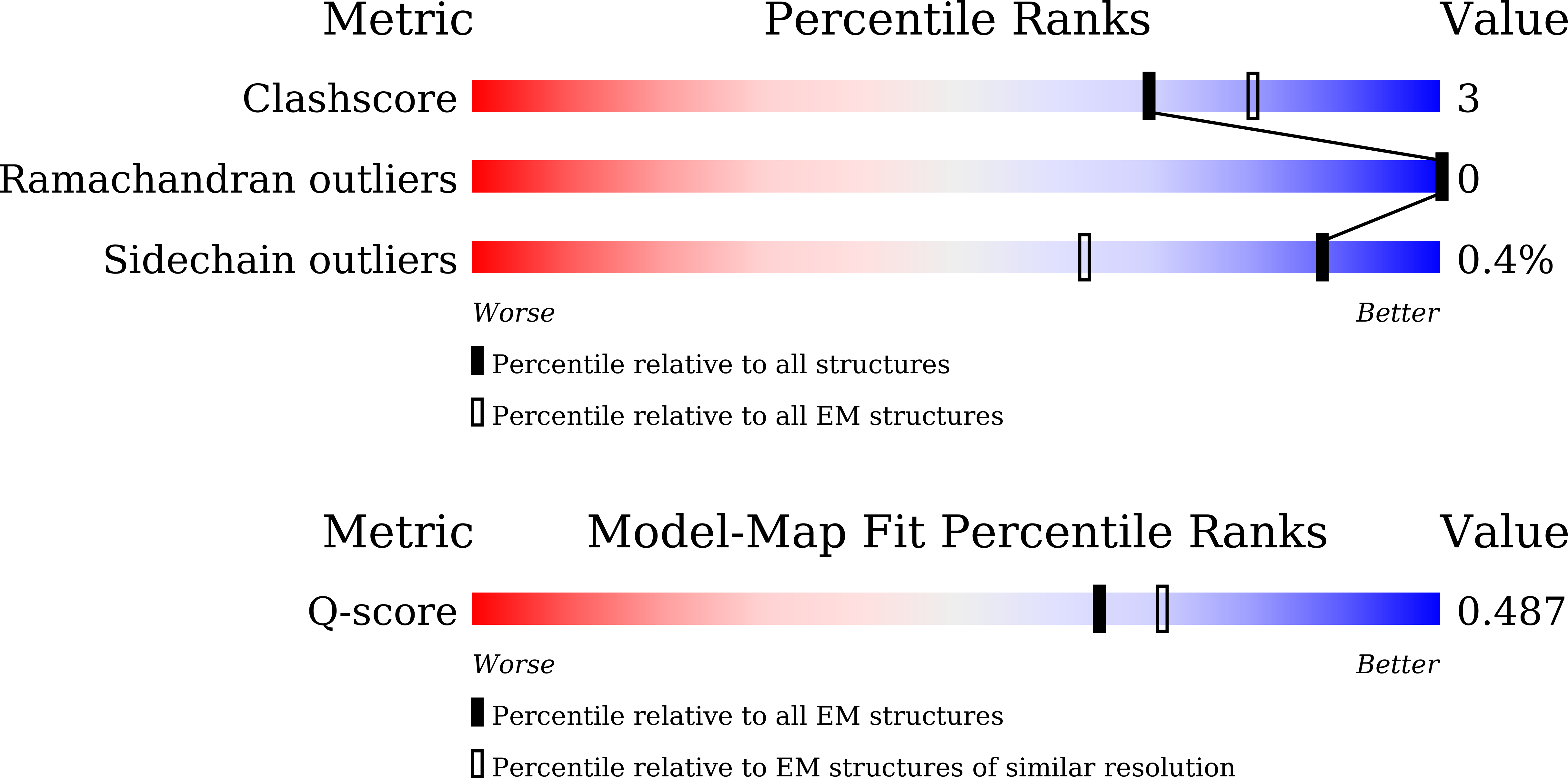
Resolution:
3.44 Å
Aggregation State:
PARTICLE
Reconstruction Method:
SINGLE PARTICLE
Macromolecular Entities
Protein Blast
Polymer Type:polypeptide(L)
Molecule:Heavy chain of nAb 8H12
Chain IDs:D (auth: A)
Chain Length:118
Number of Molecules:1
Biological Source:Mus musculus
Protein Blast
Polymer Type:polypeptide(L)
Molecule:Light chain of nAb 8H12
Chain IDs:C (auth: B)
Chain Length:107
Number of Molecules:1
Biological Source:Mus musculus
Protein Blast
Polymer Type:polypeptide(L)
Molecule:Heavy chain of nAb 8H12
Chain IDs:G (auth: C)
Chain Length:119
Number of Molecules:1
Biological Source:Mus musculus
Protein Blast
Polymer Type:polypeptide(L)
Molecule:Light chain of nAb 8H12
Chain IDs:F (auth: D)
Chain Length:107
Number of Molecules:1
Biological Source:Mus musculus
Structures with similar UniProt ID
Protein Blast
Polymer Type:polypeptide(L)
Molecule:Spike protein S1
Gene (Uniprot):S
Chain IDs:E (auth: G)
Chain Length:194
Number of Molecules:1
Biological Source:Severe acute respiratory syndrome coronavirus 2
Protein Blast
Polymer Type:polypeptide(L)
Molecule:Heavy chain of nAb 3E2
Chain IDs:B (auth: H)
Chain Length:121
Number of Molecules:1
Biological Source:Mus musculus
Protein Blast
Polymer Type:polypeptide(L)
Molecule:Light chain of nAb 3E2
Chain IDs:A (auth: L)
Chain Length:104
Number of Molecules:1
Biological Source:Mus musculus
Ligand Molecules
Primary Citation
Engineering a multivalent antibody nanoparticle to overcome SARS-CoV-2 Omicron immune evasion.
PLoS Pathog. 21 e1013744 e1013744 (2025)
PMID: 41359663 DOI: 10.1371/journal.ppat.1013744

Abstact

The rapid evolution of SARS-CoV-2 and the subsequent emergence of Omicron subvariants pose significant challenges to the efficacy of existing vaccines and therapeutics, including those previously reported most broad neutralizing antibodies (bnAbs). Here, we investigated the molecular basis of the altered neutralization profile of a bnAb, 1C4, against recent variants. 1C4 is effective against early variants from Alpha to Omicron BQ.1, but is circumvented by BQ.1.1, XBB and thereafter variants, primarily due to an additional R346T mutation that diminishes its binding affinity. Cryo-electron microscopy analysis revealed that despite the loss of neutralizing potency, 1C4 retained residual binding to the spike protein of immune-evasive variants such as XBB, which harbor altered receptor-binding domain (RBD). Furthermore, 1C4 exhibited a diminished capacity to inhibit ACE2 engagement with Omicron variants, amplifying the intricacies of viral immune evasion tactics. To address this, we employed the mi3-SpyCatcher-based nanoparticle to polymerize 1C4 (mi3-1C4), which reestablished the neutralization potency against recent variants by enhancing avidity via multivalent binding. Such multivalent binding can promote efficient spike aggregation as well as viral cross-linking, thereby providing enhanced protection against both the infection of Beta and XBB variants in a hamster model. Together, our findings delineate the molecular landscape of immune evasion by neutralizing antibodies and provide strategic insight for the adaptation of antibody engineering to keep pace with viral evolution.

Legend

Protein

Chemical

Disease

Primary Citation of related structures
Feedback Form
Name
Email
Institute
Feedback