

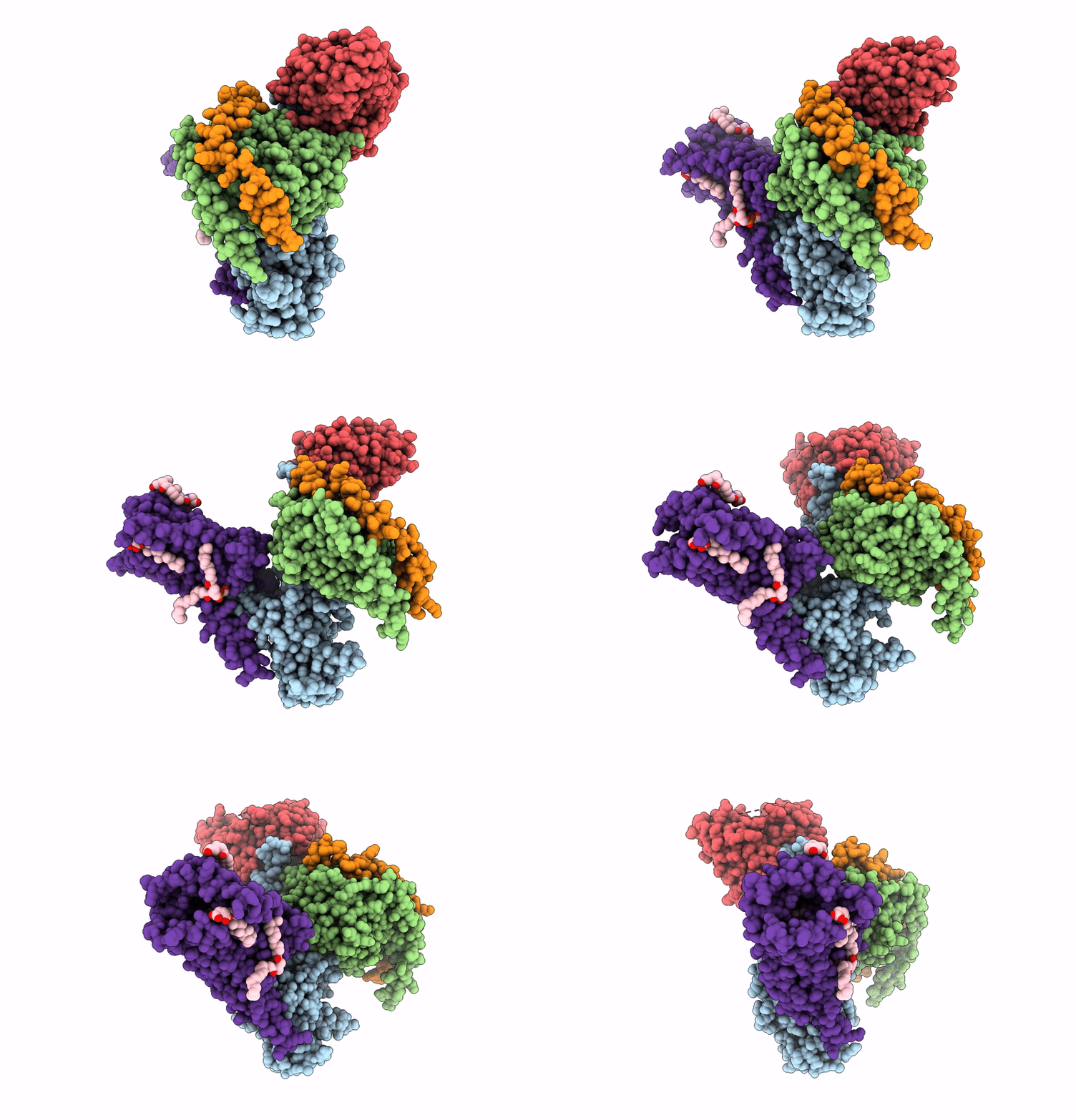
9KVG image
Deposition Date 2024-12-05
Release Date 2025-12-03
Last Version Date 2026-06-17
Entry Detail
PDB ID:
9KVG
Title:
A Cryo_EM structure of 5_HT1A complex with 5-Meo-DMT
Biological Source:
Source Organism(s):
Homo sapiens (Taxon ID: 9606)
Expression System(s):
Method Details:
Experimental Method:
Resolution:
2.63 Å
Aggregation State:
PARTICLE
Reconstruction Method:
SINGLE PARTICLE

Macromolecular Entities
Structures with similar UniProt ID
Protein Blast
Polymer Type:polypeptide(L)
Molecule:Guanine nucleotide-binding pr
Gene (Uniprot):GNAI1
Chain IDs:A
Chain Length:354
Number of Molecules:1
Biological Source:Homo sapiens
Structures with similar UniProt ID
Protein Blast
Polymer Type:polypeptide(L)
Molecule:Guanine nucleotide-binding pr
Gene (Uniprot):GNB1
Chain IDs:B
Chain Length:344
Number of Molecules:1
Biological Source:Homo sapiens
Protein Blast
Polymer Type:polypeptide(L)
Molecule:SCFV16
Chain IDs:C (auth: E)
Chain Length:247
Number of Molecules:1
Biological Source:Homo sapiens
Structures with similar UniProt ID
Protein Blast
Polymer Type:polypeptide(L)
Molecule:Guanine nucleotide-binding pr
Gene (Uniprot):GNG2
Chain IDs:D (auth: G)
Chain Length:71
Number of Molecules:1
Biological Source:Homo sapiens
Structures with similar UniProt ID
Protein Blast
Polymer Type:polypeptide(L)
Molecule:5-hydroxytryptamine receptor
Gene (Uniprot):HTR1A
Chain IDs:E (auth: R)
Chain Length:398
Number of Molecules:1
Biological Source:Homo sapiens
Primary Citation
Structural Pharmacology of Bufotenine Derivatives in Activating the 5-HT 1A Receptor for Therapeutic Potential in Depression and Anxiety.
Res 8 0987 0987 (2025)
PMID: 41446874 DOI: 10.34133/research.0987

Abstact

The 5-HT(1A) receptor is a critical target in the treatment of depression and anxiety. Bufotenine derivatives, such as 5-methoxy-N,N-dimethyltryptamine (5-MeO-DMT), 5-hydroxy-N,N-dimethyltryptamine (5-OH-DMT), and 5-hydroxy-N,N,N-dimethyltryptamine-derived from traditional Chinese medicine-have shown antidepressant potential. However, the structural basis of their interaction with 5-HT(1A) and their pharmacological profiles remain incompletely understood. This study investigated bufotenine derivatives acting on multiple serotonin receptors, highlighting 5-HT(1A) as a key mediator of antidepressant effects while recognizing 5-HT(2A) as primarily responsible for hallucinogenic outcomes, to identify candidates with therapeutic efficacy but reduced hallucinogenic liability. We determined the cryo-electron microscopy structures of 5-HT(1A) bound to selected bufotenine derivatives. Functional assays in mice, including behavioral tests and receptor activation studies, were used to evaluate the antidepressant of each compound. Structural analysis revealed that all bufotenine derivatives engage conserved motifs within the 5-HT(1A) binding pocket, with 5-OH-DMT displaying a distinct interaction pattern. Behavioral assays showed that 5-OH-DMT and 5-MeO-DMT retained strong antidepressant and anxiolytic effects. These pharmacological differences correlate with their unique receptor binding conformation. This study delineated the structural pharmacology of bufotenine derivatives at the 5-HT(1A) receptor, identifying 5-OH-DMT and 5-MeO-DMT as promising antidepressant and anxiolytic candidates. The findings establish a molecular framework for the development of next-generation nonhallucinogenic therapeutics aimed at 5-HT(1A).

Legend

Protein

Chemical

Disease

Primary Citation of related structures
Feedback Form
Name
Email
Institute
Feedback