

9KJ6 image
Deposition Date 2024-11-12
Release Date 2025-11-12
Last Version Date 2026-05-27
Entry Detail
PDB ID:
9KJ6
Title:
Crystal Structure of SpCas9 ternary complex, amino acids (1242-1263) replaced with Gly-Ser linker
Biological Source:
Source Organism(s):
Expression System(s):
Method Details:
Experimental Method:
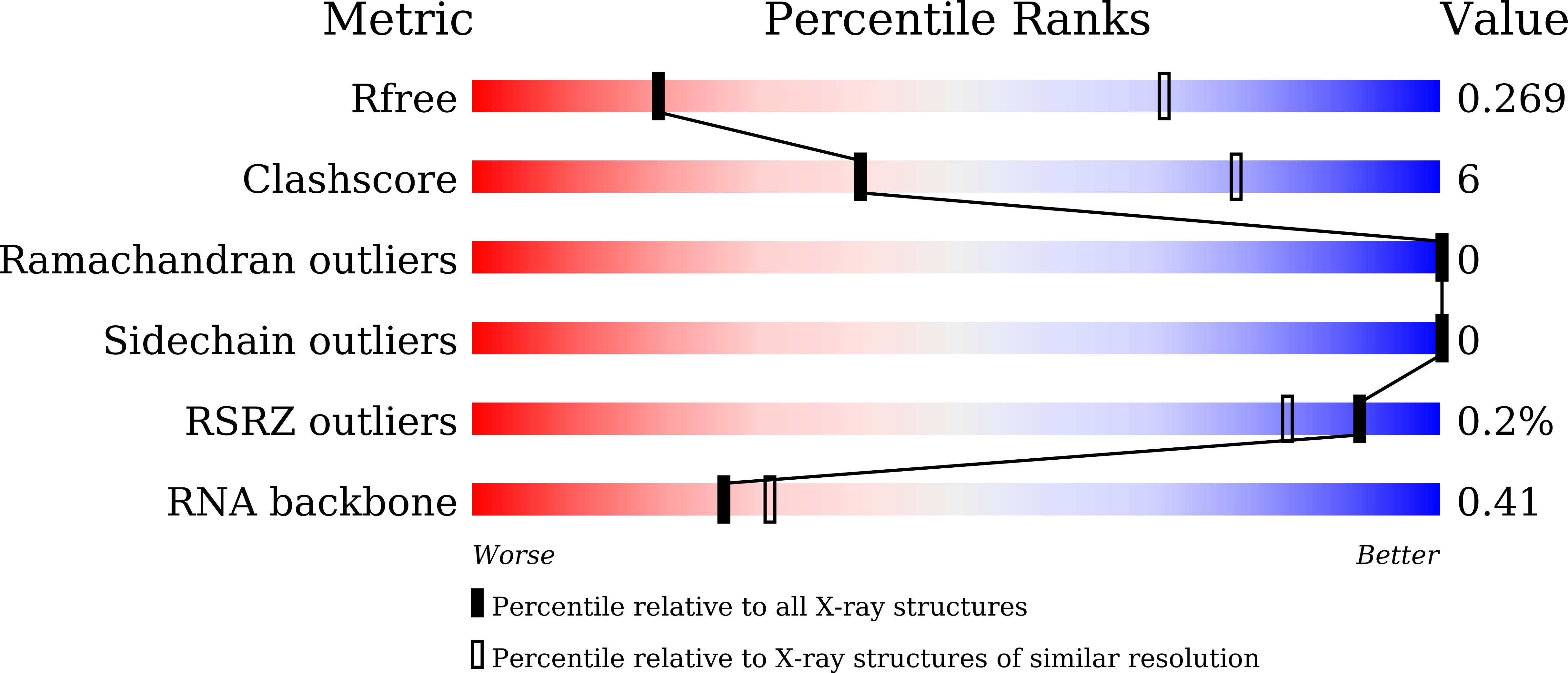
Resolution:
3.59 Å
R-Value Free:
0.27
R-Value Work:
0.22
R-Value Observed:
0.23
Space Group:
P 21 21 21
Macromolecular Entities
Structures with similar UniProt ID
Protein Blast
Polymer Type:polypeptide(L)
Molecule:CRISPR-associated endonucleas
Gene (Uniprot):cas9
Chain IDs:A
Chain Length:1357
Number of Molecules:1
Biological Source:Streptococcus pyogenes
Polymer Type:polyribonucleotide
Molecule:single-guide RNA
Chain IDs:B
Chain Length:102
Number of Molecules:1
Biological Source:Streptococcus pyogenes
Polymer Type:polydeoxyribonucleotide
Molecule:Target Strand of double-stran
Chain IDs:C
Chain Length:43
Number of Molecules:1
Biological Source:synthetic construct
Polymer Type:polydeoxyribonucleotide
Molecule:Non-target Strand of double-s
Chain IDs:D
Chain Length:27
Number of Molecules:1
Biological Source:synthetic construct
Ligand Molecules
Primary Citation
Structural and functional insights into internal domain replacement in SpCas9 for protein engineering.
Sci Rep 15 41528 41528 (2025)
PMID: 41285890 DOI: 10.1038/s41598-025-25367-9

Abstact

The CRISPR-Cas9 system has emerged as a powerful tool for precise genome editing, with ongoing research focused on enhancing its reliability and expanding its versatility. One effective strategy involves the integration of foreign functional domains into Cas9 to confer new capabilities. However, successful integration requires identification of insertion sites that preserve the protein's structural integrity and function. In this study, we identified a C-terminal region of Streptococcus pyogenes Cas9 (SpCas9), spanning residues 1242-1263, as a viable site for domain replacement. Structural and biochemical analyses of a SpCas9 variant lacking this region confirmed its dispensability for SpCas9 activity. As a proof of concept, we substituted this segment with the evolved E. coli tRNA adenosine deaminase (TadA), a key component of adenine base editors. Functional evaluation of this engineered SpCas9-TadA variant demonstrated deamination efficiency comparable to that of the ABE8e, with the potential to modulate the editing window through linker design. These results highlight the potential of targeted engineering of this region to develop more precise and versatile genome editing tools.

Legend

Protein

Chemical

Disease

Primary Citation of related structures
Feedback Form
Name
Email
Institute
Feedback