

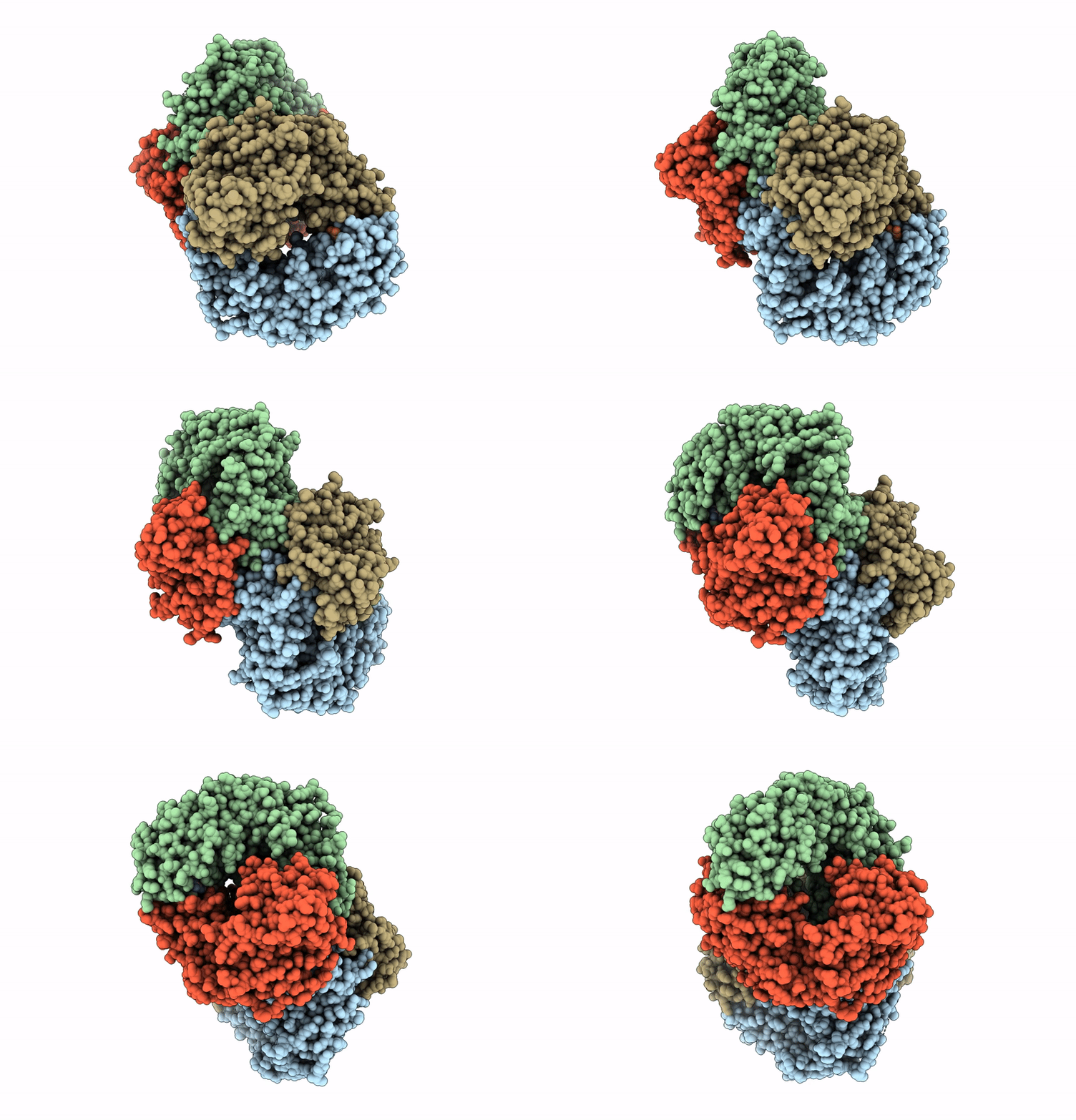
9JXX image
Deposition Date 2024-10-12
Release Date 2025-07-23
Last Version Date 2025-07-23
Entry Detail
PDB ID:
9JXX
Title:
Crystal structure of SiRe_0806 in complex with cA4
Biological Source:
Source Organism(s):
Expression System(s):
Method Details:
Experimental Method:
Resolution:
2.50 Å
R-Value Free:
0.24
R-Value Work:
0.20
R-Value Observed:
0.20
Space Group:
P 1
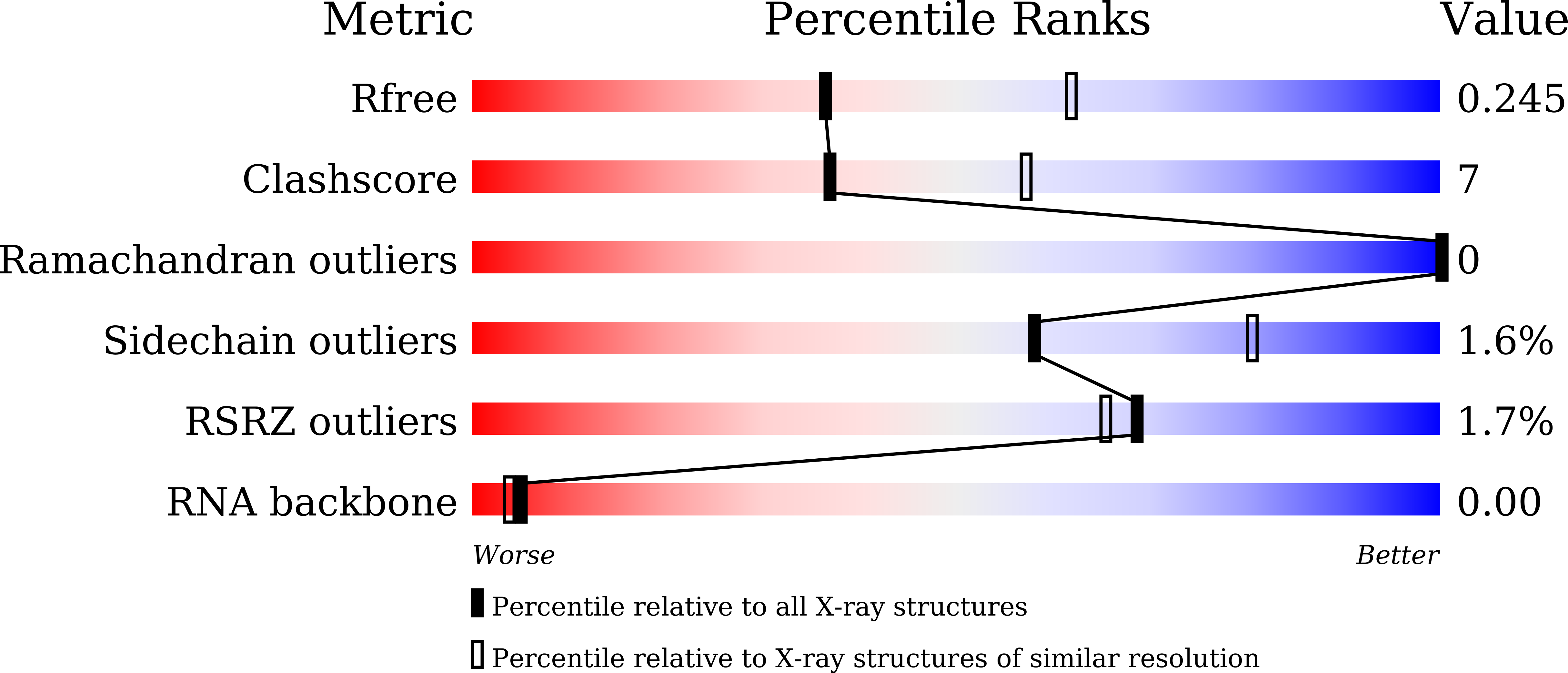
Macromolecular Entities
Structures with similar UniProt ID
Protein Blast
Polymer Type:polypeptide(L)
Molecule:PIN domain-containing protein
Gene (Uniprot):SiRe_0806
Chain IDs:A (auth: B), B (auth: D), D (auth: A), E (auth: C)
Chain Length:429
Number of Molecules:4
Biological Source:Saccharolobus islandicus REY15A
Polymer Type:polyribonucleotide
Molecule:RNA (5'-R(P*AP*AP*AP*A)-3')
Chain IDs:C (auth: Y), F (auth: X)
Chain Length:4
Number of Molecules:2
Biological Source:synthetic construct
Primary Citation
Cyclic tetraadenylate binding induces dimerization of protein dimers to activate a CRISPR-associated PIN nuclease.
Nucleic Acids Res. 53 ? ? (2025)
PMID: 40794864 DOI: 10.1093/nar/gkaf744

Abstact

Type III CRISPR-Cas systems synthesize cyclic oligoadenylates (cOAs), the second messengers that bind to the CARF (CRISPR-associated Rossman fold) sensor domain and allosterically activate the effector domain of CRISPR ancillary effectors to mediate antiviral defense. An arsenal of such effectors has been identified, but only a minority of them have been characterized thus far. Here, CaPN (a CRISPR-associated PIN domain nuclease), a novel effector protein encoded by Saccharolobus islandicus, was characterized. Biochemical characterization of CaPN revealed that the CARF domain senses cA4 (cyclic tetraadenylate), and its binding to the CARF domain activates the PIN domain for robust RNA cleavage. Genetic assay showed that CaPN mediates growth arrest/cell death to its archaeal host upon cA4 sensing. Determination of the crystal structures of CaPN in apo and in the cA4-bound form revealed that cA4-CARF interactions trigger the conformational changes, leading to the dimerization of the CaPN dimers. These structural changes reposition D296, one of the active site residues in the catalytic pocket, to yield an active PIN domain nuclease. Together, these results unveil a novel molecular mechanism for the activation of cOA-activated Cas ancillary RNases in the CRISPR signaling pathway.

Legend

Protein

Chemical

Disease

Primary Citation of related structures
Feedback Form
Name
Email
Institute
Feedback