

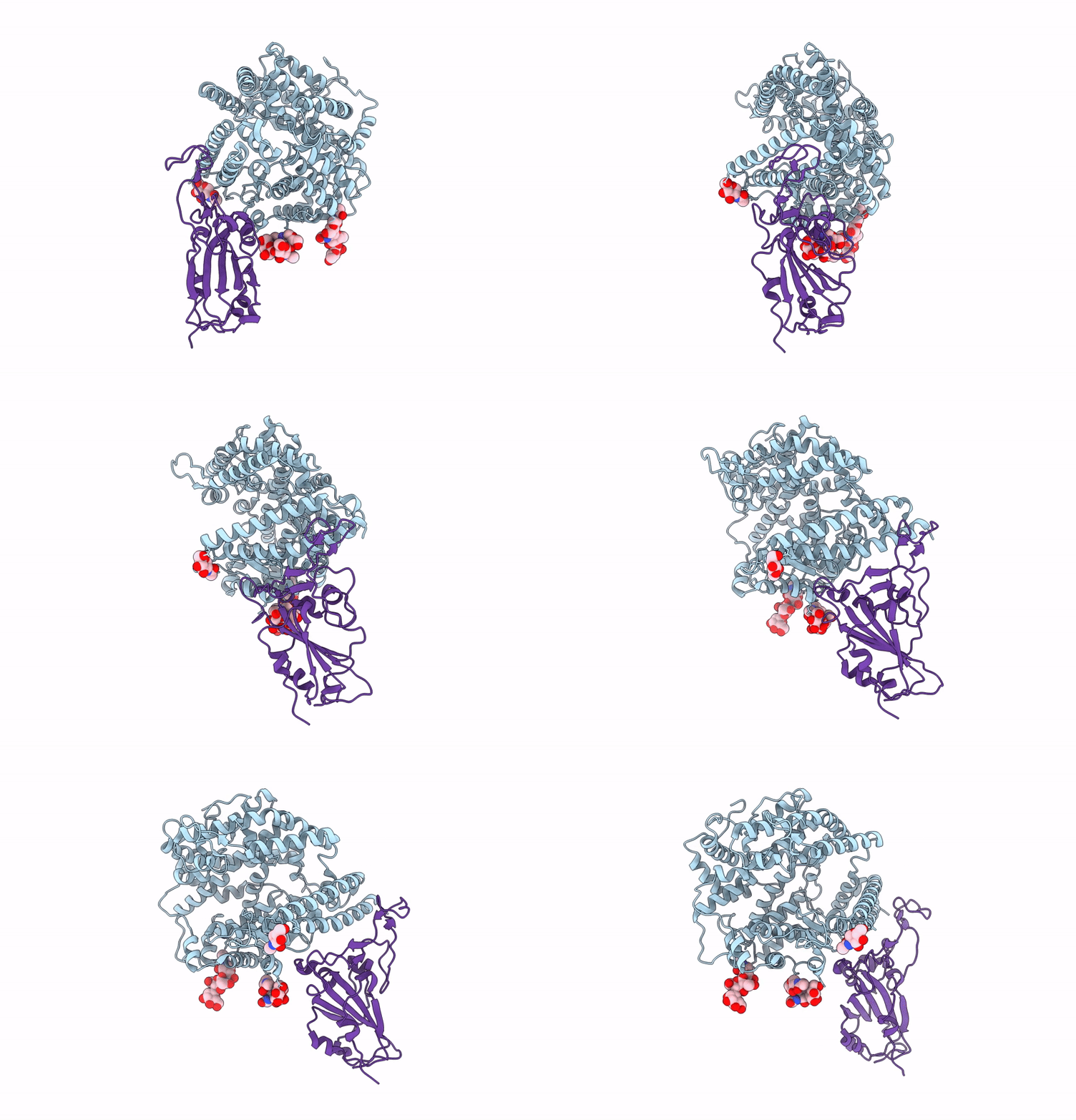
9JTD image
Deposition Date 2024-10-04
Release Date 2025-10-22
Last Version Date 2026-05-06
Entry Detail
PDB ID:
9JTD
Keywords:
Title:
Crystal structure of PCoV-GD receptor binding domain complexed with fox ACE2
Biological Source:
Source Organism(s):
Expression System(s):
Method Details:
Experimental Method:
Resolution:
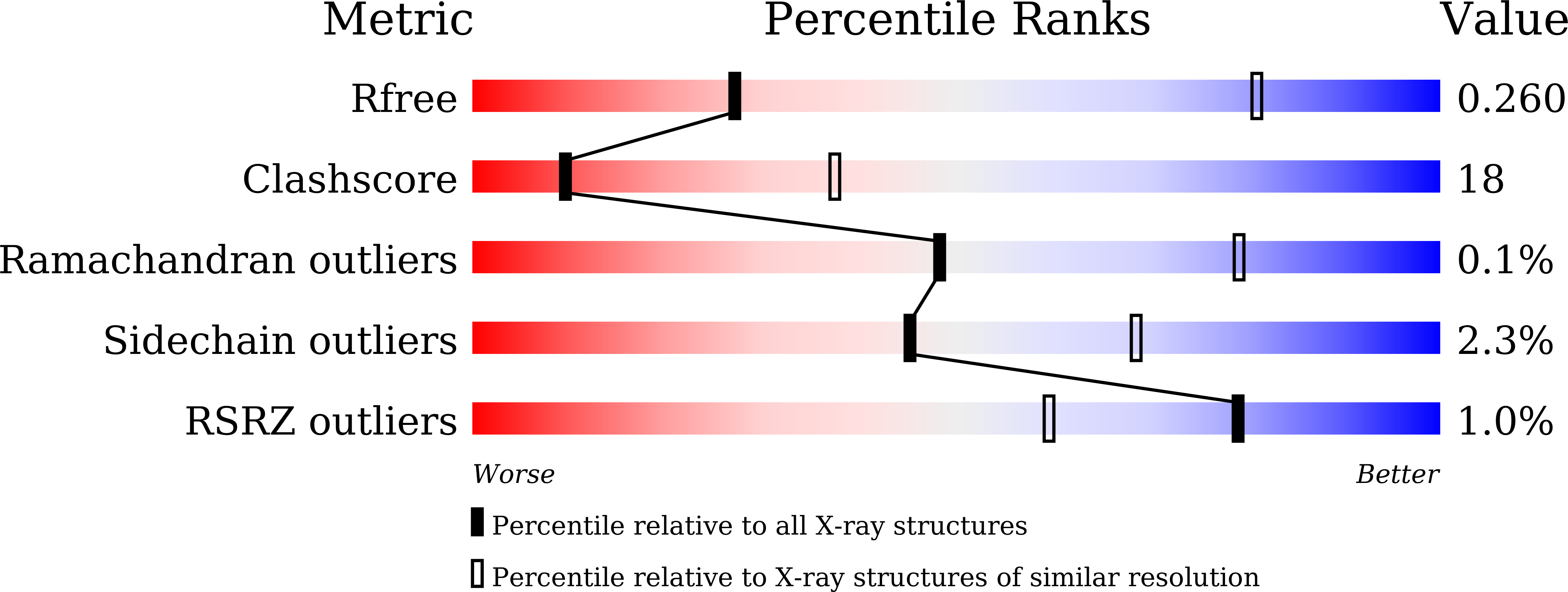
3.59 Å
R-Value Free:
0.26
R-Value Work:
0.22
R-Value Observed:
0.23
Space Group:
I 41 2 2
Macromolecular Entities
Structures with similar UniProt ID
Protein Blast
Polymer Type:polypeptide(L)
Molecule:Angiotensin-converting enzyme
Gene (Uniprot):ACE2
Chain IDs:A
Chain Length:592
Number of Molecules:1
Biological Source:Vulpes vulpes
Structures with similar UniProt ID
Protein Blast
Polymer Type:polypeptide(L)
Molecule:Spike glycoprotein
Chain IDs:B (auth: E)
Chain Length:194
Number of Molecules:1
Biological Source:Pangolin coronavirus
Ligand Molecules
Primary Citation
Molecular basis of fox ACE2 recognition by receptor binding domains of SARS-CoV-2 and PCoV-GD.
Cell Insight 5 100314 100314 (2026)
PMID: 41960421 DOI: 10.1016/j.cellin.2026.100314

Abstact

The severe acute respiratory syndrome coronavirus 2 (SARS-CoV-2) positive RNA detected in red fox swab samples provide evidence of a natural SARS-CoV-2 infection in this species. Many studies have also demonstrated that the red fox angiotensin converting enzyme 2 (fACE2) could serve as the receptor of SARS-CoV-2 and many SARS-CoV-2 related sarbecoviruses. However, the molecular mechanisms of fACE2 attached by animal-origin coronaviruses remain poorly understood. Here, we found that fACE2 could mediate pseudovirus entry and cell membrane fusion induced by the SARS-CoV-2 and pangolin coronavirus isolated from Guangdong (PCoV-GD) spikes as human ACE2 (hACE2). The binding affinity of fACE2 bound to the receptor-binding domain (RBD) of PCoV-GD was stronger than the SARS-CoV-2 RBD demonstrated by surface plasmon resonance (SPR) assay, while deglycosylation of PCoV-GD RBD N370 by T372A mutation or glycosylation of SARS-CoV-2 RBD N370 by A372T mutation had little effect on fACE2 binding compared with wild-type (WT) RBD. We further solved the crystal structures of fACE2 bound to SARS-CoV-2 RBD and PCoV-GD T372A mutant RBD. Interface analysis and SPR assay revealed that the R417 and H498 of PCoV-GD RBD might account for the binding affinity enhancement with fACE2 compared with K417 and Q498 of SARS-CoV-2 RBD. Moreover, the Y453F mutation in SARS-CoV-2 RBD increased the binding affinity to fACE2 while this mutation in PCoV-GD RBD decreased the binding affinity to fACE2 compared with the corresponding WT RBDs. Furthermore, the RBDs of many prevalent SARS-CoV-2 variants could all bind to fACE2. Our results indicated that the continuous surveillance of SARS-CoV-2 and related sarbecoviruses in fox species was also necessary to better prevent animal-to-human spillover of the coronaviruses.

Legend

Protein

Chemical

Disease

Primary Citation of related structures
Feedback Form
Name
Email
Institute
Feedback