

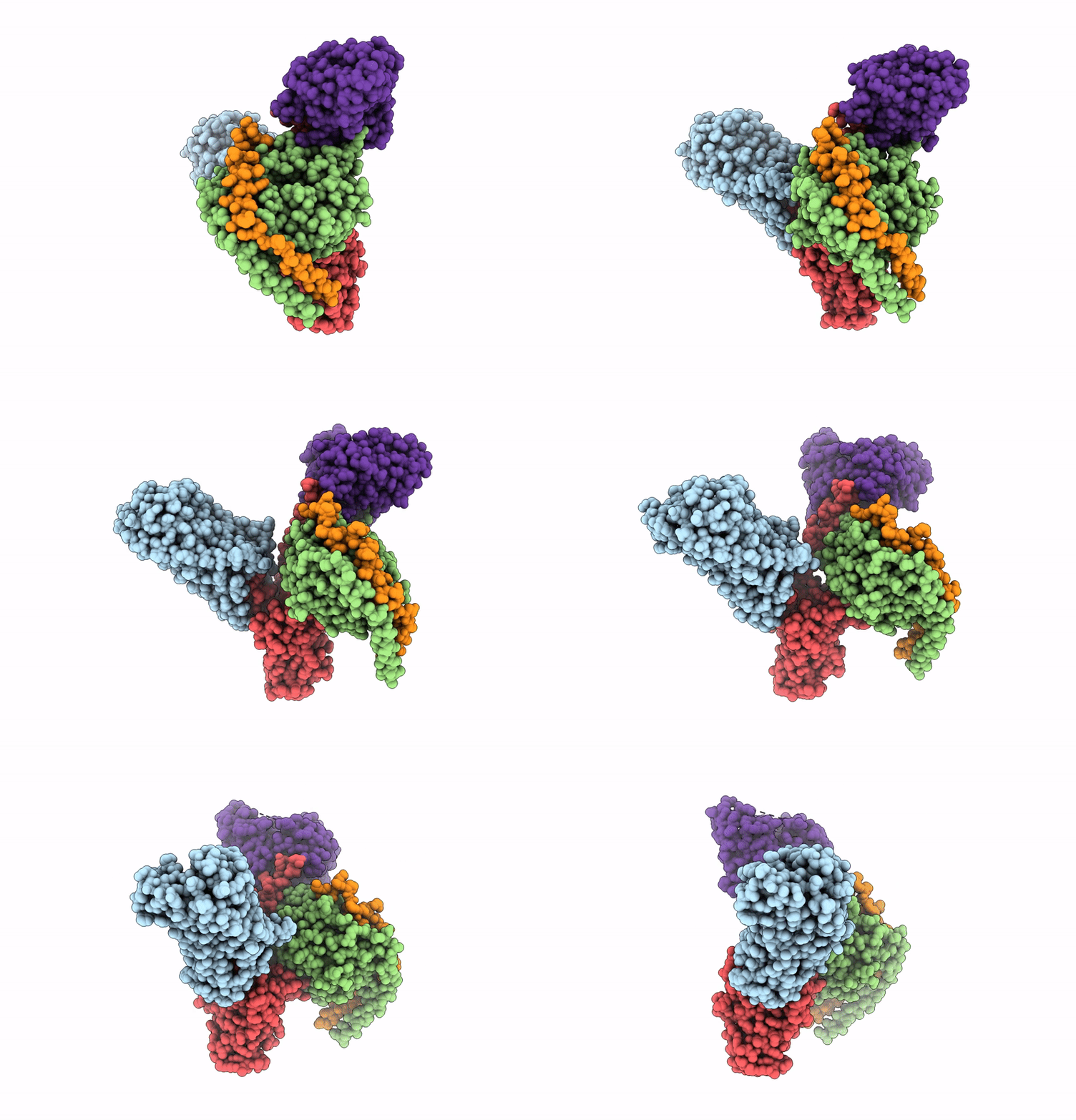
9JKT image
Deposition Date 2024-09-17
Release Date 2025-10-29
Last Version Date 2026-05-13
Entry Detail
PDB ID:
9JKT
Title:
PLA-HCAR3-Gi complex
Biological Source:
Source Organism(s):
Homo sapiens (Taxon ID: 9606)
Expression System(s):
Method Details:
Experimental Method:
Resolution:
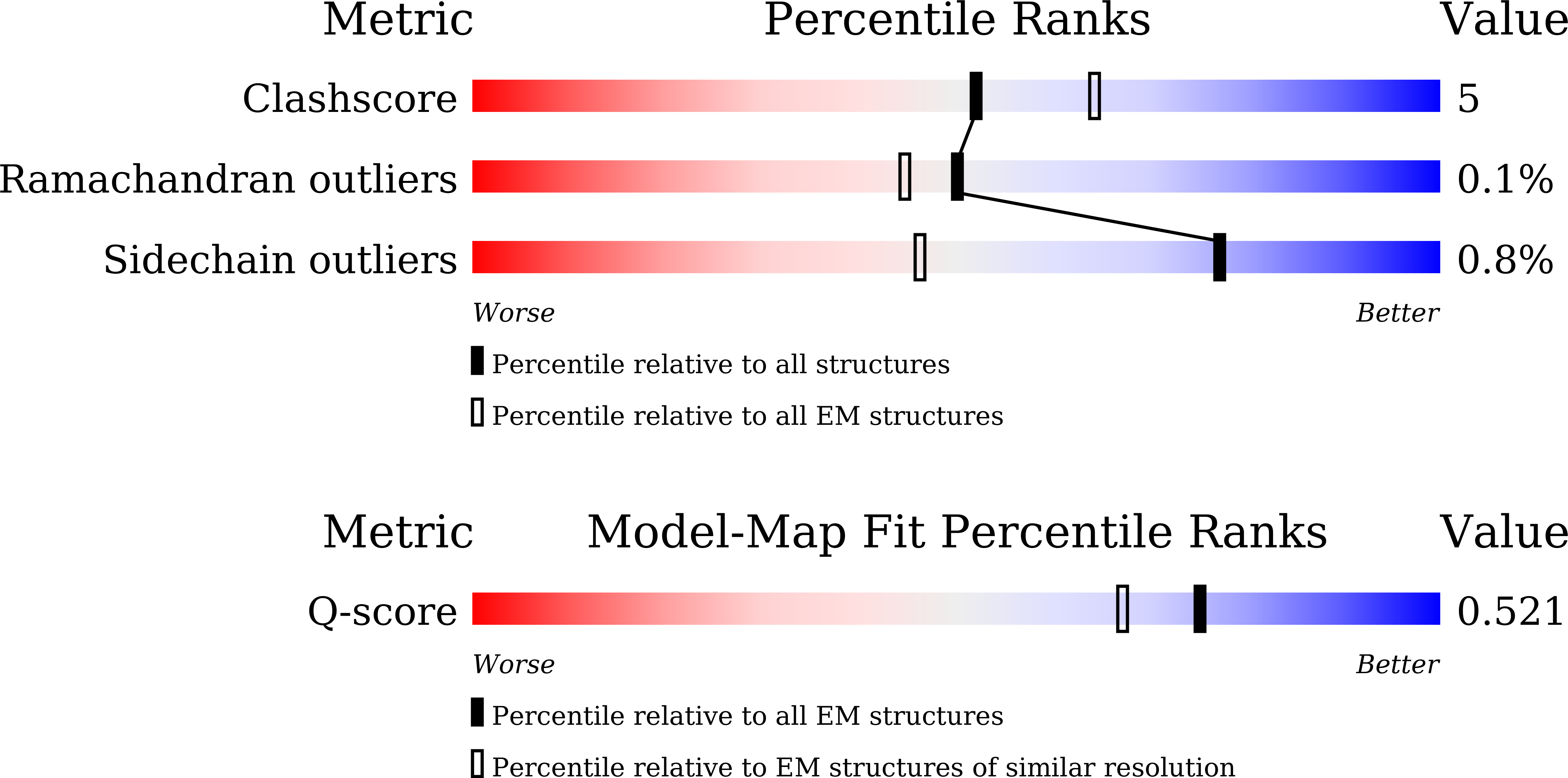
3.05 Å
Aggregation State:
PARTICLE
Reconstruction Method:
SINGLE PARTICLE
Macromolecular Entities
Structures with similar UniProt ID
Protein Blast
Polymer Type:polypeptide(L)
Molecule:Hydroxycarboxylic acid recept
Gene (Uniprot):HCAR3
Chain IDs:A
Chain Length:387
Number of Molecules:1
Biological Source:Homo sapiens
Structures with similar UniProt ID
Protein Blast
Polymer Type:polypeptide(L)
Molecule:Guanine nucleotide-binding pr
Gene (Uniprot):GNB1
Chain IDs:C (auth: B)
Chain Length:337
Number of Molecules:1
Biological Source:Homo sapiens
Structures with similar UniProt ID
Protein Blast
Polymer Type:polypeptide(L)
Molecule:Guanine nucleotide-binding pr
Gene (Uniprot):GNAI1
Chain IDs:B (auth: C)
Chain Length:351
Number of Molecules:1
Biological Source:Homo sapiens
Structures with similar UniProt ID
Protein Blast
Polymer Type:polypeptide(L)
Molecule:Guanine nucleotide-binding pr
Gene (Uniprot):GNG2
Chain IDs:D (auth: G)
Chain Length:56
Number of Molecules:1
Biological Source:Homo sapiens
Protein Blast
Polymer Type:polypeptide(L)
Molecule:ScFv16
Chain IDs:E (auth: S)
Chain Length:247
Number of Molecules:1
Biological Source:Homo sapiens
Ligand Molecules
Primary Citation
Structures of G-protein coupled receptor HCAR3 in complex with selective agonists reveal the basis for ligand recognition and selectivity.
Plos Biol. 23 e3003480 e3003480 (2025)
PMID: 41359625 DOI: 10.1371/journal.pbio.3003480

Abstact

The hydroxycarboxylic acid receptors (HCAR2 and HCAR3), also known as prototypical metabolite-sensing receptors, are key targets for treating dyslipidemia and metabolic disorders. While HCAR2 activation, but not HCAR3 activation, is associated with side effects of cutaneous flushing, the structural features and ligand preferences of HCAR3 remain less understood. Here, we used Sf9 cells to express HCAR3-Gi and HCAR2-Gi complexes, and present cryo-EM structures of HCAR3-Gi complexes with agonists compound 6O (3.31 A), D-phenyllactic acid (3.05 A), IBC293 (3.26 A), and acifran (3.18A), as well as HCAR2-Gi complex with agonist acifran (2.72 A). Our findings reveal the mechanism behind 6O's highest affinity to HCAR3, attributed to its full occupation of both R1 and R2 regions of the orthosteric binding pocket. Moreover, combined with cAMP assay in HEK-293 cells, we have elucidated that the ligand selectivity between HCAR3 and HCAR2 depended on pi-pi interaction with F1073.32 (L1073.32 in HCAR2) and ligand-binding pocket size difference, facilitated by key residues difference V/L832.60, Y/N862.63, and S/W9123.48. Collectively, these structural insights lay the groundwork for developing HCAR3-specific drugs, potentially avoiding HCAR2-induced adverse effects.

Legend

Protein

Chemical

Disease

Primary Citation of related structures
Feedback Form
Name
Email
Institute
Feedback