

9IPL image
Deposition Date 2024-07-10
Release Date 2025-07-16
Last Version Date 2026-07-15
Entry Detail
PDB ID:
9IPL
Title:
A tetrapyrrole binding domain variant of CoaR in closed conformation at 2.28 angstrom resolution
Biological Source:
Expression System(s):
Method Details:
Experimental Method:
Resolution:
2.28 Å
R-Value Free:
0.22
R-Value Work:
0.20
R-Value Observed:
0.20
Space Group:
P 61
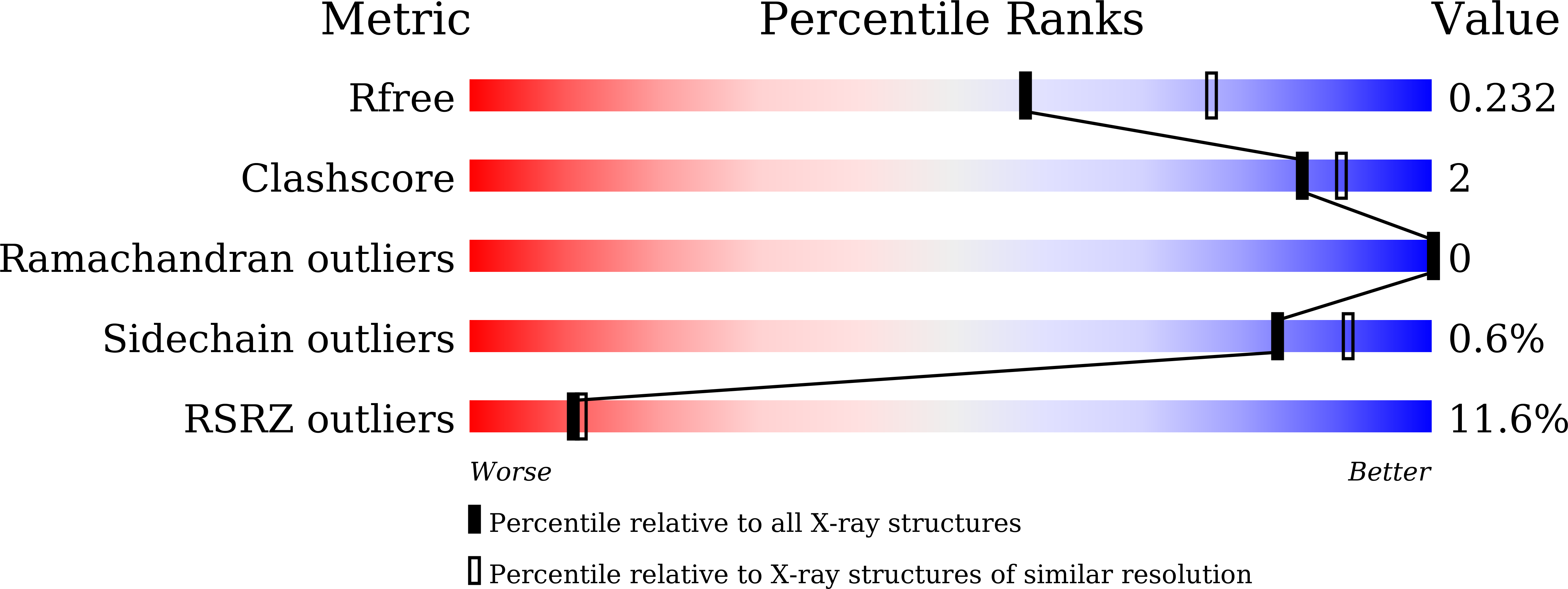
Macromolecular Entities
Polymer Type:polypeptide(L)
Molecule:Mercuric resistance operon re
Gene (Uniprot):merR
Chain IDs:A, B
Chain Length:0
Number of Molecules:2
Biological Source:Synechocystis sp. (strain PCC 6803 / Kazusa)
Ligand Molecules
Primary Citation
Site-specific incorporation of 19 F-nulcei at protein C-terminus to probe allosteric conformational transitions of metalloproteins.
Commun Biol 7 1613 1613 (2024)
PMID: 39627324 DOI: 10.1038/s42003-024-07331-x

Abstact

Allosteric conformational change is an important paradigm in the regulation of protein function, which is typically triggered by the binding of small cofactors, metal ions or protein partners. Here, we found those conformational transitions can be effectively monitored by (19)F NMR, facilitated by a site-specific (19)F incorporation strategy at the protein C-terminus using asparaginyl endopeptidase (AEP). Three case studies show that C-terminal (19)F-nuclei can reveal protein dynamics not only adjacent but also distal to C-terminus, including those occurring in a hemoprotein neuroglobin (Ngb), calmodulin (CaM), and a cobalt metalloregulator (CoaR) responding to both cobalt and tetrapyrrole. In Ngb, the heme orientation disorder is affected by missense mutations that perturb backbone rigidity or surface charges close to the heme axial ligands. In CaM, the C-terminal (19)F-nuclei is an ideal probe for detecting the binding states of Ca(2+), peptides and inhibitors. Furthermore, multiple (19)F-moieties were incorporated into the two domains of CoaR, revealing the intrinsically disordered C-terminal metal binding tail might be an allosteric conformational switch to maintain cobalt homeostasis and balance corrinoid biosynthesis. This study demonstrates that the AEP-based (19)F-modification strategy can be applied to various targets to study allosteric regulation, especially for those biological processes modulated by the protein C-terminus.

Legend

Protein

Chemical

Disease

Primary Citation of related structures
Feedback Form
Name
Email
Institute
Feedback