

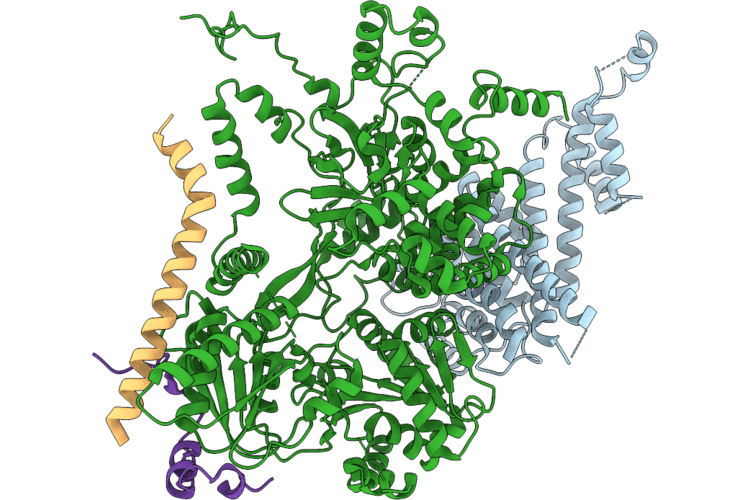
9IBD image
Deposition Date 2025-02-12
Release Date 2026-08-26
Last Version Date 2026-10-07
Entry Detail
PDB ID:
9IBD
Keywords:
Title:
Kinetoplastid ATP-dependent RNA helicase PRP22/DHX8 in open conformation
Biological Source:
Source Organism(s):
Method Details:
Experimental Method:
Resolution:
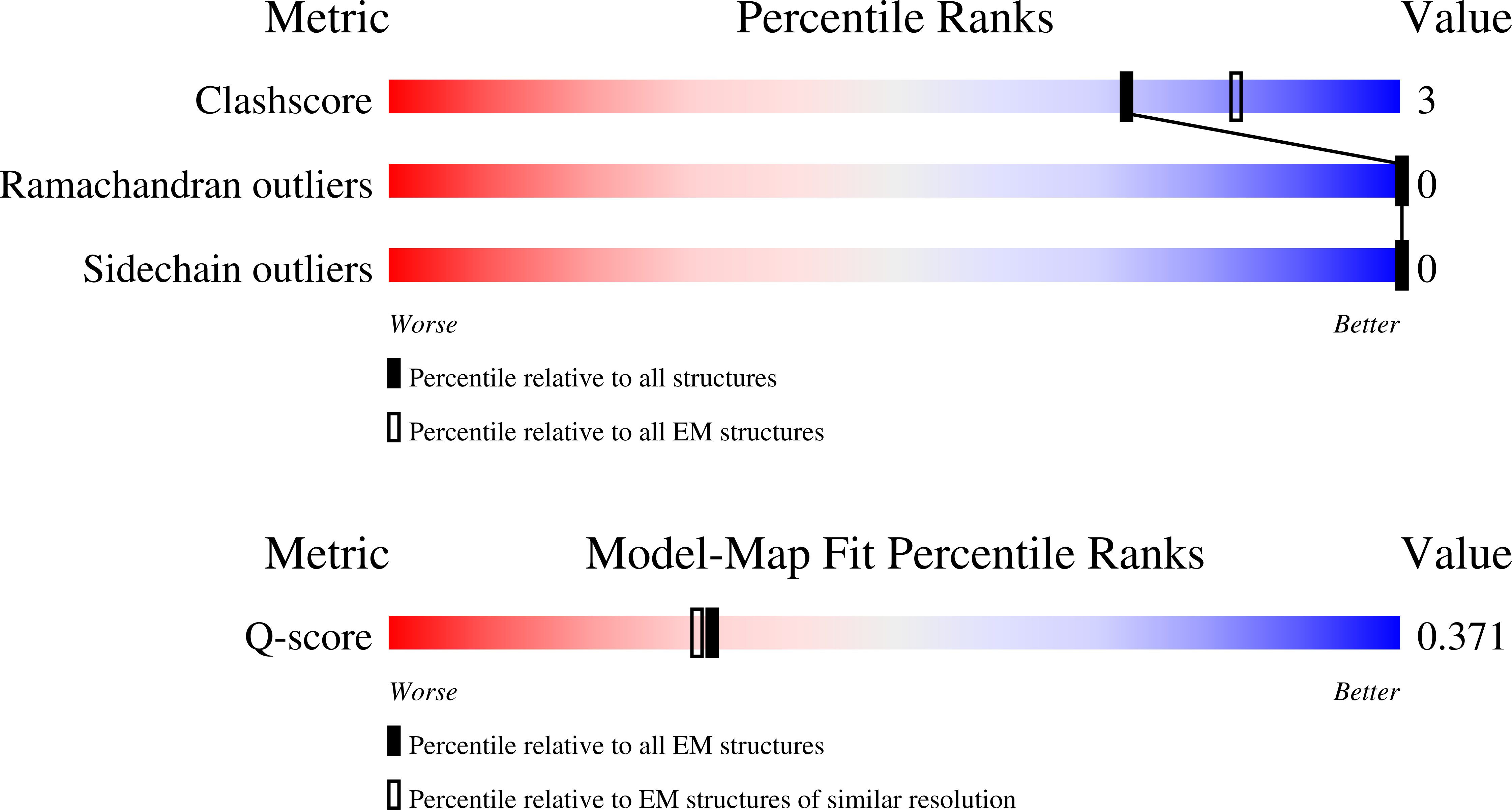
3.69 Å
Aggregation State:
PARTICLE
Reconstruction Method:
SINGLE PARTICLE
Macromolecular Entities
Polymer Type:polypeptide(L)
Molecule:Splicing factor Cactin C-term
Gene (Uniprot):LtaPh_2824100
Chain IDs:A (auth: LF)
Chain Length:706
Number of Molecules:1
Biological Source:Leishmania tarentolae
Polymer Type:polypeptide(L)
Molecule:RNA helicase
Gene (Uniprot):LtaPh_3629000
Chain IDs:B (auth: LV)
Chain Length:1087
Number of Molecules:1
Biological Source:Leishmania tarentolae
Polymer Type:polypeptide(L)
Molecule:NF-kappa-B-activating protein
Gene (Uniprot):LtaPh_3306200, LtaPh_9910501
Chain IDs:C (auth: LZ)
Chain Length:403
Number of Molecules:1
Biological Source:Leishmania tarentolae
Polymer Type:polypeptide(L)
Molecule:Probable RNA helicase
Chain IDs:D (auth: TN)
Chain Length:1181
Number of Molecules:1
Biological Source:Leishmania tarentolae
Ligand Molecules
Primary Citation
Structural basis of step II spliced leader RNA trans-splicing in trypanosomatid parasites.
Nat Commun 17 ? ? (2026)
PMID: 42778629 DOI: 10.1038/s41467-026-77480-6

Abstact

Messenger RNA (mRNA) synthesis is fundamental to eukaryotic gene expression. In kinetoplastid parasites, including the human pathogens Trypanosoma and Leishmania, mRNAs are produced through a mechanism called Spliced Leader (SL) RNA trans-splicing. In this process, a short SL exon from a small noncoding RNA is joined to the 5' end of every mRNA, ensuring transcript stability and translation. Despite decades of study, the structural and mechanistic basis of SL trans-splicing remains elusive. Here, we report cryogenic electron microscopy structures of step II SL trans-splicing machineries from Leishmania tarentolae. These structures reveal the molecular mechanism of SL exon ligation and uncover lineage-specific adaptations that remodel the trypanosomatid trans-spliceosome for SL trans-splicing while preserving fundamental spliceosomal chemistry. Altogether, our results establish a mechanistic framework for SL trans-splicing and illuminate the evolutionary diversification of RNA processing in deeply diverged eukaryotes.

Legend

Protein

Chemical

Disease

Primary Citation of related structures
Feedback Form
Name
Email
Institute
Feedback