

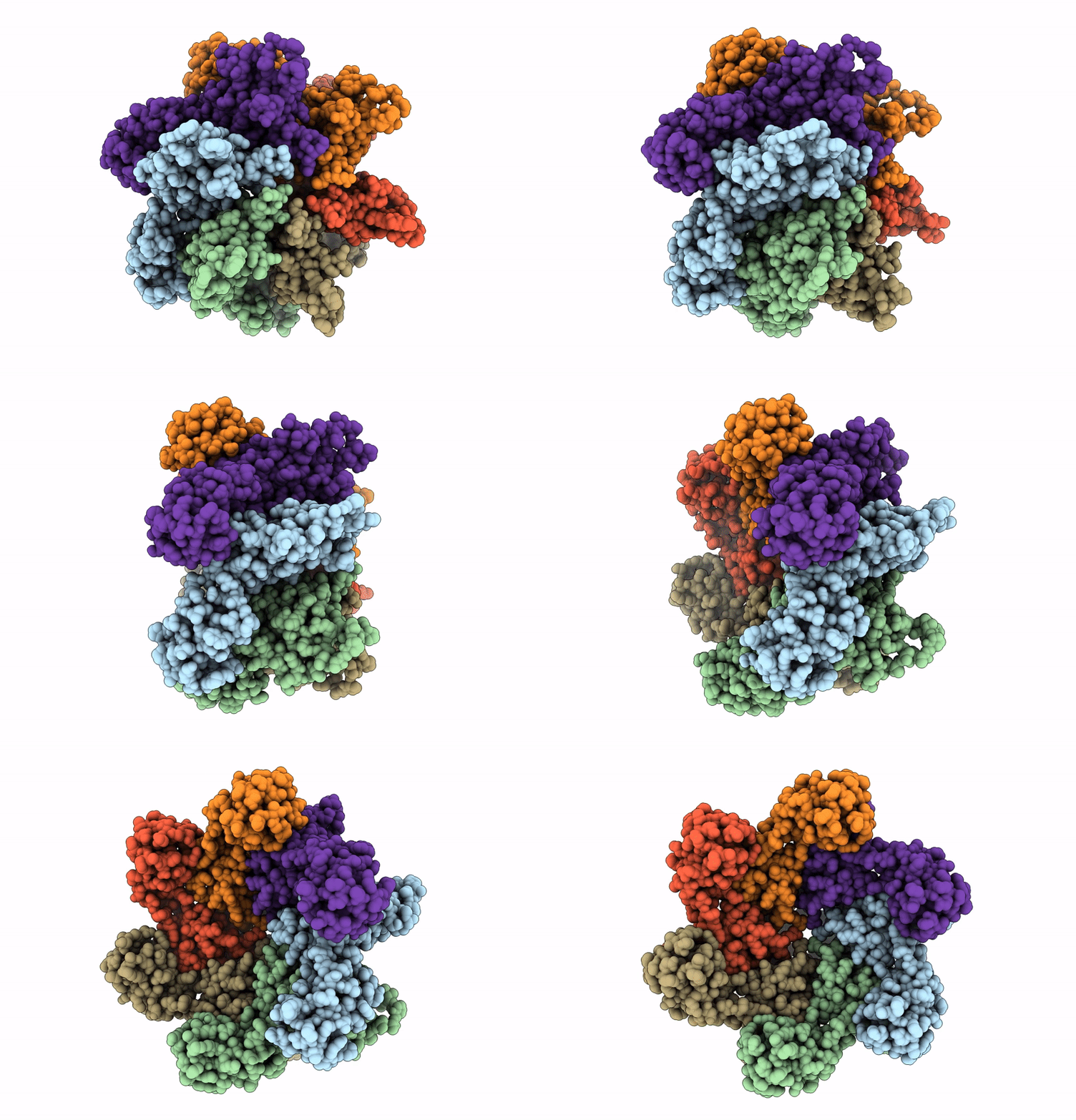
9I8I image
Deposition Date 2025-02-05
Release Date 2025-02-26
Last Version Date 2026-04-01
Entry Detail
PDB ID:
9I8I
Keywords:
Title:
cryoEM structure of HIV-1 KAKA/G225R mature CA hexamer
Biological Source:
Source Organism(s):
Expression System(s):
Method Details:
Experimental Method:
Resolution:
2.75 Å
Aggregation State:
PARTICLE
Reconstruction Method:
SINGLE PARTICLE

Macromolecular Entities
Structures with similar UniProt ID
Protein Blast
Polymer Type:polypeptide(L)
Molecule:HIV-1 KAKA/G225R CA hexamer
Chain IDs:A, B (auth: F), C (auth: E), D, E (auth: C), F (auth: B)
Chain Length:231
Number of Molecules:6
Biological Source:HIV-1 06TG.HT008
Ligand Molecules
Primary Citation
Structural basis for HIV-1 capsid adaption to a deficiency in IP6 packaging.
Nat Commun 16 8152 8152 (2025)
PMID: 40890096 DOI: 10.1038/s41467-025-63363-9

Abstact

Inositol hexakisphosphate (IP6) promotes HIV-1 assembly by stabilizing the immature Gag lattice and becomes enriched within virions, where it is required for mature capsid assembly. Previously, we identified Gag mutants that package little IP6 yet assemble particles, though they are non-infectious due to defective capsid formation. Here, we report a compensatory mutation, G225R, in the C-terminus of capsid protein (CA) that restores capsid assembly and infectivity in these IP6-deficient mutants. G225R also enhances in vitro assembly of CA into capsid-like particles at far lower IP6 concentrations than required for wild-type CA. CryoEM structures of G225R CA hexamers and lattices at 2.7 A resolution reveal that the otherwise disordered C-terminus becomes structured, stabilizing hexamer-hexamer interfaces. Molecular dynamics simulations support this mechanism. These findings uncover how HIV-1 can adapt to IP6 deficiency and highlight a previously unrecognized structural role of the CA C-terminus, while offering tools for capsid-related studies.

Legend

Protein

Chemical

Disease

Primary Citation of related structures
Feedback Form
Name
Email
Institute
Feedback