

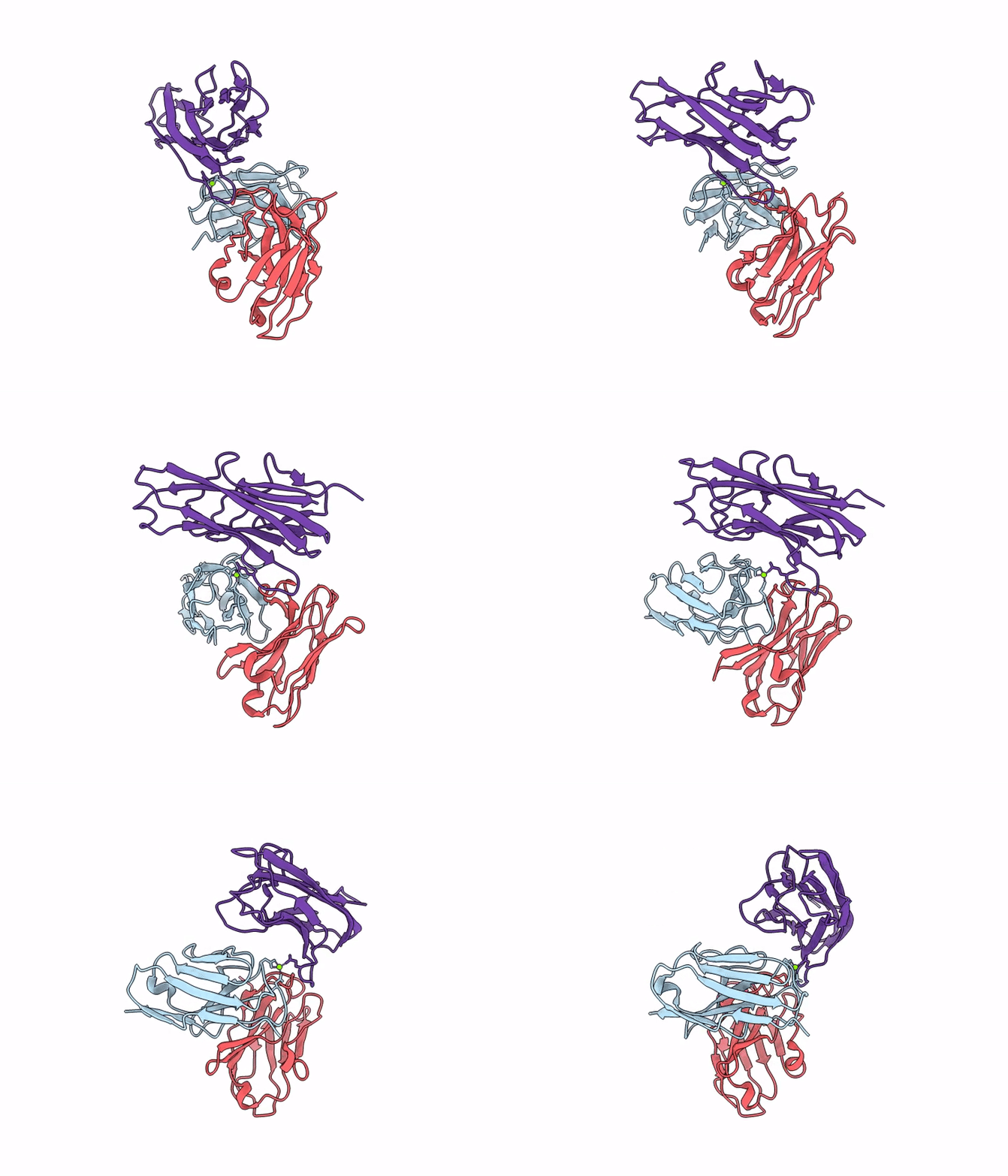
9I5N image
Deposition Date 2025-01-28
Release Date 2026-02-25
Last Version Date 2026-03-11
Entry Detail
PDB ID:
9I5N
Keywords:
Title:
Single particle cryo electron microscopy of a Fab fragment bound to recombinant human CD40 ligand
Biological Source:
Source Organism(s):
Mus musculus (Taxon ID: 10090)
Homo sapiens (Taxon ID: 9606)
Method Details:
Experimental Method:
Resolution:
3.40 Å
Aggregation State:
PARTICLE
Reconstruction Method:
SINGLE PARTICLE
Macromolecular Entities
Protein Blast
Polymer Type:polypeptide(L)
Molecule:Fab20 light chain
Chain IDs:B (auth: A)
Chain Length:107
Number of Molecules:1
Biological Source:Mus musculus
Protein Blast
Polymer Type:polypeptide(L)
Molecule:Fab20 heavy chain
Chain IDs:A (auth: B)
Chain Length:118
Number of Molecules:1
Biological Source:Mus musculus
Structures with similar UniProt ID
Protein Blast
Polymer Type:polypeptide(L)
Molecule:CD40 ligand, soluble form
Gene (Uniprot):CD40LG
Chain IDs:C
Chain Length:143
Number of Molecules:1
Biological Source:Homo sapiens
Ligand Molecules
Primary Citation
Curbing Autoimmunity: A New Fab Fragment Targeting CD40-CD40L Halts B-Cell Activation and Differentiation.
Eur. J. Immunol. 56 e70158 e70158 (2026)
PMID: 41742604 DOI: 10.1002/eji.70158

Abstact

Dysregulation of the CD40-CD40L axis is implicated in autoimmune diseases. Early clinical trials targeting CD40L with antibodies failed due to Fc-mediated side effects. To address this, we developed an anti-CD40L Fab fragment, Fab20, designed to block B-cell activation. Fab20 was evaluated for its binding properties, CD40-CD40L inhibition, and effects on human B-cell activation and differentiation using immunoassays, cryo-electron microscopy, flow cytometry, and cell cultures. Fab20 binds CD40L with a dissociation constant of 70 nM. Structural analysis revealed a "propeller-like" structure consisting of three Fabs binding to the CD40L trimer, sterically blocking parts of the CD40 binding site. Fab20 effectively inhibited B-cell activation, maintaining naive B cells in their inactive state, and suppressed antibody (IgG) production over 14 days. Fab20 represents a promising novel therapeutic approach for treating autoimmune diseases driven by CD40-CD40L dysregulation. Its mechanism of action, coupled with the absence of Fc-mediated effects, suggests a favorable safety profile.

Legend

Protein

Chemical

Disease

Primary Citation of related structures
Feedback Form
Name
Email
Institute
Feedback