

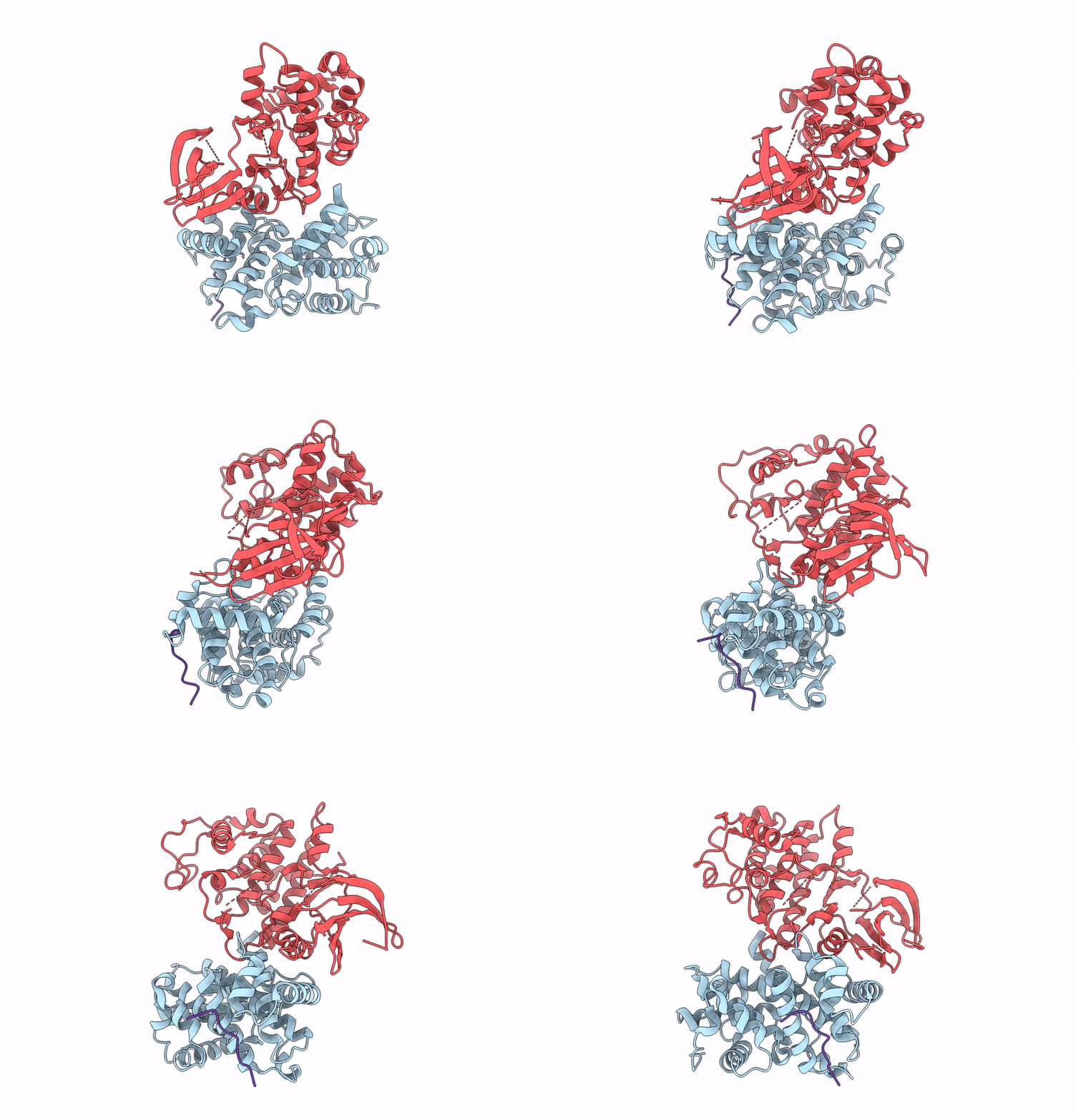
9HJ1 image
Deposition Date 2024-11-27
Release Date 2025-08-20
Last Version Date 2026-03-04
Entry Detail
PDB ID:
9HJ1
Keywords:
Title:
Cryo-EM structure of CDK2-cyclin A bound to a SCAPER peptide
Biological Source:
Source Organism(s):
Homo sapiens (Taxon ID: 9606)
Expression System(s):
Method Details:
Experimental Method:
Resolution:
2.90 Å
Aggregation State:
PARTICLE
Reconstruction Method:
SINGLE PARTICLE

Macromolecular Entities
Structures with similar UniProt ID
Protein Blast
Polymer Type:polypeptide(L)
Molecule:Cyclin-A2
Gene (Uniprot):CCNA2
Chain IDs:A
Chain Length:432
Number of Molecules:1
Biological Source:Homo sapiens
Structures with similar UniProt ID
Protein Blast
Polymer Type:polypeptide(L)
Molecule:Cyclin-dependent kinase 2
Gene (Uniprot):CDK2
Chain IDs:B
Chain Length:297
Number of Molecules:1
Biological Source:Homo sapiens
Structures with similar UniProt ID
Protein Blast
Polymer Type:polypeptide(L)
Molecule:SCAPER
Chain IDs:C
Chain Length:13
Number of Molecules:1
Biological Source:Homo sapiens
Ligand Molecules
Primary Citation
High-throughput investigation of cyclin docking interactions reveals the complexity of motif binding determinants.
Nat Commun 16 7622 7622 (2025)
PMID: 40817109 DOI: 10.1038/s41467-025-62765-z

Abstact

Many regulatory protein-protein interactions depend on Short Linear Motifs (SLiMs). In the cell cycle, cyclin-CDKs recognize SLiMs to control substrate recruitment and phosphorylation timing. Here, we measure the relative binding strength of ~100,000 peptides to 11 human cyclins from five families (D, E, A, B, and F). Using a quantitative intracellular binding assay and large-scale tiled peptide screening, we identify multiple non-canonical binders unveiling a broader repertoire of cyclin docking motif types. Cryo-electron microscopy and saturation mutagenesis studies reveal distinct binding modes and sequence features governing motif recognition, binding strength, and cyclin preference. Docking motifs vary from highly selective to pan-cyclin, thereby fine-tuning the timing of CDK phosphorylation during cell cycle. Overall, these findings provide insights into the rules encoding specificity and affinity of SLiM-mediated interactions and offer a framework for understanding motif-driven protein networks across the proteome.

Legend

Protein

Chemical

Disease

Primary Citation of related structures
Feedback Form
Name
Email
Institute
Feedback