

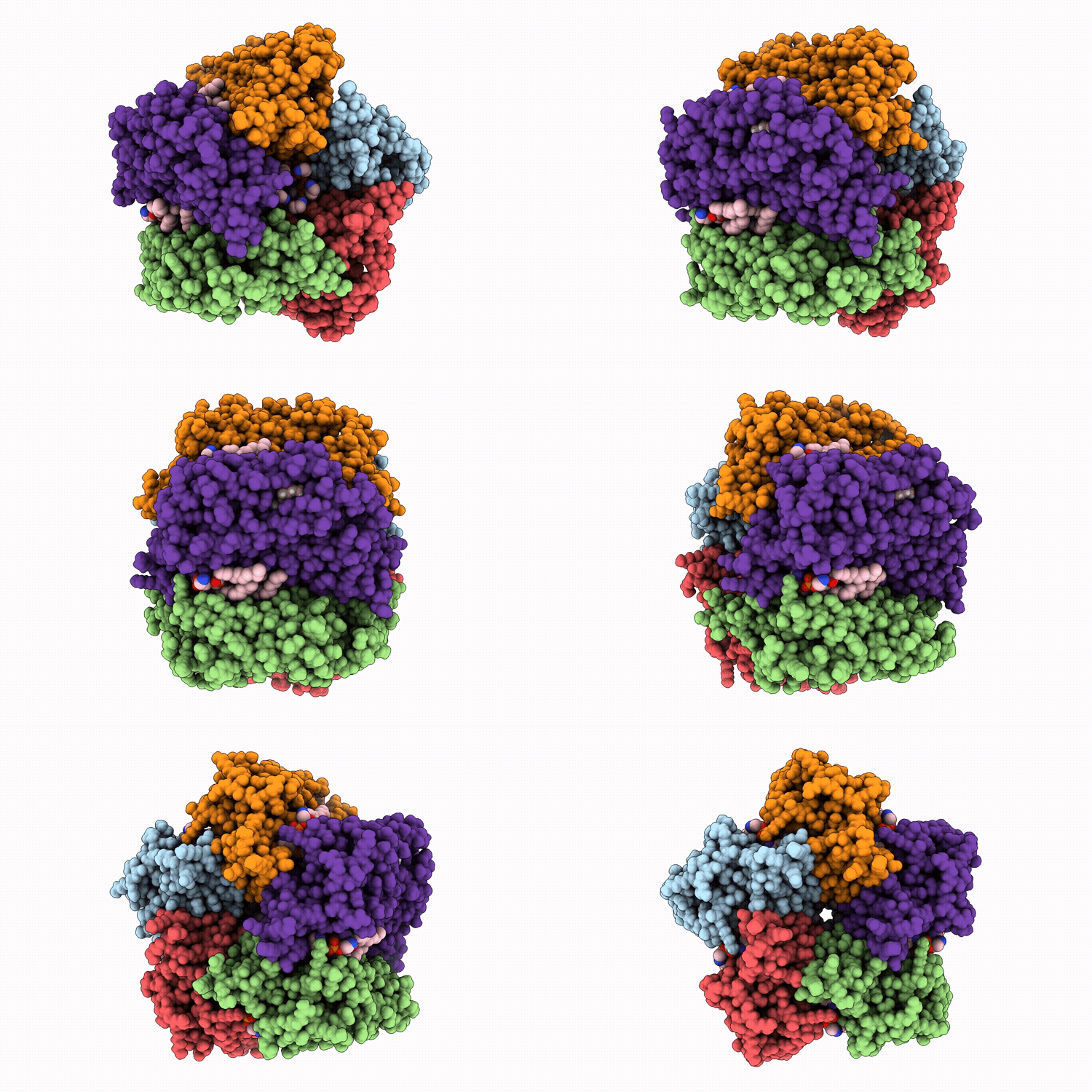
9HFK image
Deposition Date 2024-11-17
Release Date 2026-03-18
Last Version Date 2026-03-18
Entry Detail
PDB ID:
9HFK
Title:
Cryo-EM structure of the freshwater actinorhodopsin, Rhodoluna lacicola (RlActR)
Biological Source:
Source Organism(s):
Expression System(s):
Method Details:
Experimental Method:
Resolution:
2.84 Å
Aggregation State:
PARTICLE
Reconstruction Method:
SINGLE PARTICLE
Macromolecular Entities
Structures with similar UniProt ID
Protein Blast
Polymer Type:polypeptide(L)
Molecule:Bacteriorhodopsin
Gene (Uniprot):Rhola_00012080
Chain IDs:A, B (auth: E), C, D (auth: B), E (auth: D)
Chain Length:272
Number of Molecules:5
Biological Source:Rhodoluna lacicola
Primary Citation
Structural, Mechanistic and Phylogenetic Insights Into a Freshwater Actinorhodopsin.
J. Mol. Biol. 438 169725 169725 (2026)
PMID: 41720298 DOI: 10.1016/j.jmb.2026.169725

Abstact

Actinorhodopsins represent a unique subgroup of microbial rhodopsins, predominantly found in non-marine Actinobacteria and proposed to contribute to the global energy cycle. Despite their ecological significance, structural information on this family has remained scarce. Here, we present the high-resolution three-dimensional structure of the pentameric actinorhodopsin RlActR from the actinobacterium Rhodoluna lacicola, as determined by cryo-electron microscopy and single-particle 3D reconstruction. The structure provides molecular insights into key functional amino acid residues involved in retinal cofactor binding and the proton translocation pathway. In addition to describing the organization of the retinal Schiff base region, we present a comparative analysis of this region in RlActR and in prototypical microbial rhodopsins from two distinct phyla, namely, the green-light-absorbing proteorhodopsin from Bacteria and bacteriorhodopsin from Archaea. We also describe the amino acid interactions at the oligomerization interface that stabilize the pentamer. Furthermore, the structure reveals a pentameric architecture with a lipid-filled central cavity and lipid-occupied, membrane-facing interprotomer crevices, further highlighting molecular interactions that stabilize the assembly. Phylogenetic analysis and structural comparisons with selected microbial rhodopsins exhibiting light-driven proton-pumping activity position RlActR within a distinct group of proton-pumping rhodopsins, underscoring its evolutionary and functional relevance.

Legend

Protein

Chemical

Disease

Primary Citation of related structures
Feedback Form
Name
Email
Institute
Feedback