

9H5W image
Deposition Date 2024-10-23
Release Date 2025-11-05
Last Version Date 2026-07-01
Entry Detail
PDB ID:
9H5W
Keywords:
Title:
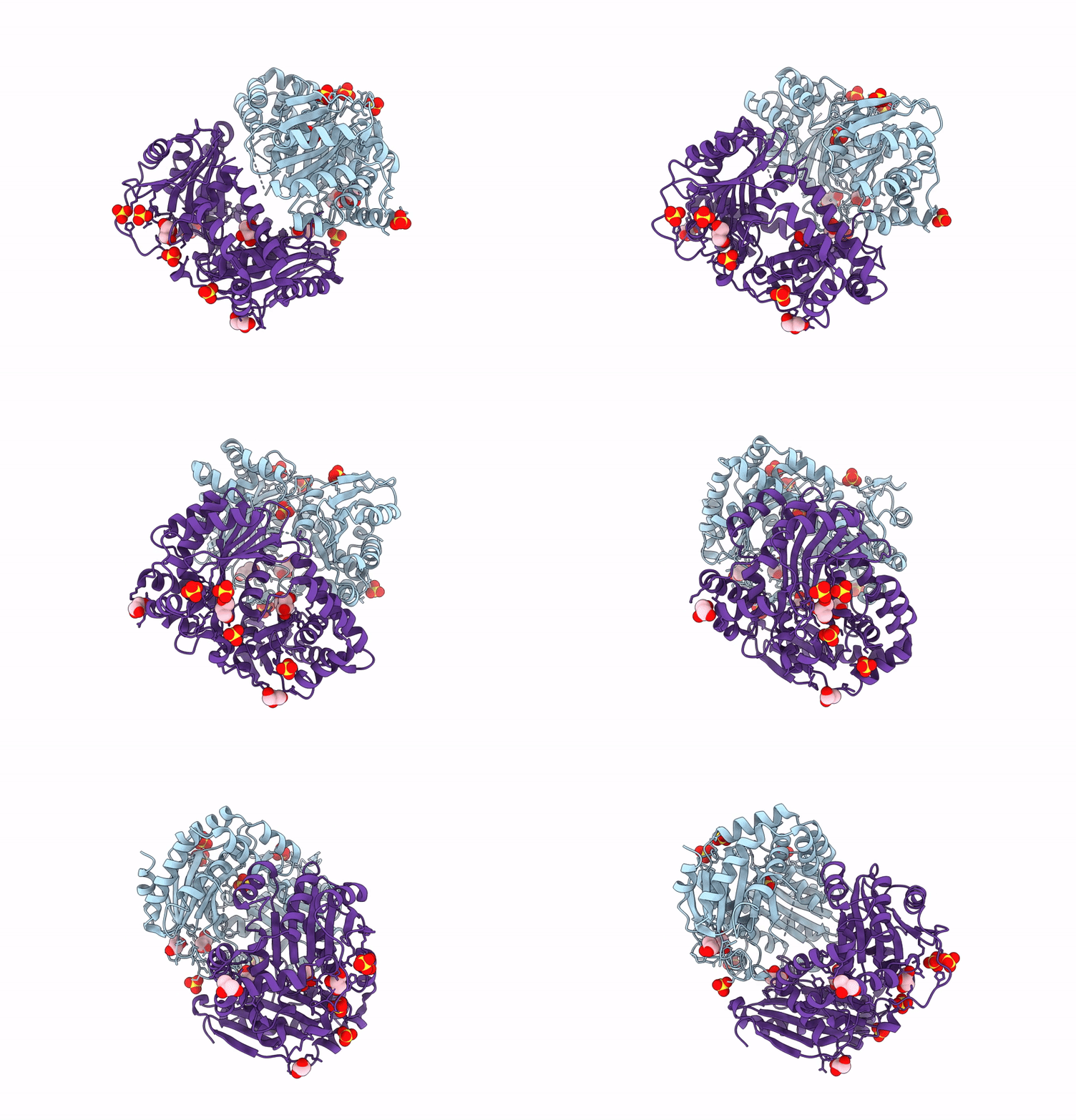
X-ray structure of Hydrogenosomal processing peptidase (HPP), E56Q inactive mutant, from Trichomonas vaginalis co-crystallized with presequence peptide from adenylate kinase (AK) - not visible in the structure model
Biological Source:
Source Organism(s):
Expression System(s):
Method Details:
Experimental Method:
Resolution:
2.00 Å
R-Value Free:
0.22
R-Value Work:
0.20
R-Value Observed:
0.20
Space Group:
P 21 21 21

Macromolecular Entities
Polymer Type:polypeptide(L)
Molecule:Alpha-MPP
Gene (Uniprot):TVAG_119710
Chain IDs:A
Chain Length:431
Number of Molecules:1
Biological Source:Trichomonas vaginalis
Polymer Type:polypeptide(L)
Molecule:Clan ME, family M16, insulina
Gene (Uniprot):TVAG_233350
Chain IDs:B
Chain Length:419
Number of Molecules:1
Biological Source:Trichomonas vaginalis
Primary Citation
Changes in the structure of mitochondrial processing peptidase driven by adaptation to anaerobiosis.
Int.J.Biol.Macromol. 372 153058 153058 (2026)
PMID: 42303018 DOI: 10.1016/j.ijbiomac.2026.153058

Abstact

Transition of eukaryotes from oxygen-rich to oligoxic or anoxic environments drove profound physiological changes, particularly in mitochondria. Low oxygen led to the loss of respiratory complexes that generate the inner mitochondrial membrane (IM) electrochemical gradient, as seen in anaerobic types of mitochondria, like the hydrogenosomes in Trichomonas vaginalis. Besides energy metabolism, IM potential is critical for organelle biogenesis, particularly the import of matrix preproteins. These preproteins contain positively charged N-terminal targeting sequences (NTSs) that facilitate import via the TIM23 translocase. Upon translocation, NTS is cleaved by mitochondrial processing peptidase (MPP), a zinc metallopeptidase composed of alpha and beta subunits. The alpha-MPP glycine-rich loop (GRL) recognizes and delivers the presequence to the beta-MPP active site. Hydrogenosomal NTSs are shorter and less positively charged, reflecting reduced IM potential. Using X-ray crystallography, modeling, and mutagenesis, we reveal distinctive structural adaptations of the hydrogenosomal processing peptidase (HPP). Compared to MPP, HPP has a central chamber about half the size, with predominantly electropositive and neutral surface charges. The alpha-HPP GRL features a reduced conserved glycine motif and is positioned closer to the beta-HPP active site. Enzymatic assays of beta-HPP mutants revealed a novel substrate interaction site involved in Zn(2+) dependent catalysis. These structural adaptations match the unique properties of hydrogenosomal NTSs, optimizing their processing under anaerobic conditions. They illustrate how adaptation to anaerobiosis drives protein structural evolution to sustain life in oxygen-poor environments.

Legend

Protein

Chemical

Disease

Primary Citation of related structures
Feedback Form
Name
Email
Institute
Feedback