

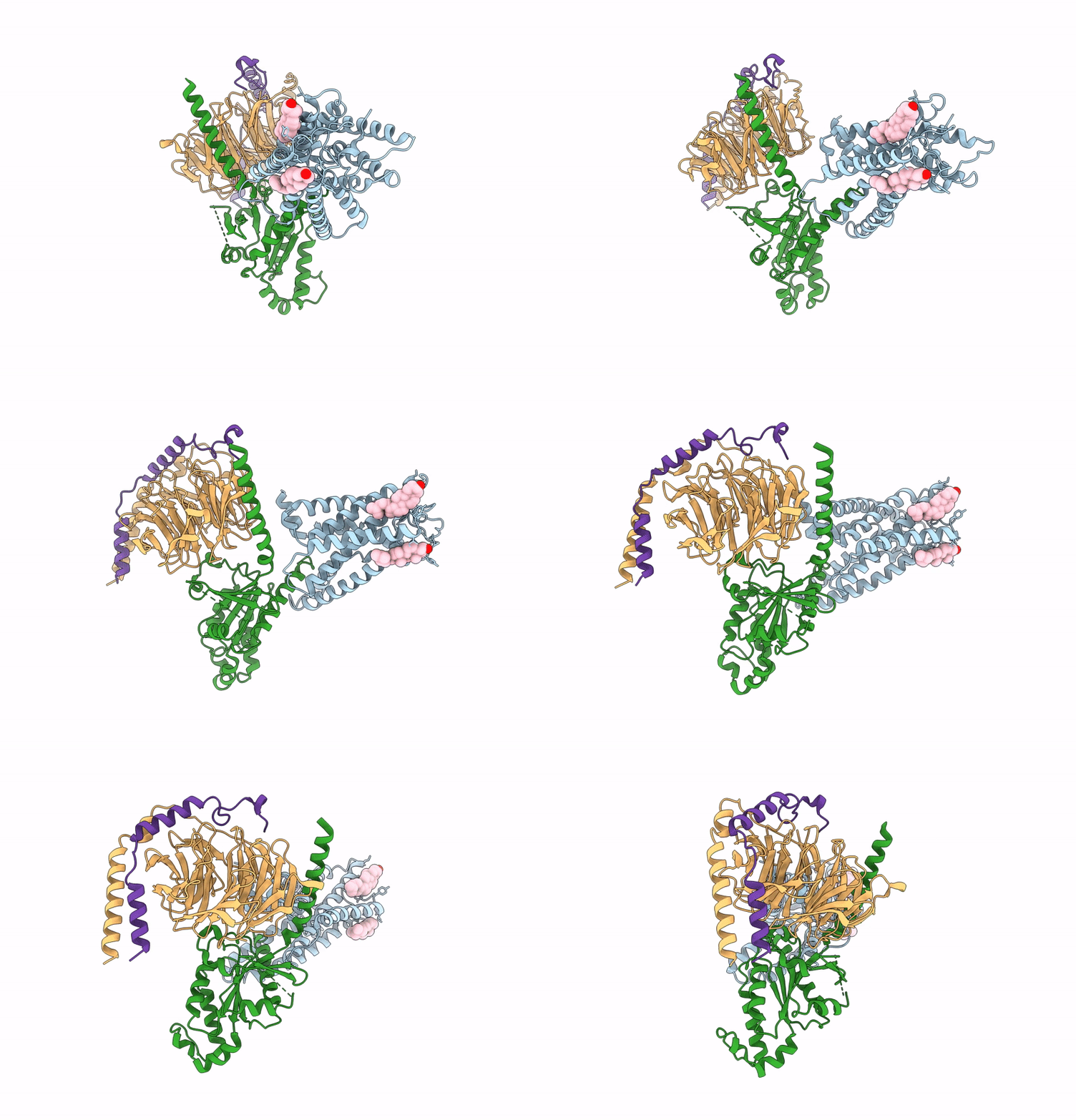
9E51 image
Deposition Date 2024-10-26
Release Date 2025-11-12
Last Version Date 2026-03-04
Entry Detail
PDB ID:
9E51
Title:
Cryo-EM structure of human LPHN2 (ADGRL2)/G13 complex in lipid nanodiscs
Biological Source:
Source Organism(s):
Homo sapiens (Taxon ID: 9606)
Expression System(s):
Method Details:
Experimental Method:
Resolution:
2.90 Å
Aggregation State:
PARTICLE
Reconstruction Method:
SINGLE PARTICLE
Macromolecular Entities
Structures with similar UniProt ID
Protein Blast
Polymer Type:polypeptide(L)
Molecule:Adhesion G protein-coupled re
Gene (Uniprot):ADGRL2
Chain IDs:D (auth: A)
Chain Length:325
Number of Molecules:1
Biological Source:Homo sapiens
Structures with similar UniProt ID
Protein Blast
Polymer Type:polypeptide(L)
Molecule:Isoform 2 of Guanine nucleoti
Gene (Uniprot):GNA13
Chain IDs:A (auth: B)
Chain Length:230
Number of Molecules:1
Biological Source:Homo sapiens
Structures with similar UniProt ID
Protein Blast
Polymer Type:polypeptide(L)
Molecule:Guanine nucleotide-binding pr
Gene (Uniprot):GNB1
Chain IDs:B (auth: C)
Chain Length:340
Number of Molecules:1
Biological Source:Homo sapiens
Structures with similar UniProt ID
Protein Blast
Polymer Type:polypeptide(L)
Molecule:Guanine nucleotide-binding pr
Gene (Uniprot):GNG2
Chain IDs:C (auth: D)
Chain Length:71
Number of Molecules:1
Biological Source:Homo sapiens
Ligand Molecules
Primary Citation
The adhesion GPCR ADGRL2 engages G alpha 13 to enable epidermal differentiation.
Proc. Natl. Acad. Sci. U.S.A. 122 e2508436122 e2508436122 (2025)
PMID: 41252157 DOI: 10.1073/pnas.2508436122

Abstact

Homeostasis relies on signaling networks controlled by cell membrane receptors. Although G-protein-coupled receptors (GPCRs) are the largest family of transmembrane receptors, their specific roles in the epidermis are not fully understood. Dual CRISPR-Flow and single cell Perturb RNA-sequencing knockout screens of all epidermal GPCRs were thus performed, uncovering an essential requirement for adhesion GPCR ADGRL2 (latrophilin 2) in epidermal differentiation. Among potential downstream guanine nucleotide-binding G proteins, ADGRL2 selectively activated Galpha13. Follow-up tissue knockouts verified that Galpha13 is also required for epidermal differentiation. A cryoelectron microscopy structure in lipid nanodiscs showed that ADGRL2 engages with Galpha13 at multiple interfaces, including via an interaction between ADGRL2 intracellular loop 3 and a Galpha13-specific QQQ glutamine triplet sequence in its GTPase domain. In situ gene mutation of this interface sequence impaired epidermal differentiation, highlighting an essential new role for an ADGRL2-Galpha13 axis in epidermal differentiation.

Legend

Protein

Chemical

Disease

Primary Citation of related structures
Feedback Form
Name
Email
Institute
Feedback