

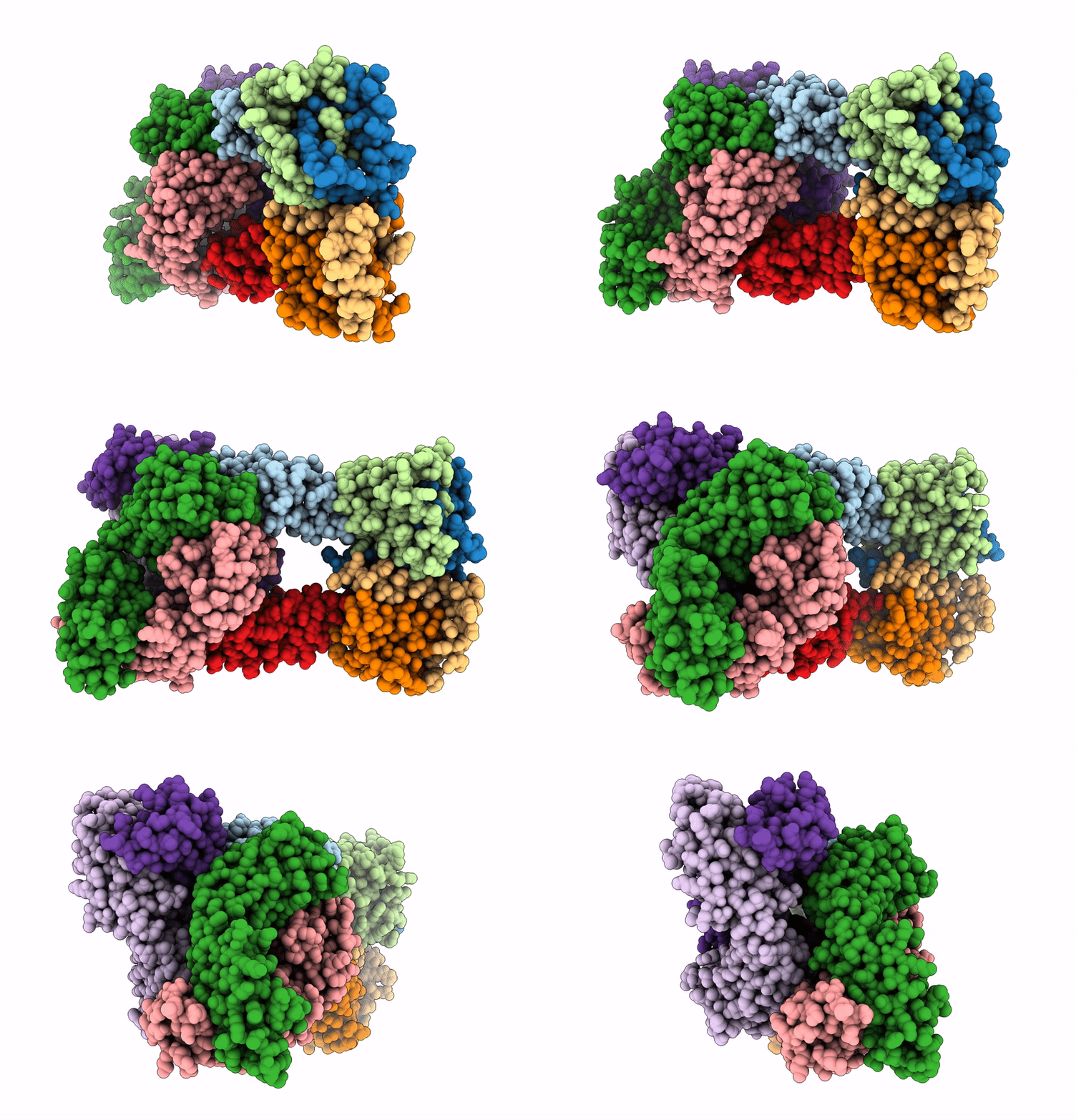
9DVB image
Deposition Date 2024-10-07
Release Date 2025-10-15
Last Version Date 2026-04-29
Entry Detail
PDB ID:
9DVB
Title:
Thermus thermophilus MreC-MreD complex with an internal MreD BRIL fusion and an anti-BRIL Fab
Biological Source:
Source Organism(s):
Expression System(s):
Method Details:
Experimental Method:
Resolution:
3.60 Å
Aggregation State:
PARTICLE
Reconstruction Method:
SINGLE PARTICLE
Macromolecular Entities
Structures with similar UniProt ID
Protein Blast
Polymer Type:polypeptide(L)
Molecule:Soluble cytochrome b562
Gene (Uniprot):cybC
Chain IDs:A (auth: B), F (auth: N)
Chain Length:117
Number of Molecules:2
Biological Source:Escherichia coli
Protein Blast
Polymer Type:polypeptide(L)
Molecule:Cell shape-determining protei
Gene (Uniprot):TthHB5018_12720
Chain IDs:B (auth: C), G (auth: O)
Chain Length:262
Number of Molecules:2
Biological Source:Thermus thermophilus
Structures with similar UniProt ID
Protein Blast
Polymer Type:polypeptide(L)
Molecule:Rod shape-determining protein
Gene (Uniprot):TTHA1190
Chain IDs:C (auth: D), H (auth: P)
Chain Length:152
Number of Molecules:2
Biological Source:Thermus thermophilus
Protein Blast
Polymer Type:polypeptide(L)
Molecule:BAG2 anti-BRIL Fab heavy chai
Chain IDs:D (auth: H), I (auth: W)
Chain Length:227
Number of Molecules:2
Biological Source:synthetic construct
Protein Blast
Polymer Type:polypeptide(L)
Molecule:BAG2 anti-BRIL Fab light chai
Chain IDs:E (auth: L), J (auth: X)
Chain Length:215
Number of Molecules:2
Biological Source:synthetic construct
Ligand Molecules
Primary Citation
Conformational regulation of two essential activators of bacterial cell elongation.
Proc.Natl.Acad.Sci.USA 122 e2514198122 e2514198122 (2025)
PMID: 41183199 DOI: 10.1073/pnas.2514198122

Abstact

The peptidoglycan (PG) cell wall is critical for bacterial growth and survival and is a primary antibiotic target. MreD is an essential accessory factor of the Rod complex, which carries out PG synthesis during elongation, yet little is known about how MreD facilitates this process. Here, we present the cryoelectron microscopy structure of Thermus thermophilus MreD in complex with another essential Rod complex component, MreC. The structure reveals that a periplasmic-facing pocket of MreD interacts with multiple membrane-proximal regions of MreC. We use single-molecule FRET to show that MreD controls the conformation of MreC through these contacts, inducing a state primed for Rod complex activation. Using Escherichia coli as a model, we demonstrate that disrupting these interactions abolishes Rod complex activity in vivo. Our findings reveal the role of MreD in bacterial cell shape determination and highlight its potential as an antibiotic target.

Legend

Protein

Chemical

Disease

Primary Citation of related structures
Feedback Form
Name
Email
Institute
Feedback