

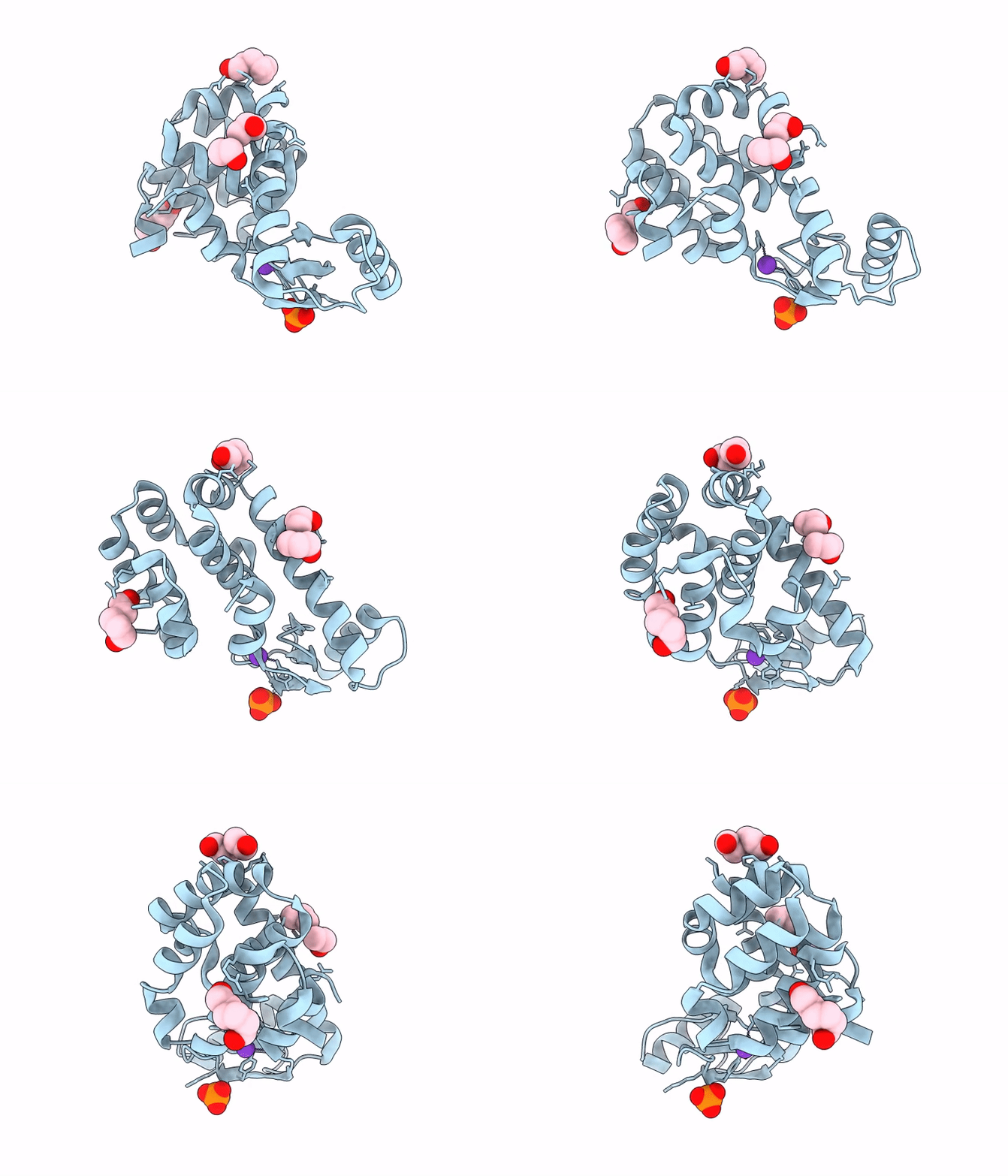
9DJM image
Deposition Date 2024-09-06
Release Date 2026-02-18
Last Version Date 2026-04-15
Entry Detail
PDB ID:
9DJM
Keywords:
Title:
T4 Lysozyme K147H/T151H
Biological Source:
Source Organism(s):
Expression System(s):
Method Details:
Experimental Method:
Resolution:
1.08 Å
R-Value Free:
0.16
R-Value Work:
0.14
R-Value Observed:
0.15
Space Group:
P 32 2 1

Macromolecular Entities
Structures with similar UniProt ID
Protein Blast
Polymer Type:polypeptide(L)
Molecule:Endolysin
Gene (Uniprot):e
Mutagens:C54T, C97A, K147H, T151H
Chain IDs:A
Chain Length:164
Number of Molecules:1
Biological Source:Tequatrovirus T4
Primary Citation
Structural characterization of the Cu(II)-NTA spin label on alpha-helices by X-ray crystallography and electron paramagnetic resonance.
Structure 34 645 ? (2026)
PMID: 41794029 DOI: 10.1016/j.str.2026.01.010

Abstact

Site-directed Cu(II)-labelling in pulsed electron paramagnetic resonance (EPR) spectroscopy has demonstrated narrow Cu(II)-Cu(II) distance distributions suitable to resolve subtle protein conformational changes. The high precision derives from a double histidine (dHis) mutation that effectively locks a Cu(II)-nitrilotriacetic acid (Cu(II)-NTA) moiety in place. To date, no structures featuring the dHis-Cu(II)-NTA motif have been resolved. This work presents the atomic-resolution X-ray crystal structures of seven alpha-helical dHis sites of T4 lysozyme (T4L) in the presence and absence of Cu(II)-NTA. Our research captured the rigid octahedral coordination of the dHis-Cu(II)-NTA complex as well as non-conventional binding modes, which provide valuable insight into dHis site selection. Pulsed EPR experiments on double dHis T4L mutants displayed remarkable agreement to the crystallography-derived distances. This research showcases the rigid configuration of the dHis-Cu(II)-NTA motif, providing geometric constraints that can be leveraged in modeling and molecular dynamics programs to extract protein structural details from EPR experiments.

Legend

Protein

Chemical

Disease

Primary Citation of related structures
Feedback Form
Name
Email
Institute
Feedback