

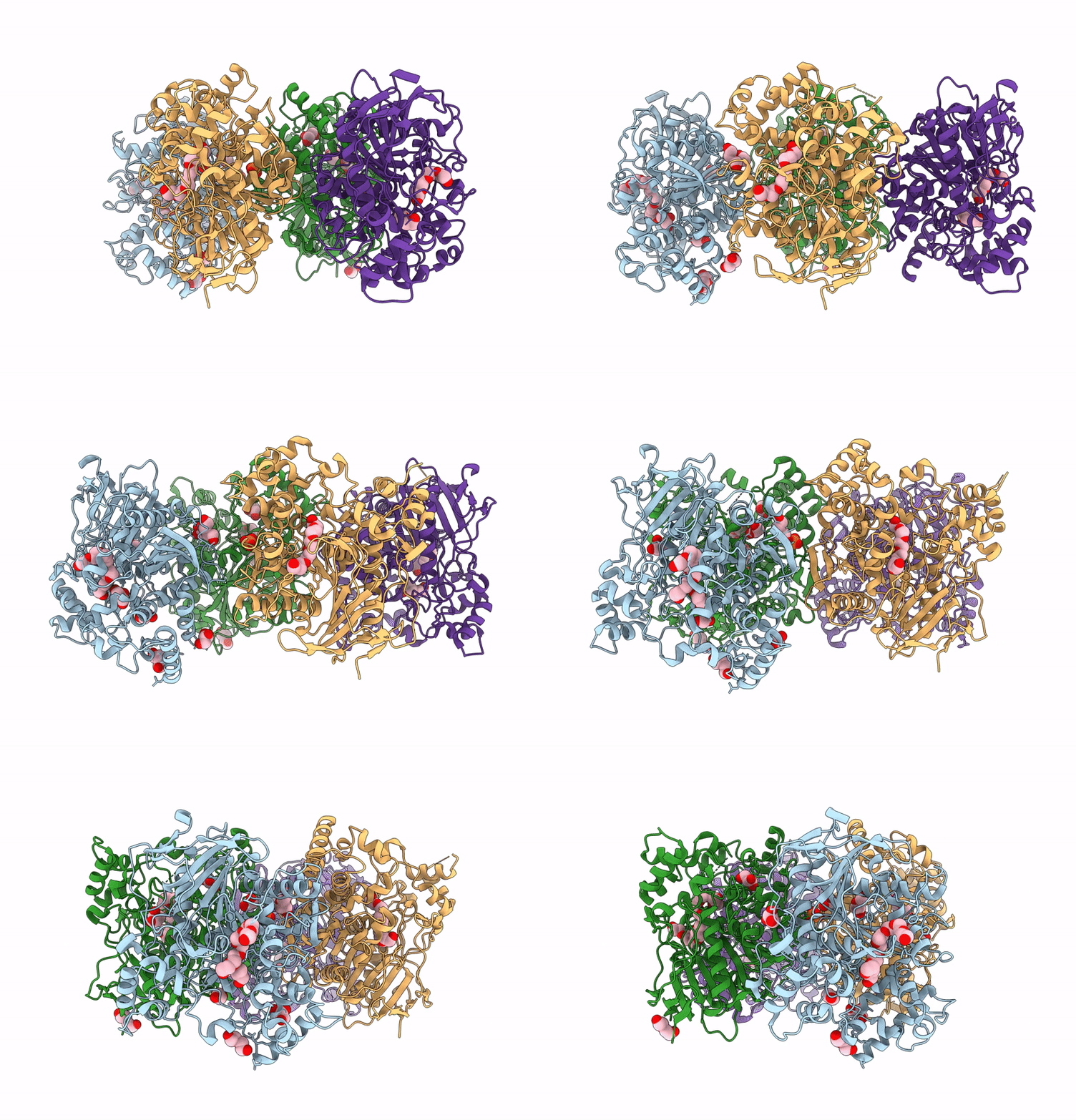
9D1K image
Deposition Date 2024-08-07
Release Date 2025-08-13
Last Version Date 2026-03-04
Entry Detail
PDB ID:
9D1K
Keywords:
Title:
The alpha-E7 carboxylesterase from Anopheles gambiae
Biological Source:
Source Organism(s):
Expression System(s):
Method Details:
Experimental Method:
Resolution:
1.79 Å
R-Value Free:
0.24
R-Value Work:
0.20
R-Value Observed:
0.20
Space Group:
P 1 21 1
Macromolecular Entities
Structures with similar UniProt ID
Protein Blast
Polymer Type:polypeptide(L)
Molecule:Carboxylic ester hydrolase
Gene (Uniprot):1276889
Chain IDs:A
Chain Length:540
Number of Molecules:1
Biological Source:Anopheles gambiae
Structures with similar UniProt ID
Protein Blast
Polymer Type:polypeptide(L)
Molecule:Carboxylic ester hydrolase
Gene (Uniprot):1276889
Chain IDs:B
Chain Length:540
Number of Molecules:1
Biological Source:Anopheles gambiae
Structures with similar UniProt ID
Protein Blast
Polymer Type:polypeptide(L)
Molecule:Carboxylic ester hydrolase
Gene (Uniprot):1276889
Chain IDs:C
Chain Length:540
Number of Molecules:1
Biological Source:Anopheles gambiae
Structures with similar UniProt ID
Protein Blast
Polymer Type:polypeptide(L)
Molecule:Carboxylic ester hydrolase
Gene (Uniprot):1276889
Chain IDs:D
Chain Length:540
Number of Molecules:1
Biological Source:Anopheles gambiae
Modified Residue
Compound ID Chain ID Parent Comp ID Details 2D Image
MLY A LYS modified residue
MLZ B LYS modified residue
Primary Citation
Structural and evolutionary constraints of organophosphate resistance in dipteran carboxylesterases.
Proc. Natl. Acad. Sci. U.S.A. 123 e2517957123 e2517957123 (2026)
PMID: 41730108 DOI: 10.1073/pnas.2517957123

Abstact

Enzymatic detoxification of organophosphate (OP) insecticides can confer resistance in some insects, yet the precise molecular basis of this trait, and how it has evolved, remains poorly understood. In certain dipteran species, a G-->D mutation in the oxyanion hole of alpha-carboxylesterases (CBEs) enhances OP hydrolysis, yet this adaptation is not widespread despite the presence of orthologous CBEs in other insect species that are also exposed to OPs. The extent, and molecular basis, of evolutionary contingency and epistasis in this catalytic OP resistance has not been explored, and how further mutations might optimize OP detoxification in the future is not clear. Here, we systematically compare OP hydrolysis and analyze structures of CBE orthologs across several dipteran species, revealing that the success of the G137D mutation is sequence context-dependent. We employed laboratory-directed evolution to enhance OP turnover over 1,000-fold vs. the wildtype enzyme and tested these variants in transgenic Drosophila melanogaster, demonstrating that improved catalytic rates do not directly translate to increased resistance. By highlighting the trade-off between organophosphate affinity and turnover, this work further clarifies the complex evolutionary trajectories determining why a particular resistance mechanism may evolve in some species but not others.

Legend

Protein

Chemical

Disease

Primary Citation of related structures
Feedback Form
Name
Email
Institute
Feedback