

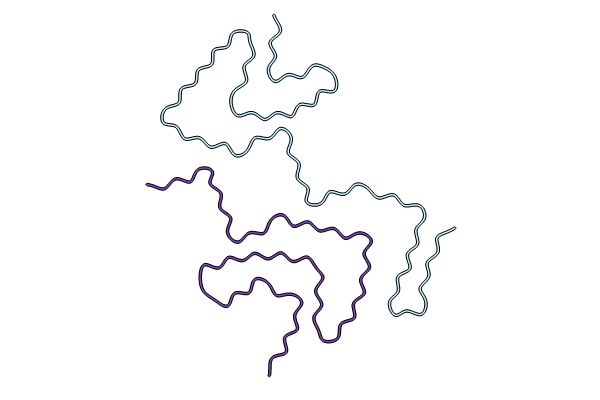
9CX6 image
Deposition Date 2024-07-30
Release Date 2024-08-14
Last Version Date 2024-08-14
Entry Detail
PDB ID:
9CX6
Keywords:
Title:
Cryo-EM filament structure in FTLD-synuclein
Biological Source:
Source Organism(s):
Homo sapiens (Taxon ID: 9606)
Method Details:
Experimental Method:
Resolution:
3.20 Å
Aggregation State:
FILAMENT
Reconstruction Method:
HELICAL

Macromolecular Entities
Structures with similar UniProt ID
Protein Blast
Polymer Type:polypeptide(L)
Molecule:Alpha-synuclein
Gene (Uniprot):SNCA
Chain IDs:A (auth: G), B (auth: H)
Chain Length:140
Number of Molecules:2
Biological Source:Homo sapiens
Primary Citation
Identical Seeding Characteristics and Cryo-EM Filament Structures in FTLD-Synuclein and Typical Multiple System Atrophy.
Neuropathol Appl Neurobiol 51 e70013 e70013 (2025)
PMID: 40135351 DOI: 10.1111/nan.70013

Abstact

AIMS The aim of this study is to identify the prevalence of frontotemporal dementia (FTD)/corticobasal syndrome (CBS) in a large cohort of pathologically confirmed cases of multiple system atrophy (MSA) and to determine the α-synuclein seeding characteristics and electron cryo-microscopy (cryo-EM) filament structure in frontotemporal lobar degeneration with MSA-type α-synuclein pathology (FTLD-synuclein). METHODS The archives of the Queen Square Brain Bank (1989-2023) were searched for histologically confirmed MSA cases, and those with a clinical diagnosis of FTD/CBS were reviewed for pathological features of FTLD-synuclein. Phosphotungstic acid (PTA)-precipitated brain homogenates from FTLD-synuclein, dementia with Lewy bodies (DLB) and G51D SNCA synucleinopathy cases were used to seed aggregation in α-syn140*A53T-YFP HEK293T cells. The structure of α-synuclein filaments from an FTLD-synuclein case was determined by cryo-EM. RESULTS We identified 283 cases of MSA. Four cases had a clinical diagnosis of CBS, one of which met pathological criteria for FTLD-synuclein. Genetic studies in this case were negative for SNCA variants, and PTA-precipitated brain homogenates seeded abundant cytoplasmic α-synuclein inclusions that were morphologically indistinguishable from those of typical MSA but distinct from those of G51D SNCA and DLB. MSA Type II α-synuclein filaments were identified by cryo-EM. CONCLUSIONS FTD/CBS is rarely associated with MSA pathology. The cell seeding characteristics and cryo-EM findings support the classification of FTLD-synuclein as a subtype of MSA, differentiating it from genetic synucleinopathies, such as those with SNCA variants G51D and A53E, which have neuropathological features overlapping with MSA and Lewy body diseases. These cases expand the clinicopathological spectrum of MSA and FTLD and have implications for our understanding of selective neuronal vulnerability in MSA and the interpretation of α-synuclein biomarker studies.

Legend

Protein

Chemical

Disease

Primary Citation of related structures
Feedback Form
Name
Email
Institute
Feedback