

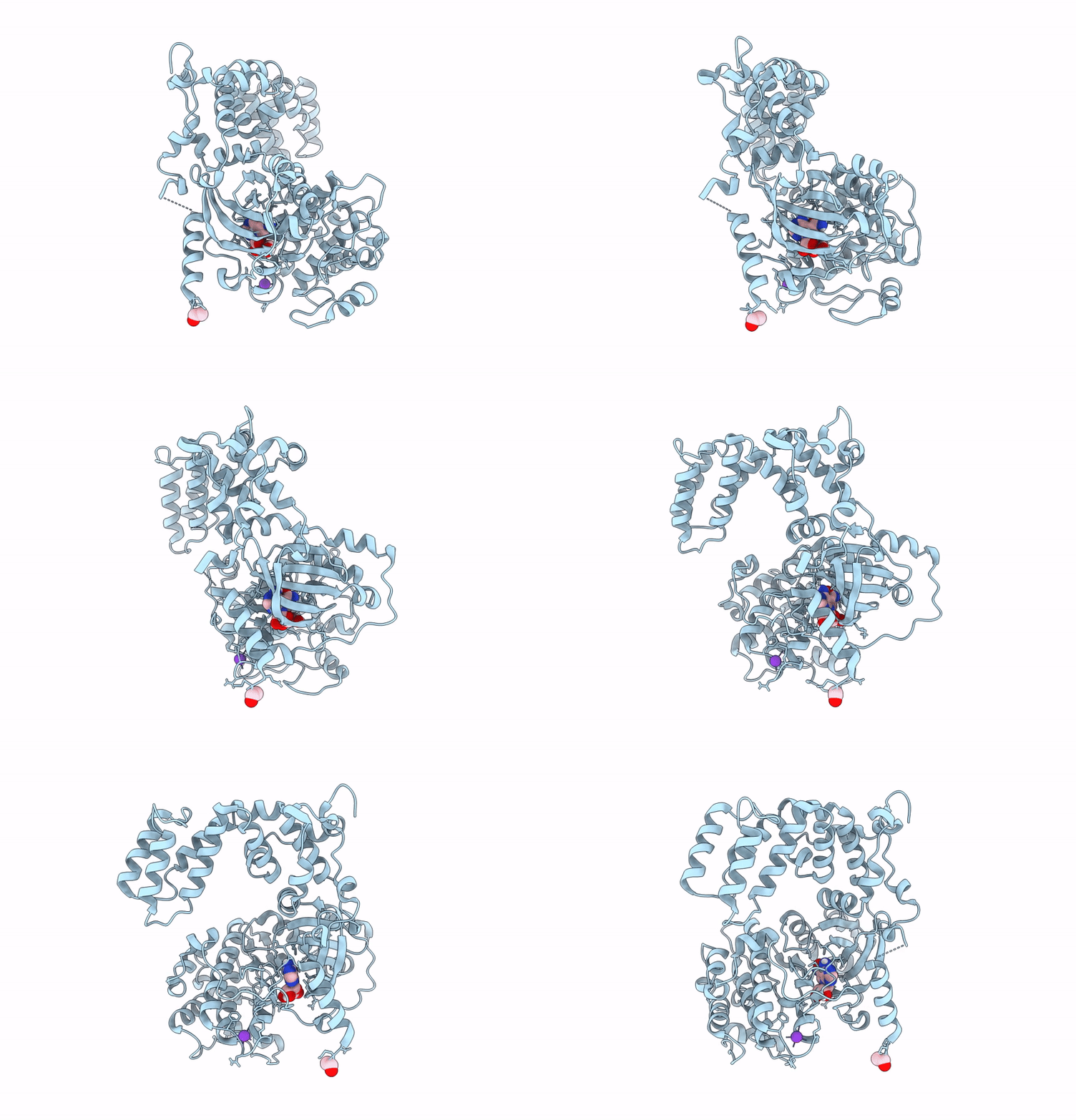
9CKP image
Deposition Date 2024-07-09
Release Date 2025-07-16
Last Version Date 2026-05-20
Entry Detail
PDB ID:
9CKP
Title:
Human G protein-coupled receptor kinase 5-D311N in complex with sangivamycin
Biological Source:
Source Organism(s):
Homo sapiens (Taxon ID: 9606)
Expression System(s):
Method Details:
Experimental Method:
Resolution:
2.60 Å
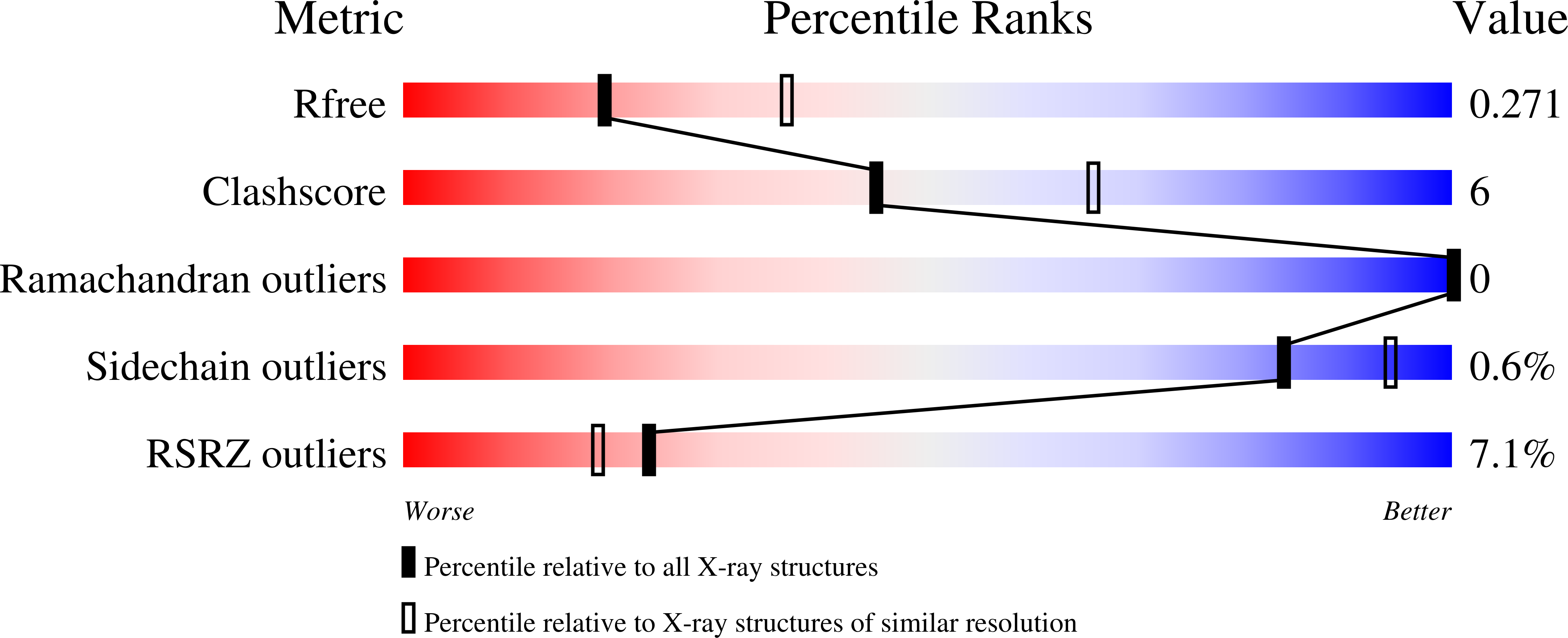
R-Value Free:
0.26
R-Value Work:
0.23
R-Value Observed:
0.23
Space Group:
P 41 21 2
Macromolecular Entities
Structures with similar UniProt ID
Protein Blast
Polymer Type:polypeptide(L)
Molecule:G protein-coupled receptor ki
Gene (Uniprot):GRK5
Mutagens:D311N
Chain IDs:A
Chain Length:598
Number of Molecules:1
Biological Source:Homo sapiens
Primary Citation
Structural insights into the catalytic cycle of G protein-coupled receptor kinase 5 and a possible regulatory site for potassium ion.
J.Biol.Chem. 301 110309 110309 (2025)
PMID: 40449596 DOI: 10.1016/j.jbc.2025.110309

Abstact

G protein-coupled receptor (GPCR) kinases (GRKs) instigateGPCR desensitization, but despite many available structures, a molecular understanding of their function and catalytic cycle remains incomplete. We present six GRK5 crystal structures that capture both open and closed states of its kinase domain as well as complexes with the ligands sangivamycin (Sgv), an adenosine analog, and ATP. The Sgv-bound structure is distinct from the previously reported GRK5.Sgv structure and features an ordered N-terminal helix that docks to the kinase hinge, mimicking its interactions in GPCR or Ca(2+).calmodulin-bound GRK complexes. GRK5 undergoes a dramatic conformational change in the crystals to a ligand-free, open state with a disordered N terminus when K(+) is omitted from the harvesting solution. This transition to a ligand-free structure, not structurally observed for the GRK4 subfamily, most likely occurs through the release of the K(+) ion from its binding site close to the kinase domain hinge in the Sgv-bound complex. Two structures of GRK5 in complex with Mg(2+) and Mn(2+).ATP were obtained via soaking crystals of the open state, which we hypothesize are reflective of a substrate-loading stage. Although K(+) significantly stabilizes GRK5 in its closed, near-active conformation, potassium citrate and KCl inhibit kinase activity just as potently as sodium citrate and NaCl, respectively, suggesting that K(+) traps a closed conformation compatible with Sgv-AMP but incompatible with ATP, thereby inhibiting the catalytic cycle. Thus, changes in K(+) concentration could play a regulatory role for GRK5 in scenarios where activated GPCRs are coupled to G protein-responsive potassium channels.

Legend

Protein

Chemical

Disease

Primary Citation of related structures
Feedback Form
Name
Email
Institute
Feedback