

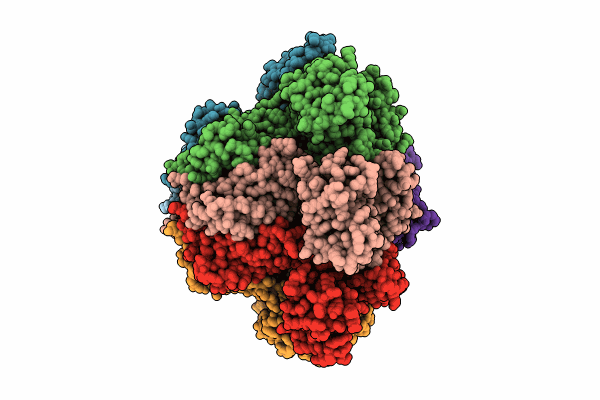
9BBF image
Deposition Date 2024-04-05
Release Date 2024-11-27
Last Version Date 2026-06-10
Entry Detail
PDB ID:
9BBF
Keywords:
Title:
Structure of Clostridioides difficile Component A (50-463) in Complex with a CDTb Oligomer
Biological Source:
Source Organism(s):
Expression System(s):
Method Details:
Experimental Method:
Resolution:
3.60 Å
Aggregation State:
PARTICLE
Reconstruction Method:
SINGLE PARTICLE

Macromolecular Entities
Polymer Type:polypeptide(L)
Molecule:ADP-ribosyltransferase bindin
Gene (Uniprot):cdtB
Chain IDs:A, B, C, D, E, F, G
Chain Length:835
Number of Molecules:7
Biological Source:Clostridioides difficile
Polymer Type:polypeptide(L)
Molecule:ADP-ribosyltransferase enzyma
Gene (Uniprot):cdtA
Chain IDs:H (auth: Z)
Chain Length:414
Number of Molecules:1
Biological Source:Clostridioides difficile
Ligand Molecules
Primary Citation
The N-terminus of the Clostridioides difficile transferase A component directs toxin activity and potency.
Mbio 16 e0240524 e0240524 (2025)
PMID: 39611841 DOI: 10.1128/mbio.02405-24

Abstact

Clostridioides difficile infection is the leading cause of antibiotic-associated, hospital-acquired diarrhea in the USA; the pathology of which is mediated by toxins. The presence of a toxin known as the C. difficile Transferase (CDT) in some clinical isolates is linked to severe symptoms including increased incidence of reinfection and higher rates of mortality. Despite its apparent importance to C. difficile pathology, a mechanistic model of how CDT intoxicates cells remains incomplete. Here, we describe a motif composed of acidic and basic residues (the KDKEK motif) that is essential for toxin function. Using Cryogenic Electron Microscopy (Cryo-EM), we highlight an orientation of the KDKEK motif wherein the acidic residues engage structures thought to play an important role during toxin delivery. We thus present a model wherein these interactions prime CDT for entry into host cells. We expect that this model can be extrapolated to other bacterial toxins to understand how they enter cells.IMPORTANCEClostridioides difficile is the leading cause of hospital-acquired infectious diarrhea in the USA. The pathology that accompanies infection is triggered by toxins produced by the bacterium. One of these, the C. difficile Transferase (CDT), has been associated with poorer patient outcomes, although a direct connection to CDT activity has remained elusive. Herein, we present new insight into the mechanism of CDT intoxication and define two regions of the toxin as important for its activity. Moreover, we have generated mutants of CDT that retain the ability to assemble but can no longer intoxicate host cells. In the future, we expect these mutants will serve as valuable tools to help elucidate the role of CDT during infection.

Legend

Protein

Chemical

Disease

Primary Citation of related structures
Feedback Form
Name
Email
Institute
Feedback