

8ZXO image
Deposition Date 2024-06-14
Release Date 2025-02-19
Last Version Date 2026-03-04
Entry Detail
PDB ID:
8ZXO
Title:
Structure of the red fluorescent protein mScarlet-H at pH8.5
Biological Source:
Source Organism(s):
Discosoma sp. (Taxon ID: 86600)
Expression System(s):
Method Details:
Experimental Method:
Resolution:
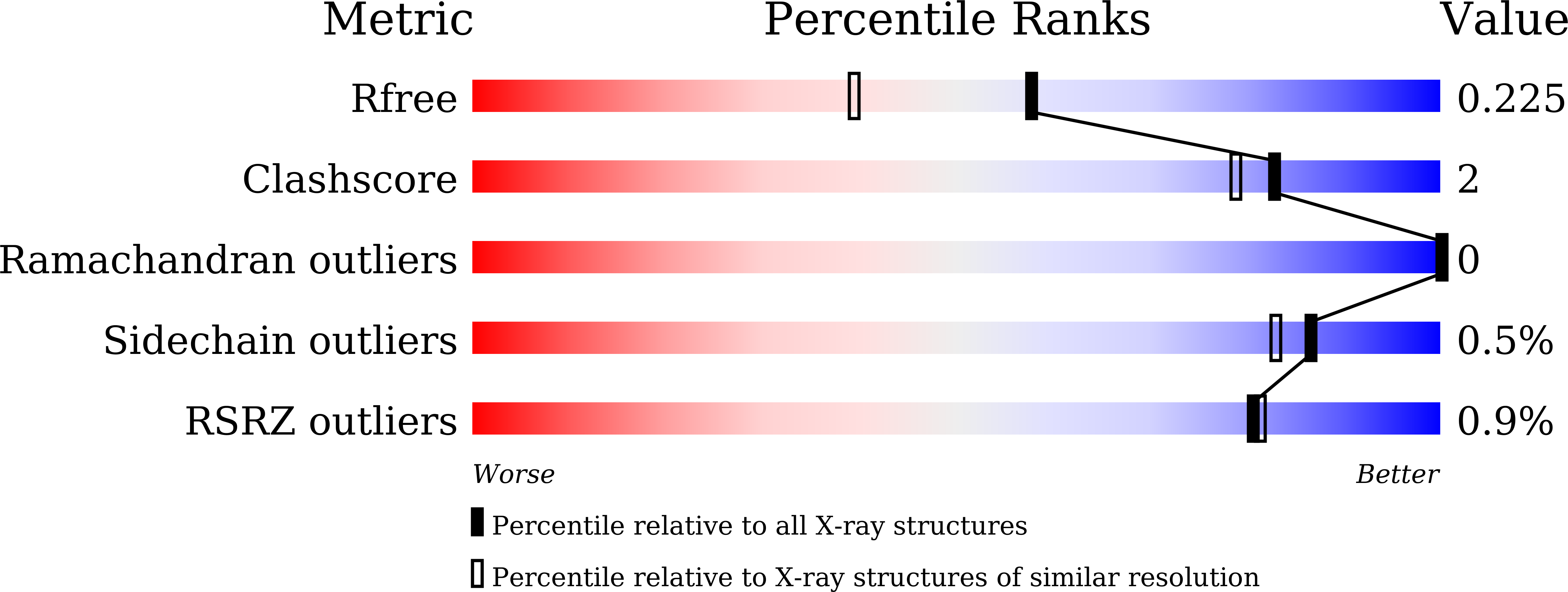
1.82 Å
R-Value Free:
0.22
R-Value Work:
0.18
R-Value Observed:
0.18
Space Group:
C 1 2 1
Macromolecular Entities
Structures with similar UniProt ID
Protein Blast
Polymer Type:polypeptide(L)
Molecule:red fluorescent protein mScar
Chain IDs:A
Chain Length:232
Number of Molecules:1
Biological Source:Discosoma sp.
Primary Citation
A highly stable monomeric red fluorescent protein for advanced microscopy.
Nat. Methods 22 1288 1298 (2025)
PMID: 40247125 DOI: 10.1038/s41592-025-02676-5

Abstact

The stability of fluorescent proteins (FPs) is crucial for imaging techniques such as live-cell imaging, super-resolution microscopy and correlative light and electron microscopy. Although stable green and yellow FPs are available, stable monomeric red FPs (RFPs) remain limited. Here we develop an extremely stable monomeric RFP named mScarlet3-H and determine its structure at a 1.5 A resolution. mScarlet3-H exhibits remarkable resistance to high temperature, chaotropic conditions and oxidative environments, enabling efficient correlative light and electron microscopy imaging and rapid (less than 1 day) whole-organ tissue clearing. In addition, its high photostability allows long-term three-dimensional structured illumination microscopy imaging of mitochondrial dynamics with minimal photobleaching. It also facilitates dual-color live-cell stimulated emission depletion imaging with a high signal-to-noise ratio and strong specificity. Systematic benchmarking against high-performing RFPs established mScarlet3-H as a highly stable RFP for multimodality microscopy in cell cultures and model organisms, complementing green FPs for multiplexed imaging in zebrafish, mice and Nicotiana benthamiana.

Legend

Protein

Chemical

Disease

Primary Citation of related structures
Feedback Form
Name
Email
Institute
Feedback