

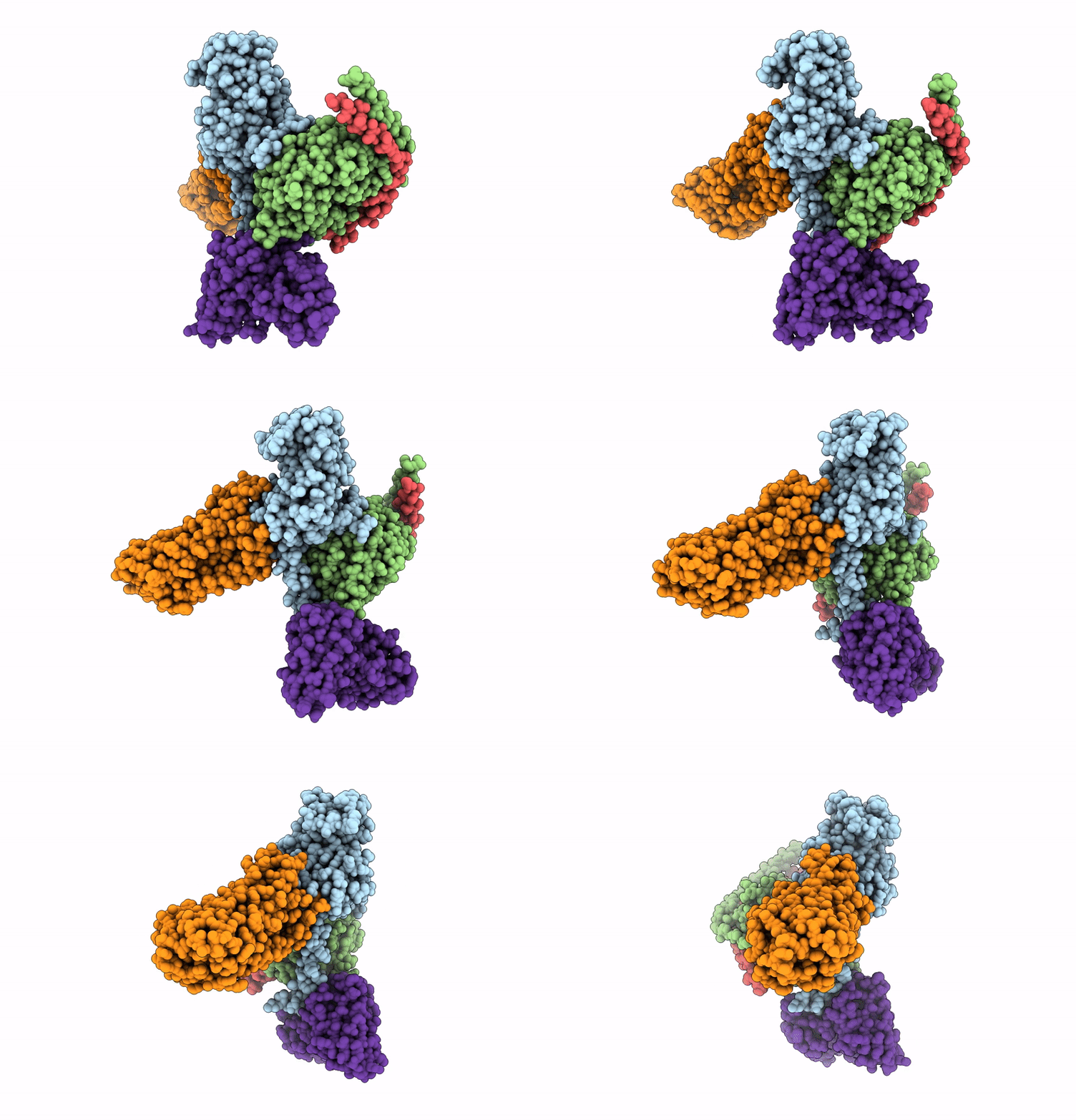
8Z3Y image
Deposition Date 2024-04-16
Release Date 2025-06-04
Last Version Date 2026-06-17
Entry Detail
PDB ID:
8Z3Y
Title:
Cryo-EM structure of of hGPR4-Gs complex in pH6.8
Biological Source:
Source Organism(s):
Expression System(s):
Method Details:
Experimental Method:
Resolution:
3.20 Å
Aggregation State:
PARTICLE
Reconstruction Method:
SINGLE PARTICLE
Macromolecular Entities
Protein Blast
Polymer Type:polypeptide(L)
Molecule:Guanine nucleotide-binding pr
Chain IDs:A
Chain Length:361
Number of Molecules:1
Biological Source:Homo sapiens
Structures with similar UniProt ID
Protein Blast
Polymer Type:polypeptide(L)
Molecule:Guanine nucleotide-binding pr
Gene (Uniprot):GNB1
Chain IDs:B
Chain Length:377
Number of Molecules:1
Biological Source:Homo sapiens
Structures with similar UniProt ID
Protein Blast
Polymer Type:polypeptide(L)
Molecule:Guanine nucleotide-binding pr
Gene (Uniprot):GNG2
Chain IDs:C (auth: G)
Chain Length:59
Number of Molecules:1
Biological Source:Homo sapiens
Structures with similar UniProt ID
Protein Blast
Polymer Type:polypeptide(L)
Molecule:G-protein coupled receptor 4
Gene (Uniprot):GPR4
Chain IDs:E (auth: R)
Chain Length:362
Number of Molecules:1
Biological Source:Homo sapiens
Protein Blast
Polymer Type:polypeptide(L)
Molecule:scFv16
Chain IDs:D (auth: S)
Chain Length:285
Number of Molecules:1
Biological Source:synthetic construct
Ligand Molecules
Primary Citation
Structural basis and biased signaling of proton sensation by GPCRs mediated by extracellular histidine rearrangement.
Mol.Cell 85 1658 1673.e7 (2025)
PMID: 40215959 DOI: 10.1016/j.molcel.2025.03.018

Abstact

Proton sensing by G protein-coupled receptors (GPCRs) is crucial in many life activities. However, its underlying mechanism remains unclear. Here, we report 8 cryoelectron microscopy (cryo-EM) structures of human GPR4 and GPR68 at different pH values and in complex with Gs or Gq trimers or in apo state. Structural inspection, structure-based pKa calculations, and mutational and computational analyses revealed that protonation of two conserved extracellular histidines induced polar network formation and other conformational changes to tether 7-transmembrane (TM7) to second extracellular loop (ECL2), and these changes constitute the central mechanisms of proton-induced activation of GPR4 and GPR68. Unexpectedly, proton sensation by specific extracellular histidine determined biased G protein coupling of GPR4. Moreover, GPR68's additional pH-sensing H84(2.67) enhances its function in a more acidic optimal pH range. The propagation path connecting proton-sensing histidines to the toggle switch was characterized. Collectively, we provide structural insights into the proton sensing, activation, and downstream effector coupling mechanisms of proton-sensing GPCRs.

Legend

Protein

Chemical

Disease

Primary Citation of related structures
Feedback Form
Name
Email
Institute
Feedback