

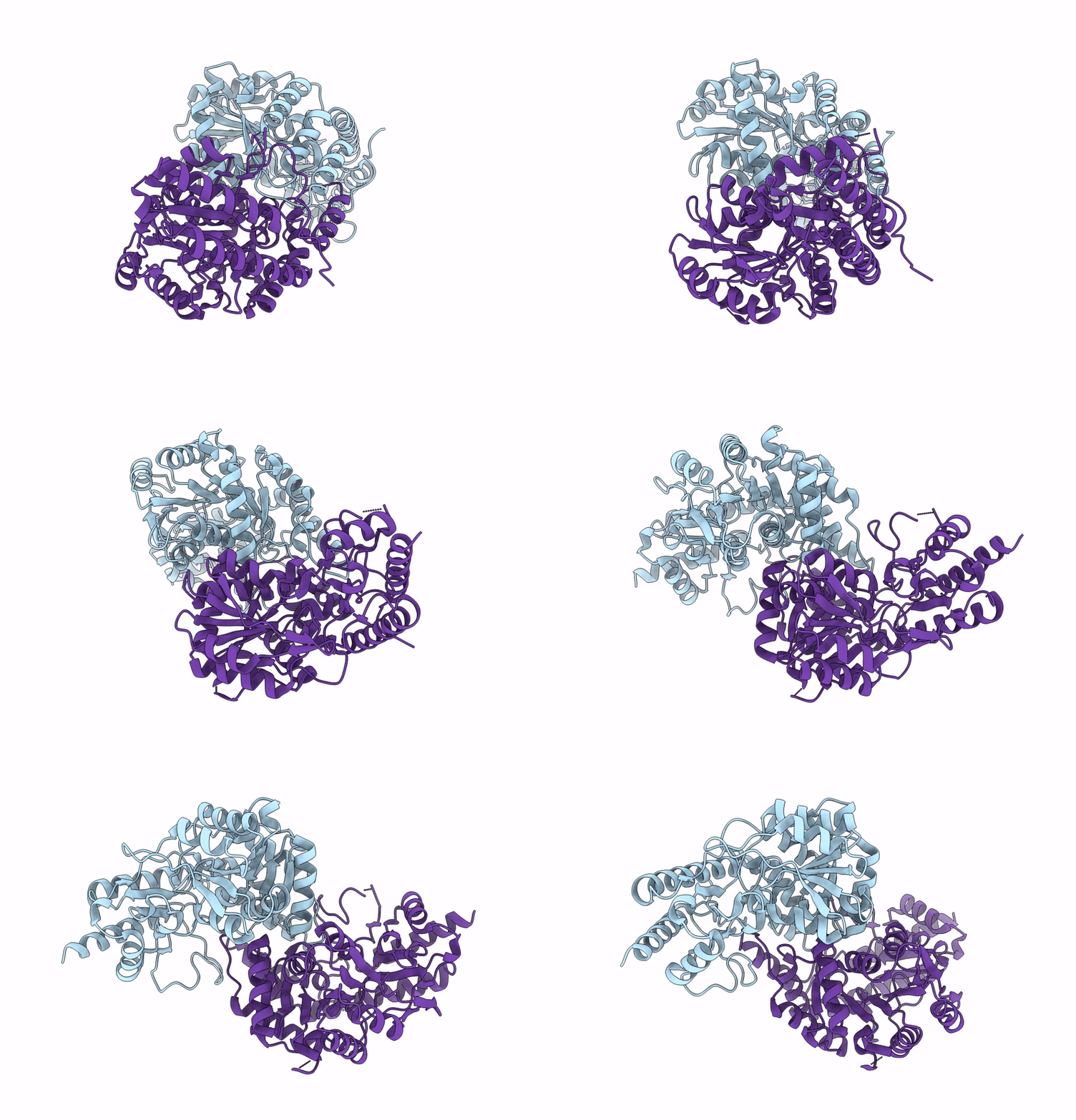
8Y54 image
Deposition Date 2024-01-31
Release Date 2024-11-20
Last Version Date 2026-06-03
Entry Detail
PDB ID:
8Y54
Title:
Three-dimensional structure of homo-dimer of cystathione beta lyase from lactobacillus delbrueckii(LdPatB)
Biological Source:
Expression System(s):
Method Details:
Experimental Method:
Resolution:
1.78 Å
R-Value Free:
0.23
R-Value Work:
0.20
Space Group:
C 1 2 1
Macromolecular Entities
Structures with similar UniProt ID
Protein Blast
Polymer Type:polypeptide(L)
Molecule:cysteine-S-conjugate beta-lya
Gene (Uniprot):LDL72_07215
Mutagens:V311E, N326D
Chain IDs:A, B
Chain Length:390
Number of Molecules:2
Biological Source:Lactobacillus delbrueckii subsp. lactis DSM 20072
Primary Citation
Electrostatic tuning of the pyridoxal-5'-phosphate cofactor site defines pH dependence in type I cystathionine beta-lyases.
J.Biol.Chem. 302 111469 111469 (2026)
PMID: 42001944 DOI: 10.1016/j.jbc.2026.111469

Abstact

Thiosulfinates, commonly known as "plant antibiotics", exhibit broad-spectrum antimicrobial activity, but are inherently unstable under alkaline conditions. Thus, the development of biocatalysts that maintain high efficiency at acidic pH is crucial. In this study, we determined the structures of two patB gene-encoded cystathionine beta-lyases from the fold-type I pyridoxal-5'-phosphate (PLP)-dependent family, BcPatB and LdPatB, which exhibit distinct pH dependencies in catalyzing the conversion of l-cysteine-S-conjugate sulfoxides to thiosulfinates. Structural comparison of these two PatBs revealed a residue pair located near the negatively charged phosphate group of the PLP cofactor, exhibiting distinct charge properties. By mutating this residue pair to enhance negative-negative charge interactions with the PLP phosphate, we generated the BcPatB mutant H263E/Q238M and LdPatB mutant H241M, both of which exhibited significantly improved activity at mildly acidic pH of 6.0. This strategy was subsequently applied to other fold-type I PLP-dependent enzymes, including MePatB, metC gene-encoded cystathionine beta-lyase from Klebsiella pneumoniae (KpMetC), and the alanine aminotransferase from Escherichia coli K-12 (Eck-12AlaA), resulting in mutants with modified pH preferences. Constant-pH molecular dynamics simulations demonstrated that the modified electrostatic interactions between PLP and the residue pair play a key role in driving pH-dependent catalysis in these mutants. These findings suggest that this residue pair may function as a pH switch in certain fold-type I PLP-dependent enzymes, and that rational engineering of this position offers a promising strategy for tailoring enzymes to specific industrial pH conditions.

Legend

Protein

Chemical

Disease

Primary Citation of related structures
Feedback Form
Name
Email
Institute
Feedback