

8XZ0 image
Deposition Date 2024-01-20
Release Date 2025-10-08
Last Version Date 2026-04-22
Entry Detail
PDB ID:
8XZ0
Title:
Crystal complex structure of SARS-CoV-2 S bound to human ezrin
Biological Source:
Expression System(s):
Method Details:
Experimental Method:
Resolution:
2.04 Å
R-Value Free:
0.25
R-Value Work:
0.21
R-Value Observed:
0.21
Space Group:
P 43
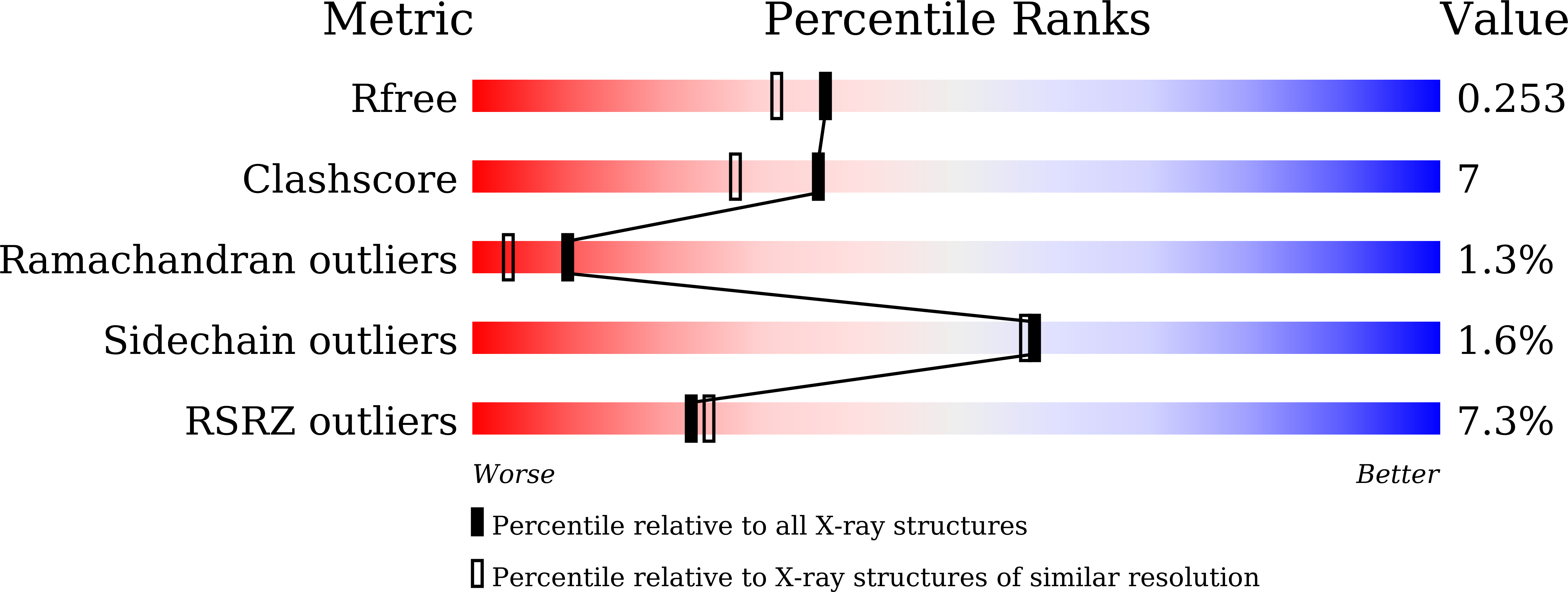
Macromolecular Entities
Structures with similar UniProt ID
Protein Blast
Polymer Type:polypeptide(L)
Molecule:Ezrin
Gene (Uniprot):EZR
Chain IDs:A
Chain Length:296
Number of Molecules:1
Biological Source:Homo sapiens
Structures with similar UniProt ID
Protein Blast
Polymer Type:polypeptide(L)
Molecule:Spike protein S2'
Gene (Uniprot):S
Chain IDs:B
Chain Length:14
Number of Molecules:1
Biological Source:Severe acute respiratory syndrome coronavirus 2
Primary Citation
SARS-CoV-2 S assembly into virions facilitated by host ERM proteins.
Proc. Natl. Acad. Sci. U.S.A. 123 e2504517123 e2504517123 (2026)
PMID: 41615754 DOI: 10.1073/pnas.2504517123

Abstact

The host cell cytoskeleton plays a critical role in the SARS-CoV-2 life cycle, though the underlying mechanisms remain poorly understood. This study investigates the interaction between the SARS-CoV-2 spike (S) protein and the cytoskeleton-associated ezrin-radixin-moesin (ERM) proteins through biochemical and structural characterization. A previously unidentified ERM-binding motif on the SARS-CoV-2 S protein is identified, revealing that S-ERM interactions are specifically conserved among highly pathogenic coronaviruses, including SARS-CoV, MERS-CoV, and SARS-CoV-2. Functionally, these interactions facilitate S packaging into virions by directing it to assembly sites, utilizing ERM's affinity for negatively curved membranes, akin to its role in cell surface protrusions. Silencing ERM expression significantly reduces SARS-CoV-2 titer, highlighting its essential role in viral propagation. Additionally, leveraging the established role of COPI-mediated trafficking in S localization, a compound is developed to disrupt S-COPI binding, promoting S secretion to the cell surface and effectively reducing viral titers. Our findings revealed a critical host-pathogen interaction that drives S incorporation into virions and identified ERM proteins as key facilitators of coronavirus assembly. Furthermore, our study suggests an antiviral strategy by targeting the S-COPI trafficking pathway. These insights advanced our understanding of coronavirus-host interactions and provided a potential therapeutic approach against SARS-CoV-2 and other highly pathogenic coronaviruses.

Legend

Protein

Chemical

Disease

Primary Citation of related structures
Feedback Form
Name
Email
Institute
Feedback