

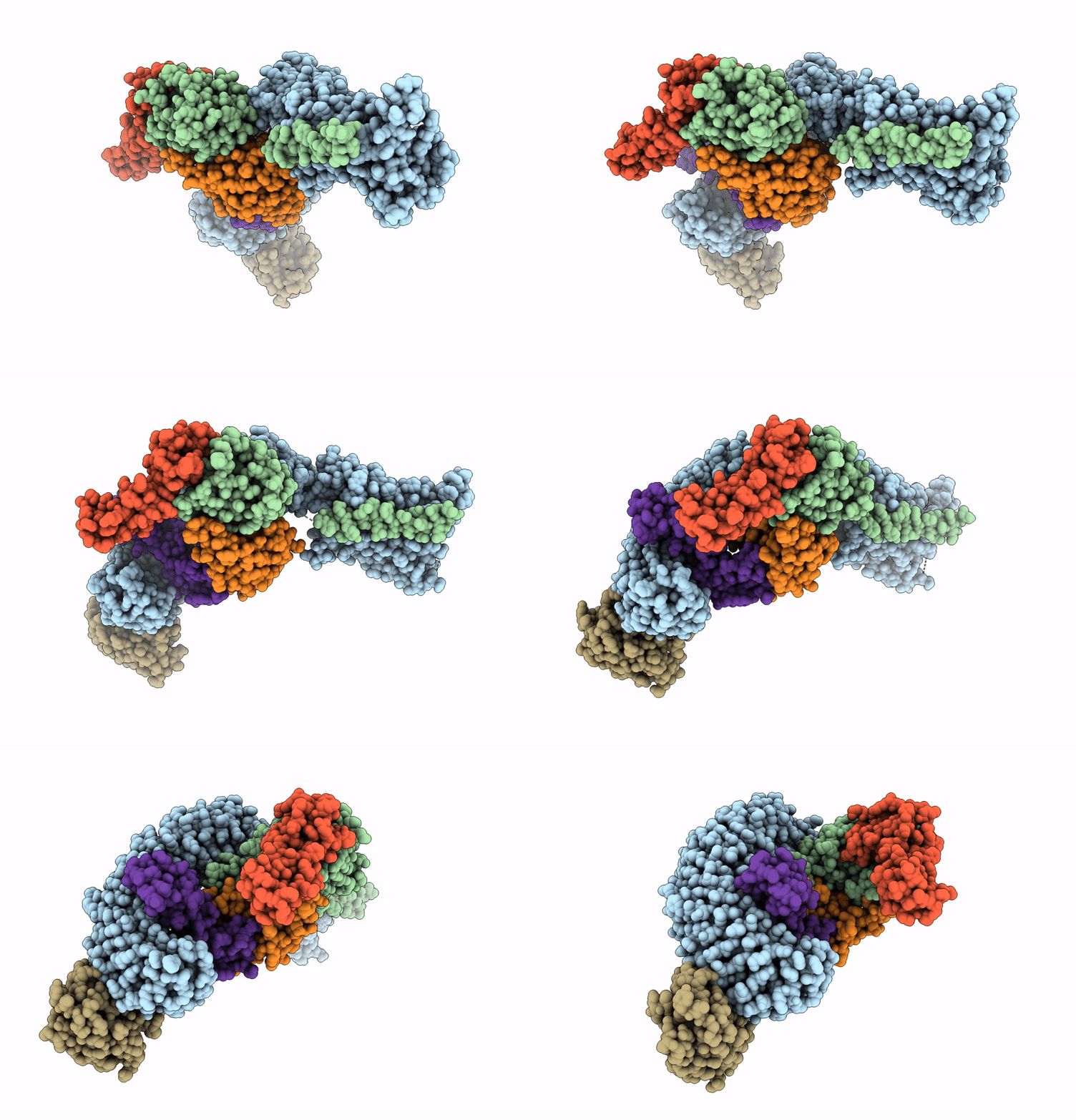
8XFP image
Deposition Date 2023-12-14
Release Date 2024-12-04
Last Version Date 2024-12-04
Entry Detail
PDB ID:
8XFP
Title:
the pentamerA complex of LGR4-RSPO2-ZNRF3(delta RING)
Biological Source:
Source Organism(s):
Homo sapiens (Taxon ID: 9606)
Camelus bactrianus (Taxon ID: 9837)
Expression System(s):
Method Details:
Experimental Method:
Resolution:
3.21 Å
Aggregation State:
PARTICLE
Reconstruction Method:
SINGLE PARTICLE
Macromolecular Entities
Structures with similar UniProt ID
Protein Blast
Polymer Type:polypeptide(L)
Molecule:Leucine-rich repeat-containin
Gene (Uniprot):LGR4
Chain IDs:A
Chain Length:951
Number of Molecules:1
Biological Source:Homo sapiens
Structures with similar UniProt ID
Protein Blast
Polymer Type:polypeptide(L)
Molecule:E3 ubiquitin-protein ligase Z
Gene (Uniprot):ZNRF3
Chain IDs:C, E (auth: H)
Chain Length:936
Number of Molecules:2
Biological Source:Homo sapiens
Protein Blast
Polymer Type:polypeptide(L)
Molecule:nanobody Nb52
Chain IDs:B (auth: E)
Chain Length:560
Number of Molecules:1
Biological Source:Camelus bactrianus
Structures with similar UniProt ID
Protein Blast
Polymer Type:polypeptide(L)
Molecule:R-spondin-2
Chain IDs:D (auth: G), F (auth: J)
Chain Length:101
Number of Molecules:2
Biological Source:Homo sapiens
Ligand Molecules
Primary Citation
Structural insights into the LGR4-RSPO2-ZNRF3 complexes regulating WNT/ beta-catenin signaling.
Nat Commun 16 362 362 (2025)
PMID: 39753551 DOI: 10.1038/s41467-024-55431-3

Abstact

WNT/β-catenin signaling plays key roles in development and cancer1,2. ZNRF3/RNF43 modulates Frizzleds through ubiquitination, dampening WNT/β-catenin signaling. Conversely, RSPO1-4 binding to LGR4-6 and ZNRF3/RNF43 enhances WNT/β-catenin signaling3-5. Here, we elucidate the overall landscape of architectures in multiple LGR4, RSPO2, and ZNRF3 assemblies, showcasing varying stoichiometries and arrangements. These structures reveal that LGR4 and RSPO2 capture distinct states of ZNRF3. The intrinsic heterogeneity of the LGR4-RSPO2-ZNRF3 assembly is influenced by LGR4 content. Particularly, in the assembly complex with a 2:2:2 ratio, two LGR4 protomers induce and stabilize the inactive state of ZNRF3, characterized by a wide inward-open conformation of two transmembrane helices (TM helices). This specific assembly promotes a stable complex, facilitating LGR4-induced endocytosis of ZNRF3. In contrast, the active dimeric ZNRF3, bound by a single LGR4, adopts a coiled-coil TM helices conformation and dimerization of RING domains. Our findings unveil how LGR4 content mediates diverse assemblies, leading to conformational rearrangements in ZNRF3 to regulate WNT/β-catenin signaling, and provide a structural foundation for drug development targeting Wnt-driven cancers.

Legend

Protein

Chemical

Disease

Primary Citation of related structures
Feedback Form
Name
Email
Institute
Feedback