

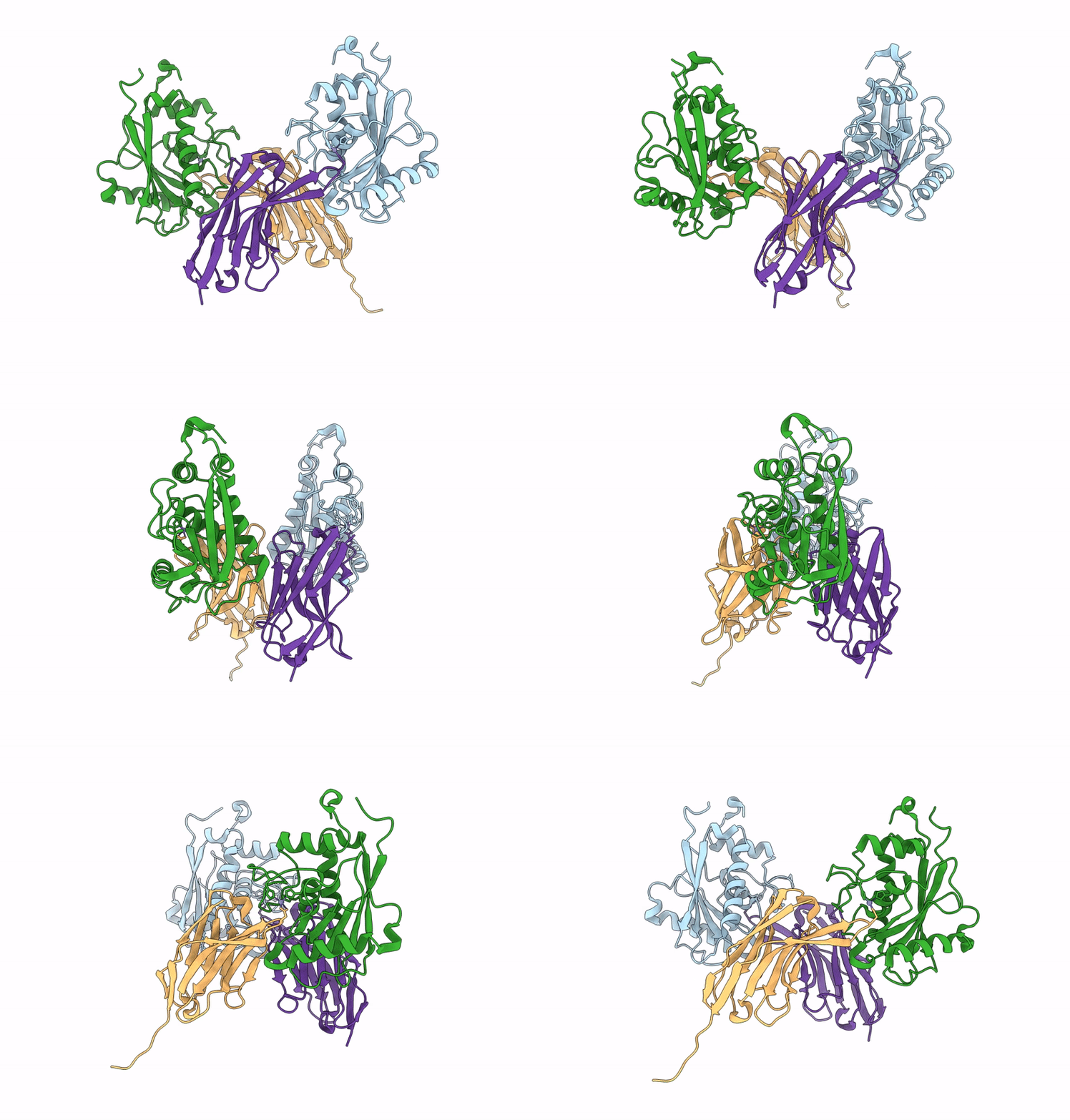
8WEO image
Deposition Date 2023-09-18
Release Date 2024-09-25
Last Version Date 2026-04-08
Entry Detail
PDB ID:
8WEO
Title:
Bacteroides fragilis toxin in complex with neutralization nanobody
Biological Source:
Source Organism(s):
Expression System(s):
Method Details:
Experimental Method:
Resolution:
1.50 Å
R-Value Free:
0.19
R-Value Work:
0.17
R-Value Observed:
0.17
Space Group:
P 65
Macromolecular Entities
Structures with similar UniProt ID
Protein Blast
Polymer Type:polypeptide(L)
Molecule:Fragilysin
Gene (Uniprot):btfP
Chain IDs:A (auth: B), C (auth: A)
Chain Length:186
Number of Molecules:2
Biological Source:Bacteroides fragilis
Protein Blast
Polymer Type:polypeptide(L)
Molecule:NB243
Chain IDs:B (auth: C), D
Chain Length:126
Number of Molecules:2
Biological Source:Vicugna pacos
Ligand Molecules
Primary Citation
Mechanistic diversity of Bacteroides fragilis toxins and neutralization with single domain antibody.
Cell Chem Biol 33 102 116.e6 (2026)
PMID: 41544614 DOI: 10.1016/j.chembiol.2025.12.009

Abstact

Enterotoxigenic Bacteroides fragilis (ETBF) promotes colonic inflammation by secreting metalloenzyme toxins (BFTs). Understanding BFT mechanisms and developing neutralization strategies is critical. Here, we have solved the structures of BFT-1 and BFT-2, revealing that residue 357 in the active site of the catalytic domain explains the diversity of function observed in BFT subtypes. We demonstrate that BFTs can directly cleave human epithelial-cadherin at extracellular domain 4, with BFT-2 possessing the highest activity. Using an alpaca antibody library, we identified a single-domain antibody, Nb2.43, targeting the BFTs. Nb2.43 can neutralize all three subtypes of BFT by directly binding the metalloenzyme catalytic zinc ion with its CDR3 antigen-binding loop. Furthermore, Nb2.43 blocks cleavage of E-cadherin by BFT and prevents the damage caused by ETBF in vitro and in a mouse colitis model. This work provides structural insights into BFT diversity and delivers a therapeutic nanobody against ETBF-mediated inflammation.

Legend

Protein

Chemical

Disease

Primary Citation of related structures
Feedback Form
Name
Email
Institute
Feedback