

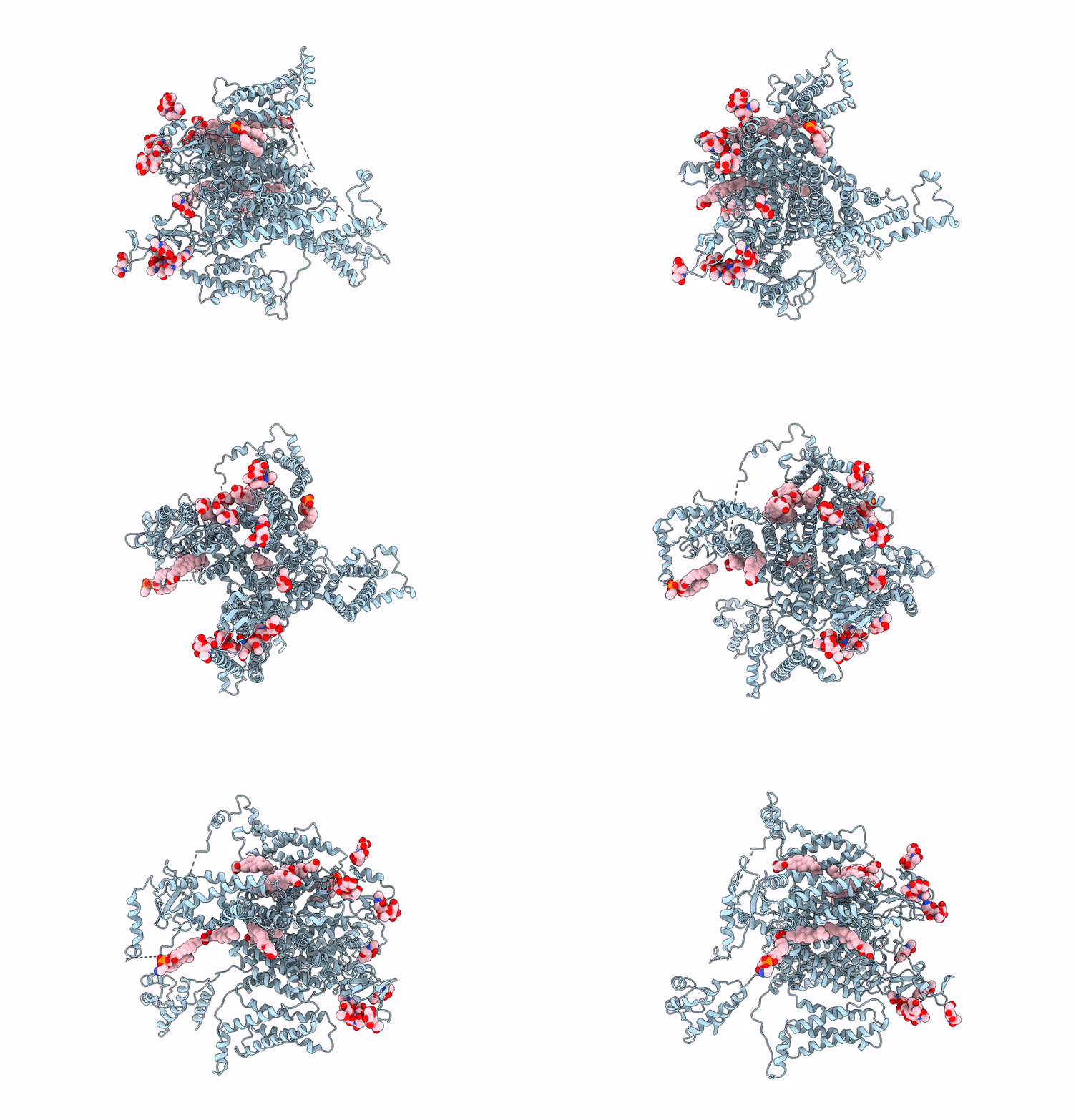
8VYK image
Deposition Date 2024-02-08
Release Date 2025-02-12
Last Version Date 2026-02-25
Entry Detail
PDB ID:
8VYK
Title:
Structure of full-length human cardiac sodium channel - Class-II.
Biological Source:
Source Organism(s):
Homo sapiens (Taxon ID: 9606)
Expression System(s):
Method Details:
Experimental Method:
Resolution:
3.90 Å
Aggregation State:
PARTICLE
Reconstruction Method:
SINGLE PARTICLE
Macromolecular Entities
Structures with similar UniProt ID
Protein Blast
Polymer Type:polypeptide(L)
Molecule:Sodium channel protein type 5
Gene (Uniprot):SCN5A
Chain IDs:A
Chain Length:2016
Number of Molecules:1
Biological Source:Homo sapiens
Primary Citation
Structural basis of human Na v 1.5 gating mechanisms.
Proc. Natl. Acad. Sci. U.S.A. 122 e2416181122 e2416181122 (2025)
PMID: 40366698 DOI: 10.1073/pnas.2416181122

Abstact

Voltage-gated Na(v)1.5 channels are central to the generation and propagation of cardiac action potentials. Aberrations in their function are associated with a wide spectrum of cardiac diseases including arrhythmias and heart failure. Despite decades of progress in Na(v)1.5 biology, the lack of structural insights into intracellular regions has hampered our understanding of its gating mechanisms. Here, we present two cryo-EM structures of human Na(v)1.5 in open states, revealing sequential conformational changes in gating charges of the voltage-sensing domains (VSDs) and several intracellular regions. Despite the channel being in the open state, these structures show repositioning, but no dislodging of the IFM motif in the receptor site. Molecular dynamics analyses show our structures with CTD conduct Na(+) ions. Notably, our structural findings highlight a dynamic C-terminal domain (CTD) and III-IV linker interaction, which regulates the conformation of VSDs and pore opening. Electrophysiological studies confirm that disrupting this interaction alters fast inactivation of Na(v)1.5. Together, our structure-function studies establish a foundation for understanding the gating mechanisms of Na(v)1.5 and the mechanisms underlying CTD-related channelopathies.

Legend

Protein

Chemical

Disease

Primary Citation of related structures
Feedback Form
Name
Email
Institute
Feedback