

8V0Z image
Deposition Date 2023-11-18
Release Date 2025-03-19
Last Version Date 2025-03-19
Entry Detail
PDB ID:
8V0Z
Title:
HIV-1 Integrase F185H W131C Complexed with Allosteric Inhibitor BI-D
Biological Source:
Source Organism(s):
Expression System(s):
Method Details:
Experimental Method:
Resolution:
4.56 Å
R-Value Free:
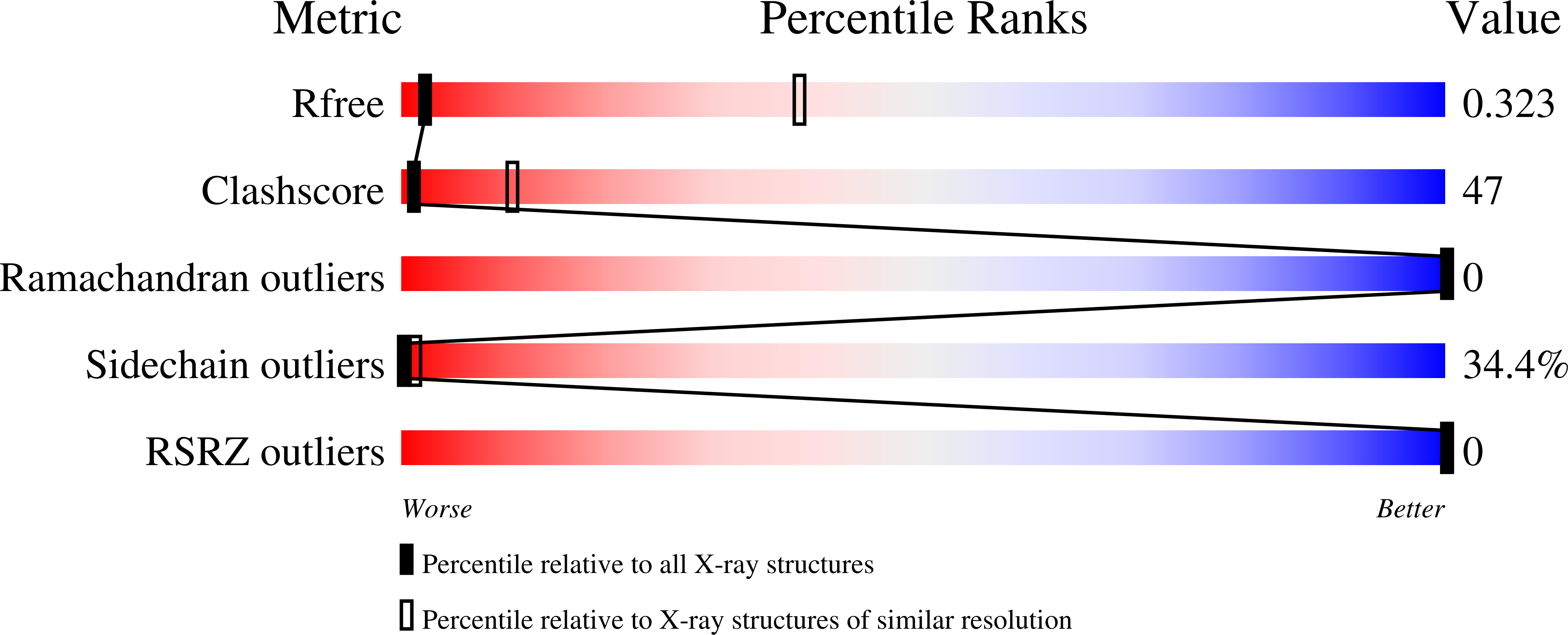
0.33
R-Value Work:
0.32
Space Group:
P 61 2 2
Macromolecular Entities
Structures with similar UniProt ID
Protein Blast
Polymer Type:polypeptide(L)
Molecule:Integrase
Gene (Uniprot):gag-pol
Mutagens:Y15A, F185H, W131C
Chain IDs:A, B
Chain Length:293
Number of Molecules:2
Biological Source:Human immunodeficiency virus 1
Ligand Molecules
Primary Citation
Structural Impact of Ex Vivo Resistance Mutations on HIV-1 Integrase Polymers Induced by Allosteric Inhibitors.
J. Mol. Biol. 437 169224 169224 (2025)
PMID: 40409709 DOI: 10.1016/j.jmb.2025.169224

Abstact

HIV-1 integrase (IN) is targeted by two classes of antivirals: integrase strand transfer inhibitors (INSTIs), which bind to the active site within the catalytic core domain (CCD), and allosteric integrase inhibitors (ALLINIs), which bind at the CCD dimer interface. ALLINIs were initially designed to disrupt interactions with the cellular cofactor LEDGF/p75, but it has become clear that ALLINIs primarily act by promoting formation of aberrant integrase polymers. The ALLINIs achieve this by stabilizing ectopic intermolecular interactions between the CCD dimer and the integrase carboxy-terminal domain (CTD), which disrupts viral maturation. Previously, we determined the structure of full-length HIV-1 IN bound to the ALLINI GSK1264 at 4.4 Å resolution, revealing its polymerization mechanism. More recently, we reported the X-ray crystal structure of a minimal ternary complex between CCD, CTD, and the ALLINI BI-224436 at a higher resolution. In this study, we improve the original 4.4 Å structure using this higher-resolution information and report two new structures of full-length HIV-1 IN harboring escape mutations in the CCD (Trp131Cys) or CTD (Asn222Lys) bound with the prototype ALLINI BI-D at 4.5 Å. These structures reveal perturbations to the tertiary organization associated with escape substitutions, which correlate with their reduced ability to form ectopic ALLINI-induced polymers in vitro. These findings suggest a general structural mechanism of ALLINI resistance and provide insights for the design of improved ALLINIs.

Legend

Protein

Chemical

Disease

Primary Citation of related structures
Feedback Form
Name
Email
Institute
Feedback