

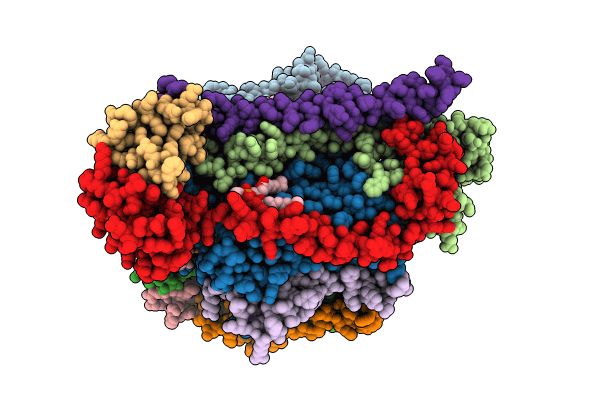
8UCN image
Deposition Date 2023-09-26
Release Date 2024-10-09
Last Version Date 2026-04-22
Entry Detail
PDB ID:
8UCN
Title:
Komagataella pastoris Cytochrome c oxidase in complex with human VMAT2 and Histamine
Biological Source:
Source Organism(s):
Expression System(s):
Method Details:
Experimental Method:
Resolution:
3.31 Å
Aggregation State:
PARTICLE
Reconstruction Method:
SINGLE PARTICLE
Macromolecular Entities
Structures with similar UniProt ID
Protein Blast
Polymer Type:polypeptide(L)
Molecule:Synaptic vesicular amine tran
Gene (Uniprot):SLC18A2
Chain IDs:A
Chain Length:514
Number of Molecules:1
Biological Source:Homo sapiens
Structures with similar UniProt ID
Protein Blast
Polymer Type:polypeptide(L)
Molecule:Cytochrome c oxidase subunit
Gene (Uniprot):COX1
Chain IDs:B (auth: a)
Chain Length:514
Number of Molecules:1
Biological Source:Komagataella pastoris
Structures with similar UniProt ID
Protein Blast
Polymer Type:polypeptide(L)
Molecule:Cytochrome c oxidase subunit
Chain IDs:C (auth: b)
Chain Length:236
Number of Molecules:1
Biological Source:Komagataella pastoris
Structures with similar UniProt ID
Protein Blast
Polymer Type:polypeptide(L)
Molecule:Cytochrome c oxidase subunit
Gene (Uniprot):PP7435_Mit-0015
Chain IDs:D (auth: c)
Chain Length:268
Number of Molecules:1
Biological Source:Komagataella pastoris
Structures with similar UniProt ID
Protein Blast
Polymer Type:polypeptide(L)
Molecule:Cytochrome c oxidase subunit
Gene (Uniprot):COX4
Chain IDs:E (auth: d)
Chain Length:117
Number of Molecules:1
Biological Source:Komagataella pastoris
Structures with similar UniProt ID
Protein Blast
Polymer Type:polypeptide(L)
Molecule:Cytochrome c oxidase subunit
Gene (Uniprot):COX5B
Chain IDs:F (auth: e)
Chain Length:124
Number of Molecules:1
Biological Source:Komagataella pastoris
Structures with similar UniProt ID
Protein Blast
Polymer Type:polypeptide(L)
Molecule:Cytochrome c oxidase subunit
Gene (Uniprot):COX6
Chain IDs:G (auth: f)
Chain Length:100
Number of Molecules:1
Biological Source:Komagataella pastoris
Structures with similar UniProt ID
Protein Blast
Polymer Type:polypeptide(L)
Molecule:Cytochrome c oxidase subunit
Gene (Uniprot):COX7
Chain IDs:H (auth: g)
Chain Length:58
Number of Molecules:1
Biological Source:Komagataella pastoris
Structures with similar UniProt ID
Protein Blast
Polymer Type:polypeptide(L)
Molecule:Cytochrome c oxidase subunit
Gene (Uniprot):COX8
Chain IDs:I (auth: h)
Chain Length:48
Number of Molecules:1
Biological Source:Komagataella pastoris
Structures with similar UniProt ID
Protein Blast
Polymer Type:polypeptide(L)
Molecule:Cytochrome c oxidase subunit
Gene (Uniprot):COX9
Chain IDs:J (auth: i)
Chain Length:56
Number of Molecules:1
Biological Source:Komagataella pastoris
Primary Citation
Molecular basis of vesicular monoamine transport and neurological drug interactions.
Cell Rep 44 116490 116490 (2025)
PMID: 41166311 DOI: 10.1016/j.celrep.2025.116490

Abstact

Vesicular monoamine transporter 2 (VMAT2) stores monoamine neurotransmitters in synaptic vesicles to regulate their release. VMAT2 is a primary target in neurological disorder treatment and contributes to amphetamine-induced psychostimulation. Here, we report cryo-electron microscopy structures of human VMAT2 capturing a cytoplasmic-open state with reserpine and lumenal-facing states with serotonin and histamine in open, amphetamine in less open, tetrabenazine in fully occluded, and unbound VMAT2 in partially occluded conformations. This structural flexibility facilitates tetrabenazine binding and proton-driven monoamine accumulation. VMAT2 binds serotonin and histamine in opposite orientations through two negatively charged sites, one functioning in protonation. Amphetamine binds in the same pocket without engaging this protonation site. Liposome-based analyses demonstrate that amphetamine directly induces the release of a fluorescent monoamine analog via VMAT2, consistent with an exchange mechanism underlying psychostimulation. These findings reveal the molecular basis of monoamine storage and drug interactions by VMAT2, informing therapeutic development for neurological diseases and substance abuse.

Legend

Protein

Chemical

Disease

Primary Citation of related structures
Feedback Form
Name
Email
Institute
Feedback